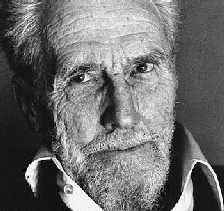
EZRA POUND
Modernist poet Ezra Pound is known for advancing the work of such contemporaries as William Carlos Williams, Marianne Moore, James Joyce, Ernest Hemingway, and especially T. S. Eliot. A proponent of Imagism, a movement derived from classical Chinese and Japanese poetry which stresses clarity and economy of language, Pound believed poetry should "compose in the sequence of the musical phrase, not in the sequence of the metronome." His later work, focused on the encyclopedic epic poem he entitled "The Cantos" for which he was awarded the Bollingen-Library of Congress Award.
Ezra Pound was born in a frontier town in Hailey, Idaho, 1885, the son of an assistant assayer and the grandson of a Congressman. One could say that both economics and politics were in his blood. Eighteen months after his birth his family moves to Pennsylvania, where they become become members of the Calvary Presbyterian Church.
He enrolled at the University of Pennsylvania in 1901. Pound was an avid reader of Anglo-Saxon, Classical and Medieval literature. In 1906 he gained his MA and had already started work on his most significant creation, The Cantos. He continued post-graduate wrk on the Provencal Troubadour poet-musicians, reinforcing his desire to go to Europe.
In 1908, when a projected academic career was cut short, he set sail for Europe, spending several months in Venice There he paid $8.00 for the printing of the first volume of his poetry, A Lume Spento (With Tapers Quenched). Pound then traveled to England to meet W.B. Yeats. He quickly became a literary success in London. The following year he met Yeats and became the dominant figure at Yeats’ Monday evenings.
Pound also came into contact with The English Review which was publishing works by new talent such as D.H. Lawrence, and the author painter and critic Wyndham Lewis.
Between 1908 and 1911 he published six collections of verse, most of it dominated by a passion for Provençal and early Italian poetry. This is filtered through the medievalizing manner of Browning and the Pre-Raphaelites. Under the influence of Ford Madox Ford and T. E. Hulme he modernized his style, and in 1912 launched the Imagist movement, advocating concreteness, economy, and free verse.
In 1911 Pound launched his campaign for innovative writing in The New Age, edited by the monetary reformer AR Orage. To Pound the new poetry of the century would be "austere, direct, free from emotional slither."
The following year Pound founded the Imagist movement of literature. He was by this time already helping to launch the careers of William Carlos Williams, T.S. Eliot, Hemingway and James Joyce. In 1913 he had also become fencing master and secretary of William Butler Yeats, 20 years Pound’s senior and already world famed.
Pound had been interested in Eastern religions, yoga, theosophy, and astrology from at least as far back as 1905. When Pound was introduced to Yeats he joined a small group Yeats was involved with, which was of a Gnostic nature. Prior to this Pound had written of his belief in a type of reincarnation of creative souls in terms similar to those expressed in Yeats’ poetry.His formal education included a study of the Provençal troubadours with whom he recognised a particular affinity. Pound considered sex to be a sacrament and an esoteric tradition which had been preserved in the West by the Troubadours. He considered the only true religion to be "the revelation made in the arts." Rejecting Christianity, he described it as "a bastard faith designed for the purpose of making good Roman citizens slaves, and which is thoroughly different form that preached in Palestine. In this sense Christ is thoroughly dead." Pound found the Churches objectionable for having gained subsidies which should have gone to artists, philosophers and scientists. Pound was inspired by the "love cult" of the Troubadours, which had been suppressed by the Church, and the Classical mystery religions. He considered the teachings of Confucious which taught a civic religion that assigned everyone a social duty, from emperor to peasant to be a means of achieving a balanced State. He later saw in Fascist Italy the attainment of such a State.
In 1914 Pound started another more enduring movement that was to have a lasting influence on English culture, the Vorticist movement. The impetus came originally from a young avant garde sculptor Henri Gaudier-Brzeski. Together with Wyndham Lewis and others they launched "Blast" as the journal of the movement. Fateful this was also the year of World War I which took its toll on many Vorticists. Association with Vorticist visual artists (e.g. Henri Gaudier-Brzeska and Wyndham Lewis) helped him to see how poems could be made up, like post-Cubist sculptures, of juxtaposed masses and planes. These lessons were reinforced by his work on Ernest Fenollosa's literal versions of classical Chinese poems, which he turned into the beautiful free-verse lyrics of Cathay (1915). Fenollosa had argued that Chinese written characters were ideograms--compressed and abstracted visual metaphors. In this interplay of concrete signs Pound saw the model for a new kind of poetry, dynamic and economical, which juxtaposed not only images but diverse 'facts’--allusions, quotations, fragments of narrative. Such a method, soon to be tried out in his major work The Cantos (on which he tentatively embarked in 1915), would permit the use of quotations from other languages and even gobbets of prose.
Vorticism was for Pound the first major experience in revolutionary propagandizing, and the first cause that placed him beyond the pale of orthodoxy. Pound saw Vorticism as setting "the arts in their rightful place as the acknowledged guide and lamp of civilization." In this way the arts were welded in a mystical union with politics in the manner already envisaged by Yeats.
Pound saw commercialism as the force preventing the realization of his artistic-political ideal. In 1918 he met Maj. C.H. Douglas, the founder of Social Credit whose theory of monetary reform explained that once money became a commodity instead of a measure of productivity and creativity then a nation and its culture would be sacrificed in the pursuit of commercial interests.
The range and brilliance of Pound's contacts in all the arts convinced him that London was to be the centre of a new Renaissance. He cast himself in the role of impresario, editor, and advocate, contributing to Yeats's mature style, discovering and promoting Joyce and Eliot, advising an American businessman on the modern works of art to buy in London. But his hopes foundered in the waste of the First World War, and the consequent disappointment was to colour the rest of his life's work. In the short term it provoked his first major poems, 'Homage to Sextus Propertius' (1919) and Hugh Selwyn Mauberley (1921). These two ironic sequences represent a contrast. The free-verse 'Homage', an ironic persona poem based on the lyrics of the first-century Roman poet, is a defence of the private and erotic in poetry against the imperialistic jingoism promoted by war. Mauberly, in tautly rhymed satirical stanzas, depicts the war as the Götterdammerung of an emasculated and philistine culture, condemned by the limitation of its own horizons. The poem is also evidence of Pound's close working relationship with Eliot, whose taste it reflects (cf. the 'Sweeney' poems of the same period). The relationship was to culminate in the crucial part played by Pound in cutting The Waste Land (1922).
Mauberley has been described as Pound's farewell to London. In 1920 he left for Paris. From 1920-1924 he was based in Paris where he took a keen interest in Dadaism and Surrealism, and he wrote for André Breton's magazine, Littérature, to which Drieu La Rochelle also contributed. He also did research there for The Cantos, the long historical poem which he had begun during the First World War and which became the major work of his life.
He then moved on to Italy, where he settled in Rapallo in 1924. He was now concentrating on The Cantos, his 'poem including history', and the first section was published in 1925. As The Cantos shows, he was now preoccupied with economics. Like T. E. Hulme and Wyndham Lewis, Pound viewed contemporary art as reflecting a cultural sickness, and strove for an assertive, sculptural art with clean clear lines, qualities which he associated with socio-economic and political health and which he recognised, for example, in the Quattrocento.
Like Yeats, Pound’s concepts of esotericism and culture brought him against liberal and democratic doctrines. Pound saw in Fascism the fulfillment of Social Credit monetary policy which would bread the power of plutocracy. He considered artists to form a social elite "born to rule" but not as a part of a democratic mandate. "Artists are the antennae of the race but the bullet-headed many will never learn to trust their great artists."
As far back as 1914 Pound had written that the artist "has had sense enough to know that humanity was unbearably stupid …But he has also tried to lead and persuade it, to save it from itself." He wrote in 1922 that the masses are malleable and that it is the arts which set the moulds to cast them.
The war, as he saw it, had been caused by the rivalries of international capitalists. He thought he had found a solution to the evils of unchecked capitalism, one especially favourable to the arts, in the Social Credit theory of Major C. H. Douglas, who argued that a system of state credit could increase purchasing power in the population at large, thus promoting creativity and removing power from bankers and financiers. Pound embraced the Social Credit theory with enthusiasm. Here was the means by which the Money Power which corrupted culture, could be overthrown. During the 1930’s and 1940’s Pound wrote a series of booklets on economics and politics, including his first "Social Credit: An Impact"(1935), "A Visiting Card" (1942), and in 1944 "Gold and Work", and "America, Roosevelt, and the Causes of the Present War", the latter three being published by Fascist Italy.
Attracted to Mussolini by his energy and his promises of monetary reform, Pound assumed that the Italian leader could be persuaded to put Douglas's theory into practice. At first, the main target of Pound's attacks is 'usury', which he depicts (e.g. in Canto 45) as an unnatural force that pollutes the creative instinct in humanity. By about 1930 the usurers he condemns are usually Jews, and his language is vitiated by virulent anti-Semitism. The way Pound came to his (political and economic doctrines was by the same esoteric path as Yeats.
In 1924 Pound moved to Italy and became involved in Fascist politics. To him Fascism was the culmination of an ancient tradition, continued in the personalities of Mussolini, Hitler, and the British Fascist Sir Oswald Mosley. Pound had already studied the doctrines of the ethnologist Frobenius during the 1920’s and gave a mystical interpretation of race. Cultures were the product of races, and each had its own soul, or "paideuma" of which the artist was the guardian. In Mussolini, Pound saw not only a statesman who had overthrown plutocracy, but someone who had made politics an art form. Pound stated, "Mussolini has told his people that poetry is a necessity of State, and in this displayed a higher state of civilization in Rome than in London or Washington." Writing in his 1935 book "Jefferson and/or Mussolini," Pound explained: "I don’t believe any estimate of Mussolini will be valid unless it starts form his passion for construction. Treat him as ARTIFEX and all the details fall into place . . . The Fascist revolution was FOR the preservation of certain liberties and FOR the maintenance of a certain level of culture, certain standards of living . . . " Pound and his wife Dorothy settled in Italy in 1924. In 1933 he had a meeting with Mussolini, outlining his ideas for monetary reform. He also became a regular contributor to the periodicals of Mosley’s British Union of Fascists, met Mosley in 1936 and continued to correspond until 1959. From the late 1930’s he began to look increasingly toward the economic policies of Hitler and regarded the Rome-Berlin Axis as "the first serious attack on the usurocracy since the time of Lincoln." In the later 1930s Pound devoted much of his energy to defending fascism and trying to avert war. When war broke out, he embarked on a series of fanatical addresses to American troops, which were broadcast on Rome Radio.
In 1940, after having returned to Italy from a tour of the USA during which he attempted to oppose the move to war against the Axis, Pound offered his services as a radio broadcaster. The broadcasts called The American Hour, began in January 1941. Pound considered himself to be a patriotic American. After the Japanese attack on Pearl Harbour he attempted to return to the USA, but the American Embassy refused him entry. With no means of livelihood, Pound resumed his broadcasts, attacking the Roosevelt administration and usury in a folksy, American style, with a mix of cultural criticism.
In 1943 Pound was indicted in the USA for treason. Hemingway, concerned at the fate of his old mentor after the war, suggested the possibility of an "insanity" plea and the idea caught on among some of Pound’s and Hemingway’s literary friends who had landed jobs in the US Governement. Other interests were pressing for the death penalty for America’s most eminent cultural figure. Two days after Mussolini’s murder Pound was taken at his home by Italian partisians, after he had unsuccessfully attempted to turn himself over to American forces.
Putting a book on Confucious in his pocket he went with the partisans expecting to be murdered. Instead he was handed over to the US forces. The US forces held him for six months at a Disciplinary Training Centre near Pisa, pending trial on a treason charge. Pound was confined to a bare, concrete floored iron cage in the burning heat, lit continuously throughout the night. It seems likely that the inhuman conditions he endured there for the first three weeks accelerated the breakdown in rationality already to be glimpsed in his writings. After a physical breakdown he was transferred to a medical compound, where he got to work on the "Pisan Cantos." Repatriated to the United States in November to stand trial, he was found unfit to plead on grounds of insanity and incarcerated in St Elizabeths Hospital, Washington DC, a ward for the criminally insane, from 1946 to 1958.
His imprisonment brought about an artistic recovery. His literary output continued, and he translated 300 traditional Chinese poems which were published by Harvard in 1954. The Pisan Cantos (1948), drafted in the DTC, are the most directly personal poems he wrote. In adversity, and conscious of the tragedy of Europe, he contemplates his own past in that context, especially the water-shed years of the modern movement. Among his many visitors he became mentor to John Kasper, a fiery young intellectual who toured the South agitating on behalf of racial segregation, and causing the calling out of the National Guard in Tennessee.
By 1953 Pound had still not been formally diagnosed. Enquiries form the Justice Dept. solicited an admission that at most Pound had a "personality disorder." By the mid-1950’s various influencial figures and magazines were campaigning for Pound’s release. Suffering and retrospection induce a new humility, exemplified in his care for the life around him--the insects, the animals, the camp guards. In St. Elizabeths he completed two rather more cryptic sections of the poem--Section: Rock-Drill (1955) and Thrones (1959)--as well as a programme of translations from the Confucian classics.
After 13 years confinement, Pound’s treason indictment was dismissed on 18 April 1958. On his release he returned to Italy, giving the Fascist salute to journalists when he reached Naples, and declaring "all America is an asylum." He continued with the "Cantos" and stayed in contact with political personalities such as Kasper and Mosley.
Despite moments of defiance, his last years were overshadowed by self-doubt and consciousness of his 'errors and wrecks'. In rare public utterances he condemned The Cantos as a failure, a view he seems not consistently to have held; but the poem was never completed. In 1969 he concluded its publication with Drafts and Fragments of Cantos CX-CXVII: thirty-two pages of verse, mostly serene but poignant in its fragmentation. He remained defiantly opposed to the American system in magazine interviews despite complaints from US diplomats. Because of his politics, Pound did not receive the honours due to him until after his death on 1 November 1972.
Pound was the central figure in the modern movement, personally responsible for the renewal of English poetry in the 1910s. Yet he remains a controversial figure. His brutal politics have been damaging to his lofty view of the artist and civilization; he is also condemned as an élitist, an obscurantist, and a charlatan—a man deficient in self-knowledge, with no real understanding of the modern world despite his avant-gardiste posturing. None of these charges quite shakes the substance of his achievement, which is fundamentally a matter of technical accomplishment to a point where refinement of skill becomes a moral quality. Such is the sensitivity of his verse movement that it seems to release independent life and otherness in his subjects, as if it had discovered them by chance. This is so whether he seeks to evoke the movement of olive leaves in the wind or the character of a Renaissance condottiere. The same quality lies behind his genius for translation, an art he has been said to have invented for our time: uncannily, he creates a language for each author which registers the remoteness of the author from our world while at the same time making his work available to us. If Pound is obscure, it is largely because of his wide frame of reference; he was also an educator, who used poetry to introduce his readers to works and ideas he had discovered for himself. It is hardly his fault that his syllabus has never been adopted.
Pound's poetry is collected in two volumes: Collected Shorter Poems (London, 1984)--the American edition is entitled Personae: Collected Poems (New York, 1971)--and The Cantos of Ezra Pound (New York, 1972; London, 1981). The Translations of Ezra Pound, ed. Hugh Kenner (New York and London, 1953), is a large selection with major omissions. The Literary Essays of Ezra Pound, ed. T. S. Eliot (London and New York, 1954), suggests the scope of his criticism, while Selected Prose, 1909-1965, ed. William Cookson (London and New York, 1973), includes much of his polemical writing as well. The fullest biography is Humphrey Carpenter, A Serious Character (London, 1988), though it has been severely criticized.
"These Fought in Any Case"
by Ezra Pound
These fought in any case,
and some believing
pro domo, in any case .....
Died some, pro patria,*
walked eye-deep in hell
believing in old men's lies, then unbelieving
came home, home to a lie,
home to many deceits,
home to old lies and new infamy;
usury age-old and age-thick
and liars in public places.
Daring as never before, wastage as never before.
Young blood and high blood,
fair cheeks, and fine bodies;
fortitude as never before
frankness as never before,
disillusions as never told in the old days,
hysterias, trench confessions,
laughter out of dead bellies.