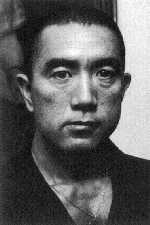
YUKIO MISHIMA
The Last Samurai
by Radbod
Yukio Mishima, pseudonym of Kimitake Hiraoka, one of Japan’s most significant novelists and playwrights, was the modern Japanese author who, at least until the arrival of Murakami Haruki and Yoshimoto Banana, had won the largest readership outside of Japan, at least in part because of the dramatic way he ended his life. A versatile and prolific writer as well as an astute critic (some would rate his criticism higher than his fiction), Mishima seems assured of a reputation as one of Japan's most important postwar writers. A man of discipline and great energy, he usually wrote from midnight until dawn and in his lifetime produced more than 100 works, including novels, short stories, traditional Japanese No and Kabuki plays, and screenplays.
His central theme is the dichotomy between traditional Japanese values and the spiritual barrenness of contemporary life. Mishima attempted to rally his people to combat the damage being done to Japanese society by such alien forces as liberalism and capitalist consumerism. "Japan will disappear," Mishima prophetically warned, "it will become inorganic, empty, neutral-tinted; it will grow wealthy and astute." True to the spirit of the samurai, Mishima was deeply troubled by the changes wrought on traditional Japanese ways by Western modernisation. This theme dominated his writings. His last work compares modern Japan to the barren landscape of the moon.
On February 14, 1925 Mishima was born in Tokyo as Hiraoka Kimitake into a samurai family. His father, Azusa, was an official in the Ministry of Agriculture; his mother Shizue was the second daughter of a former principal of Kaisei Middle School, Hashi Kenzô. The influence of Mishima's autocratic grandmother, Natsu – who had Mishima live in her room and forbade him to play with other boys – is frequently cited by biographers as the source of Mishima's later deviation from normality. Donald Keene and others, however, also point out rightly that she helped Mishima develop his precocious taste in literature.
Throughout his youth Mishima attended the Gakushûin (Peers School), serializing his first important prose work, Hanazakari no mori (The Forest in Full Flower), in the magazine Bungei Bunka (Literary Culture) in 1941. This also marked his first use of the pen name Mishima Yukio.
The war had a decisive influence on Mishima, who was wrongly diagnosed as having pleurisy and thereby avoided being conscripted. This cheating of impending death, along with Japan's eventual defeat, seems to have engendered in him a complex dialectic between the exultation of survival and the exaltation of death which was to characterize the romantic nihilism of the mature Mishima.
When Mishima failed to qualify for military service during World War II he worked in an aircraft factory instead. His relief at the war's end turned into guilt at having survived. After the war he studied law and for a short time was employed in the finance ministry.
In 1948 Mishima resigned from the Ministry of Finance to devote himself to writing, and in 1949 he met with critical and popular success when he published his first novel Kamen no kokuhaku (Confessions of a Mask). The affecting and partly autobiographical Confessions of a Mask was widely acclaimed and successful enough to enable its author to become a full-time writer.
The fifties saw the appearance of a long series of important novels, as well as Mishima's turn toward bodybuilding and the cult of the physical. In the sixties this physicality took on the specifically political coloring (refracted rather than reflected in his novels) that ultimately prompted Mishima to form his own private army, the Shield Society (Tate no Kai), in 1968. The bizarre and fascinating confluence of life and art that marked Mishima's final years was symbolized by the near-simultaneous completion of his final novel and his ritual suicide by seppuku. The true meaning of this act continues to be debated, but the intense – and often diametrically opposed – reactions it elicits in readers and critics can surely be adduced as testimony to a strength of personality unique in modern Japanese literature.
"You can easily find two contradictory characteristics in Japanese cultures or Japanese characters. One is elegance and one is brutality. The two characteristics are very tightly combined sometimes. Our brutality, I think, comes from our emotion. It is never mechanised and systematised like [the] Nazi’s brutality. I think our brutality might come from our feminine aspect and elegance comes from our nervous side. Sometimes we are too sensitive about defilement or elegance or sense of beauty or aesthetic side. And sometimes we are tired of it and we need a sudden explosion to make us free from it…I don’t like the Japanese culture just represented only by the flower arrangement or such a sort of peace/loving culture. I think we still have a very strong warrior’s mind." (Yukio Mishima)
Since youth Mishima was brought up in the spirit of the samurai tradition and values: nobility, truthfulness, complete control over mind and body, and loyalty to the Emperor. Traditional Japanese society was imbued with the samurai spirit. "What Japan was she owed to the samurai," observes the Japanese scholar Dr. Inazo Nitobe. "They were not only the flower of the nation, but its root as well. All the gracious gifts of Heaven flowed through them. Though they kept themselves socially aloof from the populace, they set a moral standard for them and guided them by their example." The "way of the samurai" or Bushido, particularly as set out in a 18th century text known as Hagakure, influenced all of Yukio Mishima’s life and work. Drawing primarily on Zen Buddhism, the Hagakure stresses dying a glorious death. It sets out a spiritual-warrior path focusing on emotional and mental discipline, the martial arts, and aesthetics. The author of the Hagakure defines the true spirit of the samurai: Lord Naoshige once said: "Bushido [way of the samurai] comes down to death. Even tens of people cannot kill such a person." Great things cannot be achieved by [merely] being earnest. A man must become a fanatic to the extreme of being obsessed by death….The martial arts require only an obsession with death. Both loyalty and filial piety [the two other major samurai virtues] are included within this. Indeed the first words of the Hagakure are: "One who is a samurai must before all things keep constantly in mind…the fact that he has to die." Mishima said that the Hagakure is "the womb from which my writing is born."
In The Temple of the Golden Pavilion (1956) Mishima portrays a young man obsessed with both religion and beauty; The Sailor Who Fell from Grace with the Sea (1963) is a tale of adolescent jealousy. All Mishima’s novels contain paradoxes: beauty equated with death; the yearning for love and its rejection when offered.
Mishima’s literary masterpiece the four volume epic The Sea of Fertility (1970), consisting of Spring Snow, Runaway Horses, The Temple of Dawn, and The Decay of the Angel, is about the transformation of Japan into a modern but sterile society.
In the first novel, Spring Snow, set in Tokyo in 1912, the closed world of the ancient aristocracy is being breached for the first time by outsiders - rich provincial families without tradition, whose money and vitality make them formidable contenders for social and political power.
The second volume, Runaway Horses is the chronicle of a conspiracy, a novel about the roots and nature of Japanese fanaticism in the years that led to war - an era marked by depression, the upheaval of radical social change, political violence, and assassination.
The third part, The Temple of Dawn is a story of the pursuit of beauty and spiritual enlightenment. It powerfully dramatises the Japanese experience from the eve of World War II through the degradation of the postwar era.
The dramatic climax of the tetralogy, The Decay of the Angel brings together the dominant themes of the three previous novels: the meaning and decay of Japan’s courtly tradition and samurai ideal; the essence and value of Zen Buddhist philosophy and aesthetics; and, underlying all, Mishima’s apocalyptic vision of the modern era, which saw the dissolution of the moral and cultural forces that throughout the ages nourished a people and a world.
Mishima detested the sedentary life of most writers. For him, words must provoke deeds, thought cannot be separated from action. His reverence for traditional Japanese martial arts led him to take up Kendo (a type of fencing with wooden swords), karate and body-building. In an effort to revive the ancient arts of the samurai he organised the Tatenokai (Shield Society), a paramilitary brotherhood stressing physical fitness, the martial arts such as karate and swordsmanship, as well as the upholding of the ideals and virtues of Japanese imperial tradition. In the 1990s the ideals of the Shield Society are carried on by Issui-kai, a Japanese pacifist nationalist organisation.
"Human life is limited. But I want to live forever," Mishima wrote in a suicide note to his wife. Loyal to the ready-for-death-at-any-instant spirit of Bushido, Yukio Mishima found in a freely chosen death the noblest and most beautiful action open to a human being. At the peak of a brilliant literary career and at the age of forty five, Yukio Mishima committed seppuku (ritual suicide) following an unsuccessful attempt to re-enact successfully, in a carefully staged 'incident', the Young Officers' rebellion of the 1930s. On November 25, 1970, Mishima and four Shield Society members took control of an office at Tokyo’s military headquarters. He gave a speech attacking Japan's post-World War II constitution and called on the ranks of the Japanese Self Defence Force to rebel in an effort to save Japan’s ancient tradition. Faithful to the samurai code he then committed ritual suicide (seppuku). His death was regarded as his final protest against modern Japanese decadence. A flamboyant figure in life, Mishima became a legend after his ritual suicide.