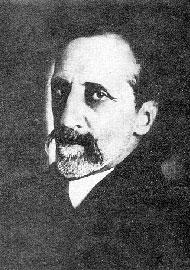
DMITRI SERGEYEVICH MEREZHKOVSKY
Prophet of a Religious Revolution
By Radbod
Dmitriy Sergeyevich Merezhkovsky was born in St. Petersburg in 1865 into the family of a court official. From 1884 to 1889 he studied History and Philology at Moscow University and St. Petersburg University. In 1888, he met 18 year old Zinaida N. Gippius, a gifted Russian poetess, who became his wife. Zinaida Gippius was a prolific poet, fiction writer, playwright, essayist, memoirist, and critic. She wrote many critical essays on literature, religion, and political issues, published in leading Moscow and St. Petersburg literary journals and newspapers under various pseudonyms.
Merezhkovsky is one of the founding fathers of Symbolism in Russian literature. In 1892 he published "Symbolism, Poems", and "The Reasons for Decline of Modern Russian Literature: Essays" the following year. Merezhkovsky's literary work included poetry, novels, dramas, critical essays, and translations from several languages including Greek. His significance was primarily cultural. He was a popularizer of French symbolism in the 1890s; formulator and chief proselytizer of the "new religious consciousness" after 1900; and a prophet of a religious revolution after 1905.
Together with his wife Merezhkovsky actively promoted the theories embodied in his novels through the Religious-Philosophic Society, which they founded in 1903. Zinaida Gippius longed for the dawn of the Golden Age when the earth would unite with Heaven into one blissful Kingdom. She saw the tragedy of human existence in man’s alienation from the spiritual world and the superficiality of his mere faith in God. Much of her writings express the trial of the spirit in its attempts to free itself from material reality and to fly heavenward.
Merezhkovsky and Gippius distinguish three phases in the history of humanity and its future. These phases represent three different realms: the realm of God the Father, the Creator – the realm of the Old Testament; the realm of God the Son, Jesus Christ – the realm of the New Testament, the present phase which is now closing; and the realm of the Holy Spirit, Divine Sophia (Wisdom) – the era of the Third Testament, which is now dawning, gradually disclosing its message to humanity. The Kingdom of the Old Testament revealed divine power and authority as truth; the Kingdom of the New Testament reveals truth as love; and the Kingdom of the Third Testament will reveal love as inner freedom.
Just as the previous Kingdoms symbolise a change in human consciousness, so the final Kingdom of the Third Testament is to be ushered in by a new religious consciousness, the genesis of a New Humanity. The Third Testament will resolve all present antitheses – sex and asceticism, individualism and society, slavery and freedom, atheism and religiosity, hatred and love. The enigma of Earth and Heaven, the flesh and the spirit, will be solved in the Holy Spirit. The Holy Spirit will redeem the world, giving humanity a new life in peace, harmony, and love. The Three in One will be realised, and Spiritual Christianity – long ago driven underground – will be brought into the open. God the Father and God the Son will be synthesised by the Holy Spirit, Divine Wisdom. The emphasis the Merezhkovsky’s placed on the Holy Spirit, reminds us of Dostoyevsky’s thought: "The Holy Spirit is a direct conception of beauty, a prophetic consciousness of harmony and hence a steadfast striving toward it." In propagating their ‘Cause of the Three in One’ Merezhkovsky and Gippius hoped for a religious revolution, a spiritual metamorphosis of man to prepare him for the Third Kingdom. According to Gippius the aim of all universal-historical development is the end of humanity and the world in their present forms through the Apocalypse. Only the coming of Christ will unite humanity in brotherly love and harmony as one living family. At this point in the spiritual evolution of mankind the apocalyptical Church will be established, not as a temple, but as a new experience of God in human consciousness and in the human soul.
Merezhkovsky was the author of a large number of spiritual-religious writings and literary criticism. He published "Eternal Companions. Portraits from Worldwide Literature" in 1897, "Tolstoy and Dostoevsky," volumes 1 and 2 from 1901 to 1902, "Gogol and the Devil" in 1906, the collection of articles "Gradushchy Kham" in 1906, "Not Peace, but the Sword. To Future Critics of Christianity" in 1908, "Sick Russia" in 1910, etc. He also put out a few collections of poetry including "Poetic Collection. 1883-1903" in 1904, and "Poetic Collection. 1883-1910" in 1910. He put out translations of tragedies written by Euripides and Sophocles, Longus' novel "Dafnis and Chloe", Goethe, Edgar Allen Po, and others.
Merezhkovsky asserted himself as a prosaic with his trilogy "Christ and the Antichrist", written from 1895 to 1905. Merezhkovsky's second trilogy, made up of one drama and two novels, was entirely devoted to Russia. It consisted of "Pavel I", in 1908, "Alexander I" in 1913, and "December 14th", in 1918. The works of Merezhkovsky's latter years were written in the form of artistic-philosophical prose. He wrote "Napoleon" in 1929, "Secret of the West: Atlantis-Europe" in 1931, and "Dante" in 1939.
His principal critical study is Tolstoi as Man and Artist; with an Essay on Dostoievsky (1901–2, tr. 1902), in which he represented the authors as seers of, respectively, the flesh and the spirit. This type of antithetical thought is developed in his trilogy of historical novels entitled Christ and Antichrist, which concerns Julian the Apostate (1896, tr. 1899), Leonardo da Vinci (1902, tr. 1902), and Peter the Great (1905, tr. 1905).
Merezhkovsky and Gippius were twice forced into exile—in 1905 temporarily, because of their support of the revolution, and after 1918 permanently, because they opposed the Bolsheviks. They fled Russia in December 1919, lived in Poland until October 1920 and then moved to Paris. From his exile in Paris he attacked Bolshevism in The Kingdom of Antichrist (1922, tr. 1922) and other works. Merezhkovsky stayed abroad until his death in 1941.