JOSEPH DE MAISTRE
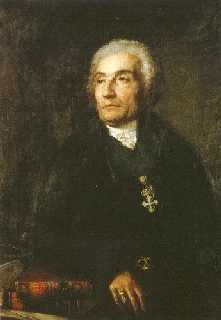
Joseph-Marie, Comte de Maistre born at Chambéry, in Savoy,
in 1753, when Savoy
did not belong to France.
His family, which was of French origin, had settled in Savoy a century earlier,
and had attained a high position, his father being president of the Senate. Joseph,
the eldest of ten children, was a pupil of the Jesuits, who, like his parents,
inspired him with an intense love of religion and detestation of the eighteenth-century
philosophical rationalism, which he always resolutely opposed. In 1774 he
entered the magistracy; in 1780 he was assistant fiscal advocate general; in
1788 he was appointed senator, being then thirt-five years old. Four years
later, he was forced to fly before the invading French, and discharged for four
years at Lausanne
a confidential mission for his sovereign, the King of Sardinia. That monarch
having lost the capital of his kingdom, de Maistre lived in poverty at Venice,
but on the restoration of the king, went to Sardinia as keeper of the great
seal (1799) and, three years later, to St. Petersburg, as plenipotentiary. This
mission lasted fourteen years, till 1817. Though weakly supported by his
Government, which was at times displeased with his frankness, poor amidst a
lavish aristocracy, he nevertheless successfully defended the interests of his
country with the Czar Alexander, who, like most of the leading personages at St.
Petersburg, highly appreciated his
character and his ability. He afterwards returned to Turin,
to fill the post of minister of State and keeper of the great seal until his
death at Turin,
26 Feb.,
1821.
The writings of Joseph de Maistre (as well as those of his younger
brother — Xavier de Maistre) were all in French, then the literary language of Piedmont.
Joseph's first important work was written during his sojourn in Switzerland.
He was then forty years of age. He had previously composed some speeches and a
few comparatively unimportant essays. We may mention "L'éloge de Victor
Amédée III", attacking the intolerance which had lighted the fires of the
stake, and glorifying the war of the Americans against their oppressors. After
the outbreak of the French Revolution, he published some writings on current
events, e.g. "Discours à M. le Marquis Costa de Beauregard sur la vie et
la mort de ton fils" and "Cinq paradoxes a la Marquise de Nav . .
." (1795). In the following year appeared his "Considerations sur la France"
(London
and Lausanne,
in folio); although its dissemination was rigorously forbidden by the French
authorities, several editions were exhausted within a year. The author
maintains the thesis that France
has a mission from God: she is the principal instrument of good and of evil on
earth. De Maistre looks on the Revolution as a providential occurrence: the
monarchy, the aristocracy, the whole of the old French society, instead of
turning the powerful influence of French civilization to benefit mankind, had
used it to foster the doctrines of the eighteenth-century philosophers: the
crimes of the Reign of Terror were the punishment thus merited. The author
added that the foreign nations were dupes of a foolish dream, in undertaking
the dismemberment of France,
"the most beautiful kingdom after that of heaven". Finally, he
predicted a speedy restoration, and disappearance of the abuses of the past.
In connection with this work must be mentioned a little book composed in
1809, under the title "Essai sur le principe générateur des constitutions
politiques et des autres institutions humaines". Its main idea is, that
constitutions are not the artificial products of the study but come in due time
and under suitable circumstances from God, who slowly brings them to maturity. After
the appearance in 1816 of the treatise "Sur les délais de la justice
divine dans la punition des coupables", translated from Plutarch, with
additions and notes, Joseph de Maistre published at Lyons
in 1819 his masterpiece "Du Pape". The work (2 vols. in 8vo.) is
divided into four parts. In the first the author proves that in the Church the
pope is sovereign, and that it is an essential characteristic of all sovereign
power that that its decisions should be subject to no appeal. The doctrinal
declarations of the pope are binding on man without right of appeal. Consequently,
the pope is infallible in his teaching, since it is by his teaching that he
exercises his sovereignty. And in point of fact "no sovereign pontiff,
speaking freely to the Church, has ever made a mistake in the matter of
faith". In the remaining divisions of his work the author examines the
relations of the pope and the temporal powers: civilization and the welfare of
nations; the schismatical Churches. He establishes that nations require to be
guaranteed against abuses of the power to which they are subject by a
sovereignty superior to all others; now, this sovereignty can be none but the
papacy, which, even in the Middle Ages, had, in fact, already saved European
civilization from the barbarians. As to the schismatical Churches, the writer
thinks that they will inevitably fall into Protestantism, and from
Protestantism through Socinianism into philosophic indifference. For "no
religion can resist science, except one."
The treatise, "L'Eglise Gallicane dans ses rapports avec les
souverains pontifes" (Paris, 1821, in 8vo), formed, in the original plan
of the author, the fifth part of the preceding work. De Maistre at the last
moment resolved on the advice of his friends, to make it a separate work. He
discusses vigorously, and at times, from the Gallican standpoint, harshly, the
celebrated Declaration of the Assemblée of 1682. Besides a voluminous
correspondence, Joseph de Maistre left two posthumous works. One of these,
"L'examen de la Philosophie de Bacon", (Paris, 1836; 2 vols in 8vo),
is an attack on Locke and Condillac, and in general on the French philosophers
of the eighteenth century, in the person whom the author considers as the
father of their system. This work is not among the most highly esteemed of De
Maistre's writings. The "Soirées de St. Pétersbourg" (Paris, 1821, 2
vols, 8vo) is a reply in the form of a dialogue to the objection against Providence
drawn from the existence of evil in the world. For Joseph de Maistre, the
existence of evil, far from obscuring the designs of God, throws a new light on
them; for the moral world and the physical world are inter-related. Physical
evil exists only because there has been, and there is, moral evil. All wrong
must he expiated. So humanity which has always believed in the necessity of
this expiation, has had recourse, to accomplish it, not only to prayer, but to
sacrifice, that is, the shedding of blood, the merits of the innocent being
applied to the guilty — a law as mysterious as it is indubitable, and which, in
the opinion of the author, explains the existence and the perpetuity of war. The
fame of Joseph de Maistre has been enhanced too, by his
"Correspondance". Almost six hundred of his letters have been
preserved. In them one finds the tender father, the loving, devoted friend, and
at the same time a keen, ingenious, unaffected, joyous writer. His complete
works were published in fourteen volumes, 8vo, at Lyons,
1884-87.
To appreciate de Maistre in his writings as a whole, one may remark that
his ideas are bold and penetrating, and his views so clear and accurate that at
times they seem prophetic. An enthusiastic believer in the principle of
authority, which the Revolution tried to destroy, he defends it everywhere: in
the State by extolling the monarchy, in the Church by exalting the privileges
of the papacy; in the world by glorifying the rights and the conduct of God. His
style is strong, lively, picturesque; animation and good humour temper his
dogmatic tone, and he might even be deemed eloquent. It is true he does not
disdain paradox in his thinking or violence in his language: he has neither the
moderation nor the serenity of Bossuet. But he possesses a wonderful facility
in exposition, precision of doctrine, breadth of learning, and dialectical
power. He influenced the age that followed him: he dealt Gallicanism such
decisive blows that it never rose again. In a word, he was a great and virtuous
man, a profound thinker, and one of the finest writers of that French language
of which his works are a distinguished ornament.
BACK