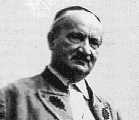
MARTIN HEIDEGGER
"Only a god can save us now."
"Philosophy gets under way only by a peculiar insertion of our own existence into the fundamental possibilities of Dasein as a whole. For this insertion it is of decisive importance, first, that we allow space for beings as a whole; second, that we release ourselves into the nothing, which is to say, that we liberate ourselves from those idols everyone has and to which they are wont to go cringing; and, finally, that we let the sweep of suspense take its full course, so that it swings back into the basic question of metaphysics which the nothing itself compels: Why are there beings at all, and why not rather nothing?"
(What is Metaphysics?, 1977)"Man acts as though he were the shaper and master of language, while in fact language remains the master of man." Building Dwelling Thinking," lecture, 5 August 1951 (published in Poetry, Language, Thought, 1971)
Martin Heidegger, one of the most significant thinkers of the 20th century, was born September 26th, 1889, to Friedrich and Johanna Heiddeger, in the Black Forest region of Messkirch. He began gymnasium at Constance in 1903, but was later transferred, in 1906, to Bertholds gymnasium in Freiberg. Here, he boarded at the archiepiscopal seminary of St. Georg. A mentor, Dr. Conrad Grober, had given him a copy of Franz Brentano's "On the Manifold Meaning of Being According to Aristotle." This early exposure to Brentano, who influenced Husserl's phenomenology, and the Greeks, most likely set Heidegger on his path toward greatness as a 20th century philosopher.
In 1909, Heidegger entered the Society of Jesus at Tisis in Austria to study as a Jesuit. However, most likely for health reasons, his canditature was rejected. Instead, Heidegger entered into study for the priesthood at the Albert-Ludwig University in Freiberg. At this time, Heidegger first began lecturing and publishing papers, and he was first exposed to Husserl's writings. For reasons that are unknown, Heidegger was directed by his superiors to change his path of study from theology to mathematics and philosophy. Heidegger took their advice, and, before long, had diligently read the works of Husserl and went on to complete his doctorate.
Personal and academic conflicts with Catholic scholars and officials, however, left Heidegger permanently disabled by a bitter anticlericalism. His marriage to a Protestant doubtless exercised some influence. Philosophically, he came increasingly under the influence of Edmund Husserl's phenomenology. As a result of these intellectual and personal transformations, sometime between 1917 and 1919, Heidegger "abandoned the faith of his birth." Shortly after the birth of his son, Jorg, in 1919, Heidegger, in a letter to a colleague, wrote that he had decided to break with "the dogmatic system of Catholicism."
In 1914 he earned his doctorate from the University of Freiburg, where he became the assistant to Edmund Husserl. Heidegger began teaching at Freiburg in 1915 and later succeded Edmund Husserl.
Heidegger entered into the German army. He was promoted from private to corporal ten months later, but was soon discharged for health reasons. After the Great War of 1914-1918 the problems of human life were discussed with new intensity. Most people felt that the old world was gone for ever. The belief in progress was brushed aside. Traditional humanism, liberalism and optimism were regarded with suspicion. In the nineteenth century there were some thinkers and individuals who did not follow mainstream philosophical thought. After the Great War these were seen by some to have prophesied the catastrophe. The Danish thinker Kierkegaard and the German Nietzsche were two philosophers who had very few readers in their own century. Their thinking inspired the generation of philosophers between the wars to develop the "philosophy of existence". Heidegger was seen to belong to this group despite his efforts to develop a path of his own.
The Germany in which Heidegger lived was a country in a constant state of war and division. Only a few years before his birth, in 1871, modern Germany was formed out of formerly feuding regions. Germany is a country with few natural borders, leading its leaders to believe that the best way to maintain Germany was a strong military. These military forces often collided. Heidegger came to desire a state ruled by an elite group of soldier-philosophers. He came to distrust the public tastes, modernity, and democratic institutions. The National Socialists matched his vision of a new, powerful central government.
Heidegger developed the phenomenology of Edmund Husserl (1859-1938), who sought to create a sort of pure science that should not explain facts or examine theories, but describe things as they actually appear to us. Phenomenology means the doctrine of the appearance of things. Heidegger employed this doctrine to describe the condition of man.
One of Heidegger's students was Jean-Paul Sartre, later the most prominent French Existentialist. History drove the two men apart, as Heidegger remained in Germany under the National Socialists, even joining the Nazi Party.
Heidegger was affiliated with the University of Freiburg throughout his career except for a brief period as a professor at the University of Marburg. As rector of the university from 1933 to 1934, he was a vocal supporter of the Hitler regime, and he remained a member of the Nazi party until 1945. Significantly, both conservative and radical philosophers supported Hitler in an effort to seize spiritual leadership of the movement; Heidegger, like many others, wanted to "make the revolution his own." Nazi propagandists, for their part, deployed whatever philosophical concepts and symbols supported their cause, with the result that what was called the "Nazi worldview" was nothing but a hodge-podge of incompatible ideas and folk traditions. Heidegger therefore was not the philosopher of Nazism.
Heidegger's chief concern was ontology, or the study of being. His most important work, Being and Time, united two philosophical approaches - the Existentialism of Soren Kierkegaard and Friedrich Nietzsche and the Phenomenology of Husserl - in an inquiry into being, specifically, human being. He developed existential phenomenology and has been widely regarded as the most original 20th-century philosopher.
Besides Husserl, Heidegger was especially influenced by pre-Socratics, by the Danish philosopher Søren Kierkegaard, and by the German philosopher Friedrich Nietzsche. In his most important and influential work, Being and Time (1927; trans. 1962), Heidegger was concerned with what he considered the essential philosophical (and human) question: What is it, to be? This led to the question of what kind of "being" human beings have. They are, he said, thrown into a world that they have not made but that consists of potentially useful things, including cultural as well as natural objects. Because these objects and artifacts come to humanity from the past and are used in the present for the sake of future goals, Heidegger posited a fundamental relation between the mode of being of objects and of humanity and the structure of time. The individual is, however, always in danger of being submerged in the world of objects, everyday routine, and the conventional, shallow behavior of the crowd. The feeling of dread (Angst) brings the individual to a confrontation with death and the ultimate meaninglessness of life, but only in this confrontation can an authentic sense of Being and of freedom be attained.
Although sometimes considered gloomy and nihilistic because of his emphasis on anguish and death in Being and Time, Heidegger was concerned with these negative aspects of human existence because they shed light on the nature of being. Being is revealed most dramatically by experiences that show the gap between nonbeing and being. The most profound such experience is reflection of the prospect of one's own nonbeing, that is, death, because this "possibility of impossibility" reveals the finitude of human being as both a limitation and an incentive to living in the world. Indeed, the prospect of death, functioning as a radical condition for the possibility of human experience, gives authenticity to human beings.
Beginning in the mid-1930s, Heidegger's thought changed in several important respects. He thus abandoned his original intention to write a second part to the ontological inquiry that he began with Being and Time. His later works, however, may be considered this second part, because in them Heidegger works from the notion of being to the more familiar notion of human existence, reversing the direction of Being and Time, in which he moved from human experience to the nature of being.
After 1930, Heidegger turned, in such works as An Introduction to Metaphysics (1953; trans. 1959), to the interpretation of particular Western conceptions of Being. He felt that in contrast to the reverent ancient Greek conception of Being, modern technological society has fostered a purely manipulative attitude that has deprived Being and human life of meaning, a condition he called nihilism. Humanity has forgotten its true vocation, which is to recover the deeper understanding of Being that was achieved by the early Greeks and lost by subsequent philosophers.
Following the war, Heidegger was suspended from all teaching duties in the post-war era from 1945 to 1950 for his cooperation with the educational policies and his public support of the National Socialist government. Heidegger suffered a nervous breakdown. One would like to think that Heidegger's breakdown involved a recognition of his guilt due to his, most likely passive, complicity with the evil deeds of the Nazi party. This may hold some truth; yet, Heidegger was also threatened with the dissolution of all that he had worked toward his entire life. Following his nervous breakdown, Heidegger applied for Emeritus status, declaring that he would refrain from teaching. He was granted Emeritus status, provided he refrain from teaching. By 1950, Heidegger was reinstated to his teaching position, and, one year later, he was made professor Emeritus.
The nature and extent of his sympathies for Nazi ideology remain matters of some dispute.
In his later works Heidegger stresses the decadence of the modern world, arguing that humanity has "fallen out of being." He traces this fall back to Greek philosophy. In the thought of the pre-Socratics, particularly Parmenides, he finds the only real understanding of being. By the time of Aristotle, that understanding was lost in the emphasis on human beings as rational creatures. Heidegger placed particular emphasis on language as the vehicle through which human beings can reencounter being and on the special role poetry plays in the development and function of language. The importance he attaches to poetry can be seen in his respect for the work of the German poet Friedrich Holderlin and in his invention of words with multiple meanings derived from their etymological roots. Heidegger's idiosyncratic use of language and sometimes quasi-mystical tone are often regarded as barriers to understanding his philosophy. Nevertheless, many concepts introduced by Heidegger are now common, for example, the necessity of achieving an authentic existence in the face of the downward drag of the anonymous crowd; the importance of intense, significance disclosing experiences; and the elusiveness of the basic features of human existence.
The role of theology in Heidegger's philosophy is obscure, but his work has greatly influenced such contemporary theologians as Paul Tillich. Heidegger himself sometimes seems to imply that being - the quest of the philosopher - and the holy - the quest of the poet - may ultimately be the same. Heidegger's original treatment of such themes as human finitude, death, nothingness, and authenticity led many observers to associate him with existentialism, and his work had a crucial influence on the French existentialist Jean Paul Sartre. Heidegger, however, eventually repudiated existentialist interpretations of his work. Since the 1960s his influence has spread beyond continental Europe and has had an increasing impact on philosophy in English-speaking countries.
Heidegger died in Messkirch on May 26, 1976.
Works
The Theory of Categories and Meaning in Duns Scotus
(1916)
Commentary
Martin Heidegger began as a recognized authority in the phenomenological movement and became an existentialist with theistic leanings. Heidegger based his philosophy upon the "hermeneutics of existence" -- or the science of existence. The "scientific" method was that of phenomenological reduction.
Kierkegaard accepted the paradox of being defining itself. As a scientist, Heidegger could not accept this paradox. According to Heidegger, a concept must be defined without using itself as reference. The difficulty of definition was confronted by defining "Being" as a collection of concepts.
Dasein
According to Heidegger's writings, human being -- as opposed to human beings -- is comprised of four components: concern, being-toward-death, existence, and moods. Dasein is the act of "being there" in essence. Without being something, there is no existence.
Concern, or Sorge, is the ability to care about the self, in relation to phenomena. Being-toward-death, or Sein zum Tode, represents the finite nature of life. This belief that death defines life complements Søren Kierkegaard's thought that G-d does not exist, but is real. Existence, or Existenz, represents knowing one is and is changing. Finally, moods, or Stimmungen, are reactions to other beings, further allowing one to define the self.
Dasein requires choices and resulting actions to define the self. These choices allow for an almost unlimited combination of the components of being. Each choice represents a pivotal point in the individuals life -- every choice, even the seemingly minor ones, contribute to the larger definition of self. Choices occur in relation to a timeline, universal and personal. These points in time became the topic of Heidegger's Being and Time.
Existence and Essence
As with Kierkegaard and Sartre, Heidegger believed the existence of a physical body preceded the essence of self. At some point in the development process, a being becomes aware that it exists. This pivotal point in time is when essence begins to form; the individual decides to acknowledge and embrace an essence at this moment.
Because man in the only known being in which essence and existence do not appear simultaneously, man is a unique creature on this planet. All things man creates have essence, or definition, before they exist. In other words, an individual thinks about a creation and its purpose before the creation exists.
Dasien Sorge
Dasien Sorge was Heidegger's term for concern and caring about the self and its existence. When confronted with the world and other beings, the individual feels anxiety and dread. The world appears complex and unsafe -- which it is. As a result, the human being, Dasien, must care for itself as no one else can or will.
Taking care of the self is a sign that the individual recognizes dangers in the universe. Recognizing threats demonstrates an understanding of the physical self. It is reasonable to conclude that concern with the physical self precedes the awareness of concern for the emotional self. While a child might instinctively want human contact, it only understands the need for food and other basic physical needs.
Classes of Dasein Existence
Being-there, Dasein, can be expressed in several fashions. The five modes of Dasein described by Heidegger are: authenticity, inauthenticity, everydayness, averageness, and publicness. Authentic being represents a choice of self and achievement. All other modes represent a failing to embrace the individuality available to all people.
Inauthenticity results from business, preoccupation, excitement, and other external forces. An inauthentic being is working to fit the definitions of others. Averageness takes hold when the individual no longer attempts to achieve and accepts a loss of differentiation. Everydayness represents a person no longer changing or making choices, but the individual might still be different from others. Many with achievement become everyday when they no longer attempt to excel.
Publicness is the complete loss of self for a public image. The individual conforms to preconceptions and opinions. Unlike the celebrity with one achievement, this individual repeats the same achievement over and over, thereby withdrawing from independence. An example would be an artist with one style of expression, repeated with minor variations to please others. By avoiding the new, the different, the individual ceases to create and define a self.
Sein zum Tode: Toward Death
The only proof that an individual understands existence is the understanding and acceptance of death. While a child can understand the physical need for food, the known consequences of not eating are limited to hunger and illness. Death is a complex concept, beyond the grasp of an immature existence.
The moment one accepts death is the point when essence is brought into focus. Knowing that life is finite reinforces the importance of all further decisions. Poor choices result in the "Existential Guilt" of failure. For the existentialist, the worst of natural sins is a failure to define the self using free will. Guilt cannot be avoided, however, because all individuals fail to take some action, to make some choices.
Desire to Be
Though life is filled with dread that the universe is not safe and guilt that life is every complete, the human being has a desire to exist and define the self. The pursuit of authenticity is constant, for the existentialist. While it cannot be perfected, as we coexist with other beings, individuals must work to define themselves.
Individuals make decisions knowing that others might try to change the universe around them. Business is unavoidable, as is a public role in the society. Only the most dedicated existential being can rise above these challenges to define the self, without regard to others.