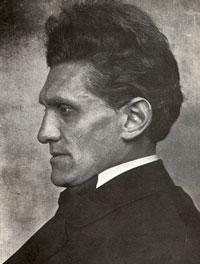
STEFAN GEORGE
A pilgrims journey
by Radbod
Stefan George, perhaps the most prominent German Symbolist poet, was one of the most important and influential poets to have written in German. His work, in its originality and impact, easily ranks with that of Goethe, Holderlin, or Rilke. Yet George's reach extended far beyond the sphere of literature. Particularly during his last three decades, George gathered around himself a group of men who subscribed to his idiosyncratic vision of "Secret Germany" and sought to transform that vision into reality. Stefan George is nonetheless not widely known outside of scholarly circles. A genial young poet, George developed a unique style which relied heavily on his mystical and aristocratic symbolism.
Stefan George was born in 1868 in the village of Büdesheim near Bingen, a small ancient town on the Rhine. His family was originally of French heritage: George's great-grandfather had moved from the French Mosel River valley into Germany, and there established a moderately well-to-do family. The family retained a sense of loyalty to the French traditions: the family name was, until George's own youth, still pronounced in frech way and the young Stefan preferred to use the French variant of his given name, Etienne. Growing up in a bilingual household was to prove advantageous to George in his later years of travel, but the choice, from a literary perspective, between writing in French and German was a serious and weighty concern for the young poet.
Even in his youth, George showed a remarkable proficiency and aesthetic obsession for language. His earliest poems, written when he was fourteen, already exhibit a sensual and carefully constructed imagery, one which relies not only on visual portrayals but on aural landscapes as well. One critic has remarked that George consistently makes use of a "specially coded language," as indeed, is evidenced by his linguistic experiments. As a young boy of 8 or 9, George invented a secret language, intended for use in his imaginary kingdom (or "caliphate") of Amhara, into which he initiated a few select playmates. This language only survives in incomprehensible fragments.
In 1873 his family moved to Bingen, where his father, who had first been an inn-keeper, became a successful wine-merchant. George's father was able to provide suitably for his eldest son's education and upbringing. George attended grammar school in Bingen from 1882 to 1888, and then continued his studies at the Gymnasium in Darmstadt, where he was a noteworthy student of languages and religion. After finishing school, George embarked in 1888 on the first of his many European journeys: first to England, where he spent five months, and then on to France.
His stay in Paris was of fateful importance: a chance meeting with Albert Saint-Paul on his first evening in the city led to George's acceptance into the salon of Stéphane Mallarmé, the French symbolist whose work George had already begun to admire. Stéphane Mallarmé became the model for the beginning of George's literary career. With very few exceptions, the literary situation in Germany at the time was marked on one side by a watered-down post-classicism, and on the other side by a brutish naturalism, both of which George found equally repelling. Mallarmé's programme of pure poetry' without any social relevance, his conviction that the Orphic interpretation of the earth is the only task of the poet' and that everything that is sacred and wants to stay sacred veils itself into mysteries', was like a revelation and quite appealing to the young George.
The influence of the French Symbolists was to remain significant throughout George's life, although he by no means merely copied the French style. George, in a curious mixture of modernism and tradition, looked backward to the Greeks, but also to a Germanic aesthetic which he saw as leading into the future. His poems exhibit a sensual and carefully constructed imagery, one which relies not only on visual portrayals but on aural landscapes as well. George may be termed a modernist, but he was not concerned with the modern world and its bustling new industries. Indeed, George addressed his poetry to the aristocratic and aesthetic mind, not to the intellectual or philosophical thinker. His poetry is in no way analytic; instead, it communicates the subtleties of experience in the most delicate and ineffable of terms.
During his stay in Paris, George wrote a great deal, and upon his return to Germany, published his first volume of verse, Hymnen. This was printed privately and presented to only a small circle of friends, setting a precedent for much of George's later literary publication. His second volume, Pilgerfahrten, underwent a similar distribution, as did Algabal, printed in 1891.
From 1889 on he was registered for three terms at the University of Berlin, but attended only a few lectures. By the time of the publication of his first volume of poems in 1890 he had already assumed the life style that he was to keep up until his end. Never living in a home of his own – not because he could not have afforded it, as he had inherited a sufficient fortune from his parents, but because of the way he saw himself – he would stay as a guest of his friends and admirers in Berlin, Munich, Heidelberg, Basel, or else traveled abroad, mostly in Italy and in Paris. He avoided all publicity, and his books were only privately published. Moreover, he underlined the esoteric character of his writings by certain orthographic peculiarities and a special ornamental typography.
In 1891, George undertook a second European journey: from Berlin to Munich, on to Verona and Venice, then Vienna. After a short return to Bingen, he then went on to London and Paris, only to return to Vienna by the end of the year. And it is here, in December of 1891, that the pivotal meeting with Hugo von Hofmannsthal, who had been occurred. George was himself only 23 when he met the still younger but precocious Austrian poet, who was 17 then. George continued his itinerant lifestyle, publishing several more volumes of poetry before the turn of the century. His representative verse of that time includes Algabal (1892).Perhaps his most memorable achievement at this time is the founding of his literary journal, the periodically appearing Blätter für die Kunst, which continued to be printed until 1919.
Most of George's early poems (in the years before 1904) deal with the process of becoming rather than being. His Jahr der Seele (the soul’s year) of 1897, for example, describes the changing moods of the seasons in an intensely private manner; almost all poems are addressed to a 'you' and consist of dialogic reflections.
By 1895, George had solidified his aesthetic approach to poetry and to culture in general. Although he cannot be classified exclusively as one of the decadent or fin de siècle poets, his works at this time do show many of these characteristics. More importantly, perhaps, is George's belief that he was writing for, and indeed could only be appreciated by, an audience of the elite. To this end, he began to gather around him a circle of admirers, selecting at first amongst his peers and contemporaries, and only later restricting his attentions to the young disciples who sought him out. This group of friends and followers, known from its beginnings as the George-Kreis, gradually took on almost cult-like rituals and symbolism, emphasizing the renewal of culture through the power of youth and beauty.
The strength of George's belief in this cult of beauty is reflected not only in many of his later, quite monumental works, such as Der Stern des Bundes and the prophetically titled Das neue Reich, but in the decisive `Maximin-Erlebnis,' which provided the poet with inspiration and material for much of his later poetry: In 1903 George, during one of his frequent stays in Munich, became acquainted with the 15-year old Maximilian Kronberger. After encountering him on the street several times, George simply approached the young boy and introduced himself. Maximilian became George's close friend and companion over the next year, and was admired by many members of the George-Kreis not only for his youth and beauty, but for his poetic talent as well. Indeed, George saw in Maximilian such perfection that he considered the boy to be an incarnation of the godhead, and worthy of absolute devotion. In 1904, Maximilian died of meningitis at 16. This shattered George's stability and after driving him to the brink of suicide brought a change in his poetry, which became increasingly transcendental, prophetic, and obscure. A new focus for George's work emerged: the series of Maximin-Gedichte center on George's belief in the transcendence of Maximin's earthy life - his idealized figure becomes for George the Stern des Bundes, "one of the new awakened spirits who would one day form the new kingdom on earth."
George's subsequently famous Kreis (Circle) of like-minded friends was beginning to rally about the same time. George considered his circle to be the embodiment and defender of the "real" but "secret" Germany, opposed to the false values of contemporary bourgeois society. Some of his disciples, friends, and admirers were themselves historians, philosophers, and poets. Their works profoundly affected the intellectual and cultural attitudes of Germany's elite during the critical postwar years of the Weimar Republic. Essentially conservative in temperament and outlook, George and his circle occupy a central place in the cultural history of Germany with their political vision of a secret Germany, antagonistic to humanism, to democracy, and to progress. The George-Kreis , his elite circle of friends and admirers, was in some ways a cultic group with hermetic mysticism and rituals.
His most ambitious poetry is contained in the volume Der Siebente Ring, (The Seventh Ring) of 1907. Now George's programme was no longer art for art's sake, but a political vision formed in opposition to a time and society he considered vile and decayed, a spiritually void world of mean commercial utilitarianism and brutal power-politics garnished with decorative phrases. In this time he wrote Der Stern des Bundes [the star of the covenant] (1914), and Das neue Reich [the new empire] (1928).
George, who had been opposed to the reality of the Prussian-dominated German Empire, as contrasted with his idea of Germany, was not carried away by the storm of enthusiasm at the outbreak of the First World War in 1914, and felt rather confirmed by the defeat of 1918. During the turmoil of the first post-war years, George became the lodestar of the most idealistic part of the young generation, as represented by Klaus Mann (born in 1906), who remembered later that "my admiration for him was boundless. I saw him as the leader and prophet, the Caesarean priestly figure as he presented himself. Amidst a rotten and barbarous civilisation, he embodied human and artistic dignity, uniting discipline and passion, grace and majesty. Each of his gestures was of an exemplary, programmatic character. He stylized his own biography like a myth: his romance, the boy Maximin, was the core of a philosophy that was a revelation to the circle of disciples. — The reunification of morals and beauty seemed to have been realized in the mystery of Maximin. Here I found the reconciliation of Hellenic and Christian ethos. Stefan George's ordering mind had – or so did I believe – solved the fundamental conflict that Heinrich Heine analyses with intuition and perspicacity, that reigns as tragic leitmotiv over the works of Friedrich Nietzsche. — My youth venerated in Stefan George the Templar whose mission and deed is described in his poem. When the black wave of nihilism was threatening to devour our culture, he arrived, the militant seer and inspired knight."
Intellectually George may be described as a disciple of Nietzsche. His lyrics, intended for an intellectual aristocracy, were esoteric and remote, but their fine classicism, their melodious words, and the austerity of George’s pure art made him a major poet. He influenced younger poets through his verse and through Blätter für die Kunst (founded 1892), the literary organ of his circle. George made gifted translations of the works of many poets, including Dante. In contemporary life George looked toward the rise of a "superman" who would unify state and culture. At the surface, there were doubtless some similarities between George's programme of a hierarchic reformation based upon a new aristocracy of mind and spirit, and the ideologies of the fascist movements as they were beginning to flourish in several European countries during the nineteen-twenties. Though to him, for his attitude and sentiments, it was impossible to identify his cause with the Nazism that was to take over Germany, the ambiguity became clear in 1933, when some of his followers embraced the upheaval wholeheartedly, while others, like his oldest companion, the Jewish poet Karl Wolfskehl, were forced to emigrate. George himself, who was already fatally ill, declined all honours by which the new rulers tried to gain his support, and, silent but demonstrative, left Germany to end his life elsewhere. He died on the 4th of December 1933, in Locarno, Ticino, Switzerland, several months after the Nazi takeover. Nevertheless the Nazis adopted him as national poet after his death. When he died, George was one of the most famous and revered figures in Germany. Today the importance of George and his circle has largely been forgotten.