JULIUS EVOLA
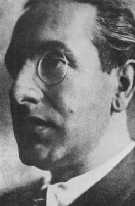
Julius Evola
by Radbod
Baron Giulio Evola, or Julius Evola for a English-speaking public, historian of
philosophy, cultural critic, and publicist, may be described as a contrarian
thinker in the best sense of the term. With his deep erudition and his
aristocratic attitude, he always remained a stranger to his and our twentieth
century. He led an extraordinary life as a mountaineer, philosopher, soldier,
religious historian, artist, magician and political theorist. Julius Evola was
the most notable representative of the traditionalist position, he was also
considered one of the most erudite authorities on Hermeticism and Magic. This
did nothing to reduce the great controversy that surrounds him. Baron Julius
Evola is one of history's most enigmatic occult and parapolitical figures.
Little-known outside Europe, Evola is often cited as the Godfather of
contemporary Italian fascism and radical politics. A close examination of the
historical record reveals a more complex figure. Evola wore many masks: a
parapolitical philosopher who ranked with Oswald Spengler and Arnold Toynbee, a
religious historian who corresponded with Mircea Eliade, and a provocateur who
dabbled in Dada. Though the English-speaking West has largely ignored Evola,
his writings have begun to appear in English editions during the last few
years. Nearly all of these writings are of Evola's esoteric pursuits in the
Traditional School of René Guenon. The most important of these editions is a
translation of Rivolta conto il mondo moderno (Revolt Against the Modern
World), originally published in 1934. Arguably the Baron's magnum opus,
this text contains the most complete renditions of the author's historical and
philosophical ideology. But "the originality" of Julius Evola appears
equally with clarity in the reconciliation, unfamiliar or less preponderant for
the other representatives of the Tradition, between metaphysical statement on
one hand, and political and social analysis of every various form of modern
expression of on the other hand.
Evola is one of the most eminent representing the metaphysics
"School" of The Tradition, as René Guénon, Ananda K. Coomaraswamy,
Titus Burckhardt and Frithjof Schuon. Because of his own idiosyncrasies the
evolian thought holds however within this "School" a very special
situation: central feature of the male-female bipolarity, "wilful"
idea of realisation spiritual, pre-eminence of the "hyperborean"
factor in the origin of traditions, importance granted to the notion of
"spiritual virility", as well as, during his youth, tension between
avant-garde and Tradition to enumerate the main axis.
From the historian of religions Mircéa Eliade to Marguerite Yourcenar and more
recently with the sociologist Pierre-André Taguieff, each has praised the
exceptional qualities of a work that, from the Taoism to the Tantrism, the
Alchemy and the Hermetism to the symbolism of Graal and to Buddhism, is the
rigorous reflection of a quest in order to elucidate and to understand the
origin of myths, legends and universal archetypes.
He has offered a metaphysical system which can answer today’s questions and
offers a path to transcendence, while his message may have been forged with a
hammer rather than with a pen, it is perhaps because of the hardness of our
heads and the emptiness of our culture that a vision of such ferocity became a
necessity. "Evola pointed the way to a steep and solitary path that in my
view is still a valid alternative to both the path of koinonia — of human
fellowship, which contemporary society has been promoting for the past thirty years
— and the spiritualised bourgeois individualism promoted by the New Age
movement." (Guido Stucco in his preface to The Yoga of Power.)
His writing are profuse yet most are not as yet translated into English, it
seems there is a great fear regarding the explosive nature of his insightful
vision. Evola was not afraid of offending peoples foibles or attacking their
sacred cows. His attempt to unite politics, occultism, religion and
traditionalism into a "world shattering" vision was remarkably successful.
Giulio Cesare Andrea Evola
was born in Rome on the 19th of May 1898 to a Catholic aristocratic family of
Sicilian origin. His child-hood was marked by intelligence close to genius and
he quickly learned many languages. He read widely in German, French and Italian.
Fluent in French and German, the young Evola was significantly influenced by
the virtue theory of German philosopher Friedrich Nietzsche. As an ardent
Mountain climber, the young Italian found spiritual invigoration upon the peaks
of the Alps. Coming to age on the dawn of the First World War, Evola joined the
Italian Army to serve in the Mountain Artillery with honor. He survived the war
to continue his search for meaning, incapable of returning to normal life,
overcome with "feelings of the inconsistency and vanity of the aims that
usually engage human activities." Evola indulged briefly in
self-experimentation with drugs through which he attained "states of
consciousness partially detached from the physical senses, ... frequently
approaching close to the sphere of visionary hallucinations and perhaps also
madness.". But such experiences only aggravated his dilemma by
intensifying his sense of personal disintegration and confusion to the point
where he decided, at the age of twenty-three, to commit suicide. He was only
dissuaded from carrying this out by coming across a passage from the Middle
Length Sayings (Majjhima Nikaya I, 1) in the Pali Canon where the Buddha spoke
of those things with which the disciple committed to awakening must avoid
identifying. Having listed the body, feelings, the elements and so on, he
concludes: Whoever regards extinction as extinction, who thinks of extinction,
who reflects about extinction, who thinks: "Extinction is mine," and
rejoices in extinction, such a person, I declare, does not know extinction. For
Evola this was "like a sudden illumination. I realised that this desire to
end it all, to dissolve myself, was a bond - 'ignorance' as opposed to true
freedom."
The young aristocrat found brief satisfaction in the artistic avant-garde
flowering as an early Dadaist and a friend of the founding figure, the Rumanian
Tristan Tzara. He also became involved with the futurist movement and was
considered a promising artist. But by 1921 he became disillusioned with the
Dadaist project of "overthrowing all logical, ethical and aesthetic
categories by means of producing paradoxical and disconcerting images in order
to achieve absolute liberation." He finally rejected the arts as
inadequate to the task of resolving his spiritual unrest and after 1922
produced no further poems or paintings.
During the early 1920's Evola's interests turned to the study of philosophy and
Eastern religion. He began his readings in the occult during this period. He
made contact with Arturo Reghini (1878-1946), a a high-ranking Mason and
mathematician, neo-Pythagorean occultist and ardent fascist, who was the
co-ordinator of a magical association called UR group which studied speculative
Freemasonry, occultism, and other occult tradition and exalted a form of
individualist-oriented "magical idealism". Arturo Reghini, who
believed himself to be a member of the Scuola Italica, an esoteric order that
claimed to have survived the fall of ancient Rome, invited Evola to join the
the UR-group.
Evola’s natural aristocracy
came to the surface and he became the learning exponent of the developing
philosophy of the UR (and its successor KRUR) group. Evola and the UR group
became aligned to the natural principles of aristocracy and while not having a
necessarily high opinion of Mussolini, they realised the pragmatic value of his
revolution and gave him their support in print. Evola became director of the UR
group and invested much time and energy in the groups newsletter, writing
articles and occasionally editing. Within the group, Evola constituted a centre
of esoteric discipline studies, insistent however on the necessity above the
operative aspect. To end in a transcendent knowledge, supposing a radical
transformation to the being, Evola had recourse to the "magic" as an
experimental science; the term of "magic" should be understood in the
senses of a specific formulation for initiatory knowledge and an active
attitude towards things spiritual. Evola was the journal’s foremost author, but
he was joined by prominent figures in the Italian esoteric scene, such as
Giulio Parese and Ercole Quadrelli. All of UR’s writers published under
pseudonyms, for the stated reason that "their individual selves count for
nothing, because everything valid they can offer now is not of their own
creation or devising, but instead reflects a collective and objective
teaching." This harks back to such seminal works as the Rosicrucian
Manifestoes, or the more recent Meditations on the Tarot, whose authors chose
anonymity so as not to distract from the message of their texts. The message of
the UR Group was as follows: there is a capacity inherent in Man to raise
consciousness above the call of the body and the distractions of the mind; a
capacity that can lead to an immortal awareness. The means to this awareness is
through a rigorous discipline wherein the transitory ego is shed, and the
individual consciousness is wedded to the Eternal. In so doing, one passes
beyond the conventional notions of Good and Evil, to a place where, in Gustav
Meyrink’s words, only "truth" and "falsehood" exist. To
know this is not a matter of intellectual knowledge, but of spiritual
experience, i.e. of gnosis.
Evola took up a project in
1927 that was to make him famous in his own day. In his idealization of virtue
and his romantic memory of Imperial Rome, Evola set out against the Catholic
Church. Following Reghini he denounced the Church as the religion of a
spiritual proletariat and attacked it ferociously in his book Pagan
Imperialism (1927). He saw the Church as antithetical to the rising
political regime of Mussolini. Evola attacked the debilitating effects of
Christianity as it was represented in the period and upheld the heroic virtues
of Rome. The Baron imagined the raising of a new Paganism, a rebirth of the regal
Empire emerging in the wake of the Christian Dark Age. These writings against
the Catholic Church caused controversy throughout Italy and brought Evola the
most notoriety, criticism and ridicule during his life in Italy. Amongst the
Church's many responses to Evola's neo-pagan polemic was the noteworthy
reaction of Giovanni Battista Montini, who latter became Pope Paul VI. However,
the association between the Church and the Fascist party was solidified in the
Laterian Accords between Pope Pious XI and Mussolini.
The philosophical part of
Evola's work traces the way of an Absolute Individual able to be the Lord of
the "Yes and the No", aiming to reintegrate the Myself in its primary
dimension, free and unconditioned, where the knowledge is power. His Théorie
et Phénoménologie de l'Individu Absolu in addition to a great vigour
of thought abounds in evocative images making rise a cosmic drunkenness, the
sensation of an abyssal world where reigns the essential and the elementary. In
the optic of the "knowledge as power", Evola was going to find with
Tantra an Hindu traditional doctrine appropriated to the situation of the Kali
Yuga, the Hésiode Age of Iron. The way of the Left Hand aims to the
"liberation" moksha by using "in order to rise up what
leads most of humans in hell". Evola was in contact with Sir John
Woodroffe (Arthur Avalon), one of the rare Europeans to have had an authentic
access to tantrism qualified representatives.
After having presented with tantrism an "wet" way, Evola was
interested equally in earliest Buddhism, the "dry" way able to lead
"beyond skies and paradise beatitudes", that are considered as being
still a link. The nirvâna (nibbâna in pâli language) is not an
"annihilation" but the Awakening, the extinction of the thirst of
desires, the ignorance.
Evola decried the decadent nature of the modern world and its social and
political isms and ologies and demanded a return to aristocratic values, which
he felt were epitomised by the Teutonic Knights, knights who could act as
spiritual warriors waging war against the whole corrupt bourgeois modern
system. This concept of spiritual warriorship he elucidated most clearly in his
radically revisionist book on Buddhism – "The Doctrine of Awakening".
He regarded the writing of this book as repayment of the "debt" he
owed to the doctrine of the Buddha for saving him from suicide. The declared
aim of the book was to "illuminate the true nature of original Buddhism,
which had been weakened to the point of unrecognisability in most of its
subsequent forms." The essential spirit of Buddhist doctrine was, for
Evola, "determined by a will for the unconditioned, affirmed in its most
radical form, and by investigation into that which leads to mastery over life
as much as death." As its sub-title ("A Study on the Buddhist
Ascesis") suggests, Evola's aim was to emphasise the primacy of spiritual
discipline and practice as the core of Tradition as represented by Buddhism. He
condemns the loss of such ascesis in Europe and deplores the pejorative sense
the term has assumed. Even Nietszche, he notes with surprise, shared this
anti-ascetic prejudice. Today, he argues, the ascetic path appears with the
greatest clarity in Buddhism. Evola bases his arguments on the Italian
translations of the Pali Canon by Neumann and de Lorenzo published between 1916
and 1927. Like many of his generation, the Pali texts represented the only true
and original source of the Buddha's teaching. He was nonetheless critical of a
large body of accepted opinion that had grown up around them. Renunciation, for
example, does not, for Evola, arise from a sense of despair with the world; he
maintains that the four encounters of Prince Siddhartha should be "taken
with great reserve." For true aryan renunciation is based on 'knowledge' and
is accompanied by a gesture of disdain and a feeling of transcendental dignity;
it is qualified by the superior man's will for the unconditioned, by the will
... of a man of quite a special 'race of the spirit.' The bearing of such a
person is "essentially aristocratic," "anti-mystical,"
"anti-evolutionist," upright and "manly." This race of the
spirit is united with the "blood ... of the white races who created the
greatest civilisations both of the East and the West" - in particular
males of warrior stock. The aryan tradition has been largely lost in the West
through the "influence on European faiths of concepts of Semitic and
Asiatic-Mediterranean origin." Yet in the East, too, Buddhism has
degenerated into Mahayana universalism that wrongly considers all beings to
have the potentiality to become a Buddha. As for Buddhism being "a
doctrine of universal compassion encouraging humanitarianism and democratic
equality," this is merely one of many "Western misconceptions."
Evola considers the world of his time to be perverse and dysfunctional.
"If normal conditions were to return," he sighs, "few
civilisations would seem as odd as the present one." He deplores the
craving for material things, which causes man entirely to overlook mastery over
his own mind. Nonetheless, one who is still an 'aryan' spirit in a large
European or American city, with its skyscrapers and asphalt, with its politics
and sport, with its crowds who dance and shout, with its exponents of secular
culture and of soulless science and so on - amongst all this he may feel
himself more alone and detached and nomad than he would have done in the time
of the Buddha. Evola believed that the original Buddhism disclosed through his
study revealed the essence of the aryan tradition that had become lost and corrupted
in the West. For him aryan means more than "noble" or
"sublime," as it was frequently rendered in translations of Buddhist
texts. " They are all later meanings of the word," he explains,
"and do not convey the fullness of the original nor the spiritual,
aristocratic and racial significance which, nevertheless, is preserved in
Buddhism." Other "innate attributes of the aryan soul" that are
described in Buddhist texts are an absence "of any sign of departure from
consciousness, of sentimentalism or devout effusion, or of semi-intimate
conversation with a God." Only among some of the German mystics, such as
Eckhart, Tauler and Silesius, does he find examples of this spirit in the
Western tradition, "where Christianity has been rectified by a transfusion
of aryan blood."
In the Doctrine of Awakening Evola offers a radical re-assessment of
Buddhism and indeed of the path to completeness. He argues than the modern
monastic approach of Buddhism is alien to Gautama’s original intent and
outlines a warrior-priest path to self-discovery. Evola argues that the
tradition that upholds priesthood, monasticism and resignation to life’s
torments (and by default degrades the warrior path) is a corruption or at least
a degradation of the pristine message. Evola believes that the primal form of
Buddhism centered on a warrior/priest path focused on action and the
achievement of what could best be described as the Aristocratic Self. The term
Aristocrat here is used in its strictest etymological sense, coming from the
Greek word Aristos meaning best. Not only does Buddhism display an aryan spirit
but, for Evola, it also endorses the superiority of the warrior caste. Brushing
aside the Buddha's well-known denunciation of the caste system, Evola notes
that "it was generally held that the bodhisattva ... are never born into a
peasant or servile caste but into a warrior or brahman caste." He cites
several examples where the Buddha makes analogies between "the qualities
of an ascetic and the virtues of a warrior." Of all the Mahayana schools
the only one he admired was that of Zen, on account of its having been adopted
in Japan as the doctrine of the Samurai class. The Buddhist disdain for talking
about self and God comes not from disbelief, Evola argues, but from a demand
for action. There is no Self, so create one, there is no God, so become one.
This approach is certainly at odds with much that passes for modern Buddhism
and yet in these days of navel gazing, channeling and armchair occultism, one
cannot help but be exhilarated by his call to arms. But a simple call is not
all of Evola’s message, he does not leave us with theory alone. The Doctrine of
Awakening re-evaluates the basic tenets of Buddhism and ex-amines them in light
of the warrior-priest ethos. Rather than advocating a negative detachment
whereby life is experienced at an arms distance, Evola suggests we experience
detachment by "riding the tiger", by flowing with the punches, rather
than against them. There is no life-denying here, more a transcendence achieved
amidst the chaos. At the same time, Evola does not wish to see partial. His
approach is that there are many ways to "ride the tiger", one can
ride slowly and with care, or struggle into the night, one can beat it into
submission or lull it with song. Evola other published works, the Yoga of
Power and The Hermetic Tradition offer various interpretations of
the means to achieve the Aristocratic Self.
The Hermetic tradition expounds the traditional virtues as found in
Alchemy, Hermeticism and even Rosicrucianism with an eye on how these are
applied towards the transformation of base man (metal) into God (gold). While
the Yoga of power does the same for Tantra. The Yoga of Power is
probably one of his more controversial titles in that it embraces both right
and left hand path occultism and does not shy from outlining the dark as well
as the light ways towards Self. Both of these titles as with the Doctrine of
Awakening challenge us to transcend the shal lowness of the present age and go
beyond the masks, illusions and charades we call selves to find our real and
ineffable nature.
Through Reghini Evola was introduced to René Guénon, whose concept of
"Tradition" came to serve as "the basic theme that would finally
integrate the system of my ideas." Evola distinguishes two aspects of this
concept. Firstly, it refers to "a primordial tradition of which all
particular, historical, pre-modern traditions have been emanations."
Secondly, and more importantly, Tradition has nothing to do with conformity or
routine; it is the fundamental structure of a kind of civilisation that is
organic, differentiated and hierarchic in which all its domains and human
activities have an orientation from above and towards what is above. Such
civilisations of the past had as their natural centre an elite or a leader who
embodied "an authority as unconditional as it was legitimate and
impersonal."
It comes as no great surprise, therefore, that Evola strongly identified with
the Right and supported the rise of Fascism in both Italy and Germany. Though
Evola had never joined any political party or voted in an election, he found in
Fascism, perhaps influenced by Reghini, the manifestation of the heroic ideal
of his youth. This association with the political right was to last thought his
life and well after his death. Evola was protected by Benito Mussolini's
administration (1922-1943), however Evola preferred intellectual stratification
of the elite over Nazism's championing of biological racism. Evola looked down
upon Mussolini with aristocratic disdain. Evola's sympathy for Mussolini's
fascism waned, and in September of 1941 the he and Mussolini met for the last
time. If the political commitment of Evola in favour of the Axis forces,
although critic, was discussed, it corresponded however to the possibility of a
temporary rectification facing the general involution. However that may be,
while the first world war contributed to "liquidate" the ancient
empires, the Second world War was finally the modern ideology triumph.
Later, Evola broke with his former mentor Arturo Reghini and found a different
concept of political agitation, which can be called a less agitative but more
profound one than Reghini's, and can be labelled as a form of "sacred
fascism." It links the sacrality of ancient Rome with the modern fascist
state, which was more or less accidentally determined by how it came to power
and through the figure of the Duce and the other personalities involved. The
fascist state, which was nevertheless a modern state, should be transformed in
the direction of the traditional sacrality of the state and its functions --
symbolised by the fasces and the axis. The concept of "pagan
imperialism" was based more on power and much less so on sacrality.
Evola founded La Torre (the Tower), his own magazine, however, due to conflict
with the prevailing state it only last ten issues. His works slowly started to
move towards the spiritual side of politics and he made it clear that the only
real return to "traditional values" can occur when we ourselves are transformed.
Evola connected more with Guido de Giorgio, whom he called the main influence
behind La Torre. After La Torre was forced to cease publication, Evola
tried to follow the same line under the umbrella of other magazines.
Around the same time he published such titles as Man as Potency and Revolt
Against the Modern World, revealing his indebtedness to Nietzsche and
Spengler. With Revolt against the Modern World, first published in 1934,
Evola was going to write one of his most important works, probably because all
his work is found in there "condensed". Like a misunderstood
visionary, he denounces the regressive aspect of the modern civilisation, by
using the Tradition as a normative principle. According to the doctrine of the
four ages, the real meaning of history is not "progress", but
increasing involution while the "Golden Age" passes by. Our
materialistic era corresponds to the Age of Iron, the lowest degree before a
new cycle. For Evola, history was a series of cycles that are degenerative
rather than evolutionary, we are then in the darkest age of all (the Kali
Yuga), rather than entering an age of light, love and peace. Our modern way of
thinking is, (according to Evola) a wasteland, it is the final stage in the
decay of truth, rather than its pinnacle. History from this perspective is a
series of "steps down-ward" whereby new religious and esoteric
systems are fragments of the truth rather than being new innovations or
developments. Evola’s magnum opus, "Revolt against the modern world",
slices through the false theosophies, new age visions and pseudo-intellectual
systems so prevalent today and offers insight into the real nature of man, his
history and his goals. The approach of Evola is elitist in the sense that it is
intellectually and spiritually demanding, Evola demands maximum concentration
from his readers, however, in return he offers a worldview, a Weltanschauug
that challenges the foundations of currently held beliefs. The nexus of "Revolt
against the modern world" is a exposition on the cycles of history and
a intense and insightful consideration of the role of aristocracy, the caste
system and Heroic virtues. As with many of the Traditionalists, Evola saw the
world in a process of devolution, as opposed to the rationalistic model of
progress and evolution. This worldview was deeply influenced by the Eastern
notion of cyclical time, which has been popularized by religious scholar Mircea
Eliade (who Evola corresponded with and met). For the Traditionalists, mankind
is experiencing ever increasing ages of strife and chaos, falling ultimately
from a divine Golden Age. Evola’s historial outline takes the Yugas a step
further, he discusses the cultural focus of each period and the changes that
take places within the ideological and spiritual traditions of each epoch.
A historical reading of many world mythologies largely shapes this worldview.
The Golden age is that of the Polar tradition, it was based in the Arctic
regions where days and nights were long and the Axis Mundi was a steady focus
within the night sky. At this time the traditions of Sky and Earth worship were
in balance, while the sky had ascendancy, the role of earth (albeit in
submission) was acknowledged and relevant. The classes as seen within the
divine caste system (which reflected the ages of history) were in balance and
creativity and intelligence were rewarded. As the Polar age ended and
migrations from the Arctic were caused by changes in weather patterns, Aryan
man spread across the globe and mankind entered the Silver age. During the
Silver or Lunar epoch, earth cults took ascendancy, the feminine and fertility
became of paramount significance and this lead to an overemphasis on pagan and
Gaia oriented traditions. The research of Gimbutas and others in some way
outlined the worship that occurred in this period, however, rather than being
paradisiacal, it was a degeneration from the Polar faith. In reaction against
this overindulgence, even hedonism earth worship, the Dionysian or Copper age
began. The worship of strength, violence, masculine virtues battle against the
feminine values and patriarchal civilisations were formed. While these
civilisations were of great historical importance, to achieve their balance
they suppressed the lunar or silver cultures and hence existed as a reaction
rather than as a creative expression. This being so, it only took so long
before the clashes between the two forces dragged man into the current age,
that of the Kali Yuga. Now lunar and Dionysian, feminine and masculine, sky and
earth are in conflict and battle and will continue so until the age ends in
bloodshed.
We now live in the Kali-Yuga of the Hindus, the Iron Age of Hesiod, the
Germanic Ragnarok, according to the Traditionalist School. Politically this age
is characterized by the governing of the materialistic masses (democracy) over
the spiritual rulership of the solar nobility. In concordance with the ancient
Indo-Aryan world-view, Evola sees the history of man as a process of permanent
decline and ever-increasing distance from the "pole" of an original
sacrality. The ancient priestly and warrior cultures of India and Egypt are
worlds apart from the democratic plebeian epoch of today. Moreover, just as in
the alchemical process, whose symbols were an intensive, lifelong concern of
Evola's, mankind must first pass through its stage of maximum degeneracy in the
material word before it can become ripe for its eventual purification and
renovation.
Evola could achieve little with the political mass movements of his time. Evola
saw a hope in Fascism for a return of the dominance of the solar aristocracy
over the earthly masses. When Fascism arose in his Italian homeland he found it
wanting in the transcendent impulse; and the American egalitarianism which,
under the banner of democracy, also infected Europe after 1945, was absolutely
alien to him. In Evola's view, political criteria are far less crucial than
traditional and metaphysical ones. Julius Evola's legacy is of no use for
electioneering or party-philosophies. An aeonian conservatism speaks through
his work: but to individuals, not to the masses. Evola also knew that history
is always made by men, and that every change for the better must begin in their
hearts and souls. It is questionable whether our time is yet ripe to assimilate
his world-view. But what difference does one century more or less make? As a
"Traditionalist" in the particular, philosophical sense, one knows
only that after every end there comes a new beginning. When it comes, is a
secondary matter.
Inherent within Evola’s outline of history is that natural structure of society
which he sees as reflected within the caste system. This fourfold pattern, of
which we will say much later, represents a natural division according to
ability. However, as the ages unfold it too becomes corrupted and conflicts
arise, giving birth to modern political and social movements.
After Hitler came to power, Evola was feted by high-ranking Nazis, his books
were translated into German and he was invited to the country to explain his
ideas to select aristocratic and military circles. But, as with many of his
German admirers, he kept aloof from what he considered the nationalist,
populist and fanatic elements of National Socialism. His views on race were the
same as most traditionalist occultists, there are obviously variations between
races and multiculturalism as a philosophy or political system is simply
ludicrous. At the same time he emphasised the danger of reducing man to
physical breeding alone and rejected the reductionist approach of much racialist
theory. He believed in the cultural integrity of discrete, individual cultures
as opposed to a melting mentality. He had particular contempt for the values of
the USA. He claims in his autobiography that because of his position as a
foreigner from a friendly nation, he was free to present ideas which had they
been voiced by a German would have risked imprisonment in a concentration camp.
Nonetheless, when Mussolini was overthrown in 1943, Evola was invited to Vienna
by a branch of the SS to translate proscribed texts of Masonic and other secret
societies. During an Allied-bombing sweep in 1945 in Vienna Evola refused to go
and shelter, continuing to write under the whistling of bombs, like a tacit
interrogation of his destiny. A brutal reply occurred as the form of a bombing,
that caused an inferior member paralysis after a year and a half in hospital.
He was hit by a stray bomb and paralyzed from the waist down, leaving him in a
wheelchair for his remaining life. Before his accident, Evola regularly practised
the mountaineering as a spiritual way, and notably the North face of the
oriental Lyskamm. The Mountaineer was never to climb a peak again. He spent the
rest of his life writing, researching and offering guidance to those seeking a
spiritual revolution.
The use of sexuality in order to bring a change of level of the ordinary
conscience had already been approached by Evola during various studies, notably
those about tantrism. But it is in Métaphyique du Sexe that he released
fully the ultimate sens of eros, not its biological foundation but ontological
one, sexes existing first as a transcendent principle. It is therefore the
myths, the sacredness, the hierogamies, rather than the quantitative
sexologists' approach, that are going to remind facing the "sexual
liberation" and the Puritanism, the metaphysic primordiality of sex.
"Darker than the den of darkness" ; this sentence of John Parvulesco
might well qualify Riding the Tiger, denier breviary of modern
illusions. In this book, Evola observing the failure of all rectification
attempts, recommended an individual solution whose principle is borrowed to
Tantra, "transform the poison into cure". Because in a world where
there is nothing left to love, the last meaning of existence remains a spiritual
realisation.
Evola deceased in Rome, the city where he was born, the 11th of June 1974.
After his death, a funeral urn containing his ashes was deposited by a roped
party in one of the innumerable crack the Mont-Rose, buried in the eternal ice,
respecting thus his last will: the ascent to the peak as a symbol of
resurrection. In the silence of the gods' estate, perhaps Evola has rejoined
the wonderful city called Felik at a distance away from the world... Today,
Evola still has a significant influence on Continental magic (especially
Italian), and has remained an icon for right wing political groups, such as
Italy's "revolutionary cells" and France's National Front Party.