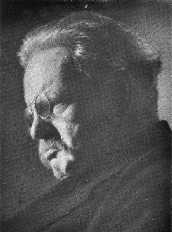
GILBERT KEITH CHESTERTON
"Moderns hate the past because they fear it: There have been so many harsh heroisms that we cannot imitate."
"The modern tyrant is evil because of his elusiveness. He is more nameless than his slave. He is not more of a bully than the tyrants of the past; but he is more of a coward."
"All revolutions are doctrinal. For it stands to common sense that you cannot upset all existing things, unless you believe in something outside them, something positive and divine."
"There is nothing the matter with Americans except their ideals. The real American is all right; it is the ideal American who is all wrong."
(G. K. Chesterton)
Gilbert Keith Chesterton was born in London, England on the 29th of May, 1874. He was educated at St. Paul’s, but never went to college. Instead, he went to art school. In 1900, he was asked to contribute a few magazine articles on art criticism, and went on to become one of the most prolific writers of all time. He wrote a hundred books, contributions to 200 more, hundreds of poems, including the epic Ballad of the White Horse, five plays, five novels, and some two hundred short stories, including a popular series featuring the priest-detective, Father Brown. In spite of his literary accomplishments, he considered himself primarily a journalist. He wrote over 4000 newspaper essays, including 30 years worth of weekly columns for the Illustrated London News, and 13 years of weekly columns for the Daily News. He also edited his own newspaper, G.K.’s Weekly. His writing has been praised by Ernest Hemingway, Graham Greene, Evelyn Waugh, Jorge Luis Borges, Gabriel Garcia Marquez, Karel Capek, Marshall McLuhan, Paul Claudel, Dorothy L. Sayers, Agatha Christie, Sigrid Undset, Ronald Knox, Kingsley Amis, W.H. Auden, Anthony Burgess, E.F. Schumacher, Neil Gaiman, and Orson Welles, to name a few. Many of his writings are still in print.
This man who composed such profound and perfect lines as "The Christian ideal has not been tried and found wanting; it has been found difficult and left untried" stood 6’4" and weighed about 300 pounds, usually had a cigar in his mouth, and walked around wearing a cape and a crumpled hat, tiny glasses pinched to the end of his nose, swordstick in hand, laughter blowing through his moustache. And usually had no idea where or when his next appointment was. He did much of his writing in train stations, since he usually missed the train he was supposed to catch. In one famous anecdote, he wired his wife, saying, "Am at Market Harborough. Where ought I to be?" His faithful wife, Frances, attended to all the details of his life, since he continually proved he had no way of doing it himself. She was later assisted by a secretary, Dorothy Collins, who became the couple’s surrogate daughter, and went on to become the writer’s literary executrix, continuing to make his work available after his death.
This absent-minded, overgrown elf of a man, who laughed at his own jokes and amused children at birthday parties by catching buns in his mouth, this was the man who wrote a book called The Everlasting Man, which led a young atheist named C.S. Lewis to become a Christian. This was the man who wrote a novel called The Napoleon of Notting Hill, which inspired Michael Collins to lead a movement for Irish Independence. This was the man who wrote an essay in the Illustrated London News that inspired Mohandas Gandhi to lead a movement to end British colonial rule in India. This was a man who, when commissioned to write a book on St. Thomas Aquinas, had his secretary check out a stack of books on St. Thomas from the library, opened the top book on the stack, thumbed through it, closed it, and proceeded to dictate a book on St. Thomas. Not just any book. The renowned Thomistic scholar, Ettienne Gilson, had this to say about it: "I consider it as being without possible comparison the best book ever written on St. Thomas. Nothing short of genius can account for such an achievement. Everybody will no doubt admit that it is a 'clever' book, but the few readers who have spent twenty or thirty years in studying St. Thomas. . . cannot fail to perceive that the so-called 'wit' of Chesterton has put their scholarship to shame. He has guessed all that which we had tried to demonstrate, and he has said all that which they were more or less clumsily attempting to express in academic formulas. Chesterton was one of the deepest thinkers who ever existed; he was deep because he was right; and he could not help being right; but he could not either help being modest and charitable, so he left it to those who could understand him to know that he was right, and deep; to the others, he apologized for being right, and he made up for being deep by being witty. That is all they can see of him."
Chesterton was equally at ease with literary and social criticism, history, politics, economics, philosophy, and theology. His style is unmistakable, always marked by humility, consistency, paradox, wit, and wonder. His writing remains as timely and as timeless today as when it first appeared, even though much of it was published in throw away papers. Though not written for a scholarly audience, his biographies of authors and historical figures like Charles Dickens and St. Francis of Assisi often contain brilliant insights into their subjects. His "Father Brown" mystery stories, written between 1911 and 1936, are still being read and adapted for television.
Though he considered himself a mere "rollicking journalist," he was actually a prolific and gifted writer in virtually every area of literature. A man of strong opinions and enormously talented at defending them, his exuberant personality nevertheless allowed him to maintain warm friendships with people -- such as George Bernard Shaw and H. G. Wells -- with whom he vehemently disagreed. Chesterton debated many of the celebrated intellectuals of his time: George Bernard Shaw, H.G. Wells, Bertrand Russell, Clarence Darrow. According to contemporary accounts, Chesterton usually emerged as the winner of these contests, however, the world has immortalized his opponents and forgotten Chesterton, and now we hear only one side of the argument, and we are enduring the legacies of socialism, relativism, materialism, and skepticism. Ironically, all of his opponents regarded Chesterton with the greatest affection. And George Bernard Shaw said: "The world is not thankful enough for Chesterton." T.S. Eliot said that Chesterton "deserves a permanent claim on our loyalty." Chesterton is the most unjustly neglected writer of our time. Perhaps it is proof that education is too important to be left to educators and that publishing is too important to be left to publishers, but there is no excuse why Chesterton is no longer taught in our schools and why his writing is not more widely reprinted and especially included in college anthologies.
But there is another problem. Modern thinkers and commentators and critics have found it much more convenient to ignore Chesterton rather than to engage him in an argument, because to argue with Chesterton is to lose. Chesterton argued eloquently against all the trends that eventually took over the 20th century: materialism, scientific determinism, moral relativism, and spineless agnosticism. He also argued against both socialism and capitalism and showed why they have both been the enemies of freedom and justice in modern society.
And what did he argue for? What was it he defended? He defended "the common man" and common sense. He defended the poor. He defended the family. He defended beauty. And he defended Christianity and the Catholic Faith. These don’t play well in the classroom, in the media, or in the public arena theses days. The modern world prefers snobbish writers with exotic and bizarre ideas, who glorify decadence, who scoff at Christianity, who deny the dignity of the poor, and who think freedom means no responsibility.
Though not known as a political thinker, his political influence has circled the world. His politics fitted with his deep distrust of concentrated wealth and power of any sort. Along with his friend Hilaire Belloc and in books like the 1910 "What's Wrong with the World" he advocated a view called "Distributism" that is best summed up by his expression that every man ought to be allowed to own "three acres and a cow." Fritz Schumacher, founder-philosopher of the new conservationist and decentralist movement, frequently acknowledged his debt to the inspiration of Chesterton and the social philosophy of Distributism. Indeed, his famous book, Small is Beautiful, grew from an essay which he originally named, Chestertonian Economics. Chesterton was, however, not a mere politician, far less a slave to party politics. He was a radical and a visionary, a man who knew the Truth instinctively, and knew how to convey that Truth to others. Chesterton had no difficulty standing up for what he believed. He was one of the few journalists to oppose the Boer War. His 1922 Eugenics and Other Evils attacked what was at that time the most progressive of all ideas, the idea that the human race could and should breed a superior version of itself. History demonstrated the wisdom of his once "reactionary" views.
It was this capacity for illumination which made his influence so deep and wide ranging. In an article in the Illustrated London News in 1909, he remarked that the then burgeoning Indian Nationalism "seems not very Indian and not very national", and went on to give a brilliant analysis of the situation in India. This so impressed Gandhi, the future leader of India, that he immediately translated the article into Gujarati and used it as the basis of his own book and of his future campaigns.
Orthodoxy belongs to yet another area of literature at which Chesterton excelled. A fun-loving and gregarious man, he was nevertheless troubled in his adolescence by thoughts of suicide. In Christianity he found the answers to the dilemmas and paradoxes he saw in life. In 1905 he wrote Heretics and its sequel Orthodoxy and in 1925 The Everlasting Man. That great Christian scholar, C.S. Lewis, paid high tribute to the insight and value of G.K.C.'s study of Chaucer, and of The Everlasting Man he said that it gave him the first outline of Christianity set out in a form that made sense, and that it was one of the major steps in his journey from atheism to Christianity. "For the critics who think Chesterton frivolous or 'paradoxical', I have to work hard", wrote Lewis, "to feel even pity. Sympathy is out of the question".
How did Chesterton come to impress so greatly even major scholars in the fields he entered in humility as a confessed amateur? The answer is to be found chiefly in two characteristics of his mind and work. Firstly, a penetrating insight, uncluttered by preconceived ideas, which took him unerringly to the heart of the matter, followed by an exposition so lucid and so free from pomposity or jargon that the reader immediately sees the rightness of the judgement or comment and, indeed, takes it to be mere commonsense which he himself should have seen. Secondly, Chesterton had one of the unmistakable marks of the truly wise, in that his thoughts were never fully circumscribed by contemporary fashions and boundaries. In "What's Wrong with the World" (1910), "Eugenics and Other Evils" (1922), "The Outline of Sanity" (1926) and many other books, he advanced ideas and re-statements of older philosophies for which he was then ridiculed. Defenders of both Capitalism and of monolithic State control derided his fierce defence of the family and of the small owner and tradesman, and his attacks on factory farming, as being an unrealistic yearning for a return to medievalism. Since then, however, we have lived to see and suffer the results of unbridled commercialism and of State domination of lives as well as of economies. Few people now doubt that the powers of the State on the one hand and the greed of monster, supra-national monopolies on the other are evils which must be resisted. Almost everybody now accepts that a large measure of genuine independence must, as a matter of urgency, be restored to the small farmer, craftsman, trader and, above all, to the family. We live in disturbed and, largely, unhappy times. I am neither diffident nor apologetic in saying that one factor in our finding a path back to social stability and sanity may well depend upon how carefully we are prepared to listen to G.K. Chesterton.
It may seem to many a little odd that a writer who thought of himself as being merely a journalist, and who died half a century ago, should now be the subject of an enthusiastic worldwide revival. The truth is that G.K. Chesterton was one of the deepest and most lucid thinkers that England has produced. His thought and writing is full of vivid commonsense, cutting through the jargon or cant of the day and throwing light into hitherto dark places, so that the reader constantly thinks "How obvious! Why didn't I think of that before?"
Chesterton died on the 14th of June, 1936 in Beaconsfield, Buckinghamshire.