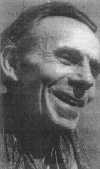
LOUIS FERDINAND CELINE
Journey to the End of the Night
by Radbod
"Almost every desire a poor man has is a punishable offence."
"Experience is a dim lamp, which only lights the one who bears it."
"To philosophize is only another way of being afraid and leads hardly anywhere but to cowardly make-believe."
"The whole business of your life overwhelms you when you live alone. One's stupefied by it. To get rid of it you try to daub some of it off on to people who come to see you, and they hate that. To be alone trains one for death."
Louis Céline, originally named Louis Ferdinand Destouches was born in Courbevoie in the Seine Department on May 27, 1894. His father was employed by an insurance company and mother dealt in quality lace. Céline grew up in Paris, where his mother set up a shop in the Passage Choiseul. Céline's parents planned him a career in business and sent him abroad to learn languages. He studied at a school at Diepholz in Lower Saxony, then at an English boarding school and worked in various commercial companies.
In 1912, at the age of 18, he enlisted in a cavalry unit, the Twelfth Regiment of the Cuirassiers. He was seriously wounded during the First World War in Ypres, which left him with a damaged arm, a buzzing and ringing in his head and headaches that lasted all his life. In the autobiographical novel North (1960) he wrote about his ear noises: "I listen to them become trombones, full orchestras, marshaling yards...". He was awarded the Médaille militaire and a seventy-five percent disability pension and respected as a national hero.
Céline was then assigned to the French passport office in London. In 1915 he married Suzanne Nebout, a Frenchwoman working as a barmaid in London, but this marriage was not registered with the French consulate. In 1916 he worked for a lumber company in the Cameroons and was sent back to France with malaria and dysentery. In 1919 he married Edith Follet, whose father was a director of a medical school. Céline studied medicine in Rennes and received his degree from the University of Paris in 1924. His doctoral thesis was entitled LA VIE ET L'OEUVRE DE PHILIPPE-IGNACE SEMMELWEISS. In the following year he left his practice, his wife, and his child to work for the League of Nations. His second marriage ended in 1926.
Employed by the League of Nations Céline traveled in Switzerland, the Cameroons, the United States, Cuba, and Canada. In Detroit he studied problems of social medicine at the Ford factories. In 1928 he opened a private practice in a suburb of Paris and in 1931 he began to work for a municipal clinic at Clichy, in Paris.
While working in Clichy, Céline made his debut as a novelist with Journey to the End of the Night (1932; Eng. trans., 1943), and assumed the pseudonym Céline - it was the Christian name of his maternal grandmother. The book was praised both by the right-wing extremist Léon Daudet and then exiled Leon Trotsky and received the Renaudot Prize. Ferdinand Bardamu, the protagonist, had much in common with Céline. The story covered author's life from1913 to 1932, although the events are rearranged and modified for the tale. Narrated in the first person in vernacular slang, it depicted Bardamu's adventures in the trenches of the First World War, his experiences in Africa running a trading post, hellish work in a Ford factory in the United states, and his return to Paris, where he sets up a medical practice. "It's sickening to see the workers bent over their machines, intent on giving them all possible pleasure, calibrating bolts and more bolts, instead of putting an end once and for all to this stench of oil, this vapour that burns your throat and attacks your eardrums from inside. It's not shame that makes them bow their head. You give in to noise as you give in to war. At the machines you let yourself go with three ideas that are wobbling about at the top of your head. And that's the end." (from Journey to the End of the Night)
Céline's second novel, Death on the Installment Plan (1936; Eng. trans., 1938) also gained critical success. It continued the story of Ferdinand, but returned to his childhood memoirs, his violent father and his mother, who suffered from polio and earned living for the family as a saleswoman. Ferdiand leaves homes, and helps the inventor and hot air ballooner, Courtial des Pereires, in his swindling plans.
His first novels Journey to the End of the Night and Death on the Installment Plan are innovative, chaotic, and antiheroic visions of human suffering. Pessimism pervades Céline's fiction as his characters sense failure, anxiety, nihilism, and inertia. Céline was unable to communicate with others, and during his life sank more deeply into a hate-filled world of madness and rage. A progressive disintegration of personality is visible in the stylistic incoherence of Guignol's Band (1944; Eng. trans., 1954), Castle to Castle (1957; Eng. trans., 1968), and North (1960; Eng. trans., 1972). His novels are verbal frescoes peopled with horrendous giants, paraplegics, and gnomes, and are filled with scenes of dismemberment and murder.
Céline's journey to the Soviet Union produced the first of his notorious pamphlets, MEA CULPA, where Céline declared his disenchantment with the Communist system. He started to work on a third novel but interrupted it because he thought it was more urgent to try to prevent his country from entering a new war. Céline believed that this war would be disastrous. He produced anti-Semitic, pacifist pamphlets, two of which were condemned by the courts. In BAGATELLES POUR UN MASSACRE Céline argued, that there is an international Jewish conspiracy to start a world war. Once he interrupted a lecturer talking about 'Judeo-Marxist tyranny' with the remark "Hey, why don't you talk about Aryan stupidity?" Céline's writings also expressed the fears of an anti-Semitic petit bourgeois who bitterly resented Léon Blum's Popular Front government (1936-38).
At the outbreak of World War II Céline served as a volunteer doctor on a French naval vessel, the Shella, which was sunk by a Nazi submarine. After the fall of France in 1940, he rejected both resistance and collaboration and worked in municipal clinics in Satrouville and in a dispensary at Bezons. Céline was denounced on the BBC as a traitor and to avoid execution during the Allied liberation of France, he fled with his young wife to Berlin.
In Sigmaringen, where Céline found himself with Marshal Petain, members of the Vichy Government and French collaborators, he treated refugees of the regime. After a journey through devastated Germany with his wife and their constant companion, the cat Bebert, he settled in Denmark, where he had deposited his savings. During his stay in Denmark Céline was convicted in absentia by a civil court and condemned by default (1950) in France to one year of imprisonment and declared a national disgrace. He spent some years in exile at Korsør on the Baltic Sea. In 1951 he was cleared and permitted to return to France.
Céline spent the remaining decade of his life at Bellevue, on the outskirts of Paris. Gallimard, France's leading publishing house, printed in the 1950s such Céline's works as FÉERIE POUR UNE AUTRE FOIS I-II (1952-54) and D'UN CHÂTEAU A L'AUTRE (1957) - the publisher had rejected Céline's - and Proust's - first submissions. Céline's later works were badly received. Soon after finishing the novel RIGADON, he had a stroke. Céline died on July 1. 1961 of a ruptured aneurysm. He was buried in a small cemetery at Bas Meudon.
Céline's reputation as a writer in present days has been shadowed his anti-Semitism and anti-Communism, although his importance as an innovative author has been recognized. Andre Gide said about him: "It is not reality which Céline paints but the hallucinations which reality provokes." Céline used in his works slang, which owed much to the Parisian poet Jehan Rictus (Gabriel Randon, 1967-1938). The author's attacks against war, colonialism, and the nightmarish conditions of urban life influenced such writers as Henry Miller, Kurt Vonnegut, Jr., and William Burroughs. All of Céline's books are more or less based on his own life. This is emphasized in his use of first-person narrative and his own name - Ferdinand, Ferdine, Dr. Destouches, Céline. In the post-war works the narrator is a Louis-Ferdinand Céline / Dr. Louis Destouches, except in Conversations with Professor Y, which is a series of imaginary interviews. His last three novels dealt with war.
"Those who talk about the future are scoundrels. It is the present that matters. To evoke one's posterity is to make a speech to maggots." Céline wrote in Journey to the End of the Night in 1932.