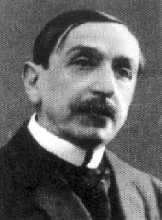
MAURICE BARRES
"It is not reason that gives us our moral orientation, it is sensitivity."
"The politician is an acrobat. He keeps his balance by saying the opposite of what he does."
Auguste-Maurice Barres was born at Charmes-sur-Moselle (Vosges) on August 19, September 1862. His father was a civil engineer and Professor. After completing his secondary studies at the Nancy lycée, Barrès went to Paris in 1883 to study law but instead turned to literature. He soon became a contributor to the monthly periodical, Jeune France, and later issued a periodical of his own, Les Taches d’encre, which survived for a few months only.
After four years of journalism he went to Italy, where he wrote Sous l'oeil des Barbares (1888), the first volume of a trilogie du moi, completed by Un Homme libre (1889), and Le Jardin de Bérénice (1891). In this trilogy Barrès advocates the supremacy of the individual self. It locates a source of moral energy in a sense of self that is at once disciplined and liberated, dividing the world into moi and the barbarians, the latter including all those antipathetic to the writer’s individuality. In it, Barreès also describes a searching period of self-analysis resulting in his entry into politics.
These apologies for individualism were supplemented by L’Ennemi des lois (1892), and an admirable volume of impressions of travel, Du sang, de la volupté et de la mort (1893).
His early books are written in an elaborate style and are often very obscure. His reputation as a literary artist rests on his graceful, lyrical prose and his powers of analysis and description. His play, Une Journde parlementaire, was produced at the Comédie Française in 1894. From September 1894 to March 1895 he was the director of a Boulangist paper at Nancy, la Cocarde, in which he tried to combine individualism with national solidarity.
The spiritual benefits of a living relationship with one's regional patrimony of family, native environment, and inherited tradition become the focus of attention in the trilogy Le Roman de l'énergie nationale (Les Déracinés, 1897; L'Appel au soldat, 1900; Leurs figures, 1902), which follows the fortunes of seven young men who leave Lorraine, Barrès' own province, to pursue their careers in Paris. The first narrates the adventures of the seven, who set out to conquer fortune. Six of them survive in the second novel of the trilogy, which gives the history of Boulangism; the sequel deals with the Panama scandals. The series is a plea for local patriotism, and for the preservation of the distinctive qualities of the old French provinces.
Later works are: Scènes et doctrines du nationalisme (1902); Les Amitids francaises (1903), in which he urges the inculcation of patriotism by the early study of national history; Ce que j’ai vu d~ Rennes (1904) and Le Voyage de Sparte (1906).
Finding that cultivation of the ego called for action as well as analysis, Barrès turned to a nationalism that grew into vengeful hatred of Germany, fanned by strong racist feeling and by love for his native Lorraine. Les Bastions de L'Est (Au service de l'Allemagne, 1905; Colette Baudoche, 1909; Le Génie du Rhin, 1921) explores the meeting of the French and German national characters in the eastern provinces of Alsace and Lorraine and the experiences of an Alsatian conscript in a German regiment. His rigid nationalism was linked with Catholicism in La Colline inspirée (The Sacred Hill 1913, tr. 1929), a symbolic story showing Catholicism as a bar to nationalism. It presents the conflict between the Roman Catholic Church and a religious community rooted in regional consciousness.
His reputation as a novelist rests largely upon his attempt to chronicle his times in the three didactic trilogies. In 1906 Maurice Barrès was admitted to the French Academy. He profoundly influenced such French writers as André Gide and André Malraux.
Barrès carried his theory of individualism into politics as an ardent partisan of General Boulanger. He strongly believed in the propaganda of the word and refused to bow to the need for an artist until he began to loose circulation as a result of not having an editorial artist. In the "Dreyfus affair", a violent partisanship dominating French life during the 1890s, Maurice Barrès was among the anti-Dreyfusards together with Édouard Drumont, Paul Déroulède and Charles Maurras. They all violently opposed to Dreyfus being freed. For Barrès the fate of an individual was of far less importance than the reputation and prestige of France's generals. In 1898 Barrès was among the founders of the ligue de la Patrie française.
As a writer Barrès critiqued modern urban civilization, which he depicted as a society of decadent, uprooted individuals cut off from their native soil and ancestral customs. His later work he was concerned chiefly with expounding his views on making France a strong nation. He early became active in politics as a committed nationalist-Boulangiste, anti-Dreyfusard, and militant of the Ligue de la patrie française, providing a good example of late nineteenth-century radical nationalism. In 1889, at the age of twenty-six he was elected deputy for Nancy to the Chamber of Deputies with the Boulangistes, retaining his seat in the legislature until 1893. In 1898, Barres ran again as a National Socialist in the city of Nancy, using the platform below. Although he lost, the platform illustrates how the nationalism of right-wing populist movements reconfigured political discourse with its xenophobia and antisemitism. Later, Barrès became deputy for Paris (1906-23).
When France entered the First World War as one nation, Barrès commented: "We have ceased dividing ourselves into Catholics, Protestants, Socialists and Jews. Suddenly something more basic has emerged, something all of us share: we are Frenchmen." In 1917 he wrote about the soldiers dying in the war: "Oh you young men whose value is so much greater than ours! They love life, but even were they dead, France will be rebuilt from their souls which are like living stones. The sublime sun of youth sinks into the sea and becomes the dawn which will hereafter rise again."
After World War I, Barrès remained a patriotic extremist. He died on December 4, 1923 in Neuilly sur Seine near Paris at the age of 61 years. His memoirs, Mes cahiers (14 vols, 1929-57), were published posthumously.
The Nancy Program
by Maurice Barres from France: Empire and Republic 1850-1940.
Electors,
The nationalist and social ideas which we brought to a joint triumph for the first time in 1889, had at that time alarmed certain minds because of the popularity of General Boulanger. Today, whether because they seem to be more matured, or whether circumstances now justify them more, they attract many adherents even among the antagonists of the previous campaign, disabused by a party which has done nothing since we left it with a free field.
The "Nationalist Socialist Republican Committee of Meurthe-et-Moselle" and a large number of independent electors have asked me to take up again the electoral battle.
To a policy having for its aim only animosities to satisfy, and for its driving force only lust for power, I come anew to oppose those national and social ideas which already you have acclaimed and which you will not today repudiate.
I. We Are Nationalists
In the top ranks of society, in the heart of the provinces, in the moral and in the material sphere, in commerce, industry, and agriculture, even in the shipyards where they are competing with French workers, foreigners are poisoning us like parasites.
One vital principle that should underlie the new French policy is to protect all its nationals against this invasion, and to beware of that brand of socialism that is so cosmopolitan, or rather so German, that it would weaken the country's defenses.
The Jewish problem is linked to the national problem. The Jews were assimilated to the native French by the Revolution, but have retained their peculiar characteristics and now, instead of being persecuted as they once were, are themselves the overlords. We believe in complete freedom of conscience; what is more, we should consider it highly dangerous to allow the Jews the chance of invoking (and so to appear to be defending) the principles of civil liberty promulgated by the Revolution. But they violate these principles by characteristically isolated behavior, by monopolies, speculation, and cosmopolitanism. There is, moreover, in the army, the magistracy, the ministries, in all branches of the administration, a far higher proportion of them than their numbers justify. They have been appointed prefects, judges, treasurers, officers-because they have money, which corrupts. We ought to destroy this dangerous disproportion, without even changing the law, by insisting on greater fairness on the part of those who govern, and so gain more consideration for our real nationals, the children of Gaul and not of Judea.
But the most urgent need is to make the process of naturalization more difficult. It is by this loophole that the worst Jews and many secondrate Frenchmen have slipped in.
Statistics show that 90 per cent of foreigners do not become naturalized until they have evaded active army service. We should insist that military service is a condition of nationality. What is more, a naturalized person (except those from AlsaceLorraine) should be allowed just private rights, while only his descendants should be assimilated to French-born citizens and enjoy political rights.
The opportunist policy over the last twenty years has favored Jews, foreigners, cosmopolitans. The reason given by those who committed this criminal mistake was that these aliens would introduce a vigorous element into France. Fine elements these-Reinach, Cornelius Herz, Alfred Dreyfus, and the like-who have almost brought us to decay! This is the real position: French society does need vigorous new elements, it is true, but they can be found within that society, by encouraging the least privileged, the poorest, by raising their standard of living and improving their vocational training.
So nationalism leads inevitably to socialism. We define socialism as "the material and moral improvement of the largest and poorest classes."
It has taken some centuries for the French nation to give political security to its members. It must now protect them against that economic insecurity that prevails at all levels.
Let us define this insecurity.
II. We Demand Protection against Economic Insecurity
Insecurity of the worker
The elderly worker has not enough to eat. Even if he is'able-bodied, he runs the risk of unemployment. Wages are kept low by foreign competition. Mechanization means that he is crowded into factories, subjected to military discipline under the arbitrary rule of the boss. In some districts he is reduced by certain economic organizations to real slavery. He cannot get out. For one thing, you do not take your native earth with you on the soles of your boots, and for many of them exile is heartbreak. Again, materially speaking, if he goes, he and his family will probably starve to death for will have no savings. Besides, where could he find work?
Insecurity of the small trader
The small trader has the same economic insecurity as the worker. They are interdependent. It is, in fact, the lower working class, black-coated and manual workers, who keep the small trader going, for the middle classes go to the big stores. The small trader helps the black-coated or manual worker to survive periods of unemployment by allowing credit. But the credit that the worker gets from the small trader -baker, butcher, grocer, or landlord-lays him open to ruin if unemployment is prolonged or too frequent. Another cause of insecurity is that prime costs for small industrialists and tradespeople fluctuate arbitrarily, at the bidding of speculators. We should note in passing that these traders and industrialists did not gain from the lowering of the bank rate. They still pay 8 per cent (6 per cent for three months with four renewals that cost 1/2 per cent, making 8 per cent in all). Without going so far as a State bank, which could be held to ransom in wartime, we should like to have seen commerce profit by the renewal of the charter of the Bank of France. But the Government and the financial feudality thought otherwise.
Insecurity of the farmer
The price of wheat no longer depends solely on the French harvest. At one time the producer used to get compensation for a poor harvest in the higher prices charged to the consumer. Nowadays these prices depend on the harvests of India and the United States. They have begun to remedy this situation by protection, which is basically a socialist measure, intervention by the State in the natural course of events. (just as the same circumstances are sweeping away parties, like a flood tide!) We are in full agreement with the major aspects of protection. It aims at guaranteeing a minimum price to the producer. But the big middlemen absorb the profits with their fluctuations and speculative maneuvers, which should be opposed with terrorist severity....
Insecurity of the bourgeoisie
The bourgeoisie is menaced by the international finance feudality, which turns financial securities into bits of paper. I will not go back as far as Panama-I could find ten examples in the last twelve months. Take this one. The price of gold mines launched on the French market was raised to the point where their total value reached about 1.8 billion francs. Today they are worth no more than 615 million. This means that in less than two years national savings worth 1.2 billion was lost on securities held by small French investors.No investigation followed.
Electors,
It is for the defense of the ideas that I have just explained that I propose for your approbation the following Program:
I. MEASURES TO BE TAKEN TO ENSURE THE UNION OF ALL FRENCHMEN against foreign produce: the work of protectionism must be maintained:
Against the foreign worker who, being dispensed from military service, draws every year a billion in wages from France and causes poverty and destitution, through unemployment, among the families of French workers. In particular public works, financed from taxes, must be carried out by national workers;
Against the international financial feudality which, through its joint-stock association, eliminates the worker from the country andreplaces him by undercutting with foreign workers, paralyzes the action of protective measures taken in support of agriculture and industry, organizes monopoly and speculation in the basic essentials, falsifies prices, sending them up and down, and in the end ruins the real producers of wealth-our farmers, our traders, our workers;
Against the naturalized foreigner, who claims to play a role in politics and to whom we would allow only private rights, reserving political rights for his descendants. This is the best way to get at the Jew, whose invasion of State functions the executive power would otherwise have to restrict.
II. INSTITUTION OF A SUPERANNUATION FUND for workers organized by the State. The duties which must be levied on foreign workers and the customs duties levied on basic essential goods must be specifically allotted to this superannuation fund in order to simplify somewhat these taxes where strictly no levy should be imposed. The matter of superannuation funds is one of the most important to settle for the sake of social peace. It is urgent. It forces itself upon us. But it is complicated by a grave financial problem which has to be solved. I shall give this all my attention and care. I declare myself in favor of the principle. I shall accept any solution likely to produce the quickest and most lasting results.
III. REFORM OF TAXATION TO PROMOTE DEMOCRATIC JUSTICE aiming at lowering taxes on consumer goods and charges which hit the small growers. The land tax is charged on an estimated income which often does not exist, on the basis of assessments which no longer correspond to reality. The tax on consumer goods is infinitely heavier on the poor than on the rich.
IV. ORGANIZATION OF AGRICULTURAL CREDIT, WHICH COULD INCLUDE THE FUNDS OF THE SAVINGS BANKS, today drained away from the whole province in order to BE CENTRALIZED and riskily used for the purchase of stocks.
V. FREEDOM OF ASSOCIATION. THIS IMPLIES EXTENSION OF THE CIVIL PERSONALITY OF THE TRADE UNIONS IN SUCH A WAY THAT WHETHER AGRICULTURAL OR INDUSTRIAL UNIONS, THEY CAN USE THE POWER OF CREDIT, BECOME ASSOCIATIONS OF PRODUCERS and own the premises and working tools needed in industrial, commercial, or agricultural production.
VI. EXTENSION OF THE INDEPENDENT FREEDOMS AND THE CIVIL PERSONALITY OF THE COMMUNES, so as to permit them to achieve in part certain kinds of social progress-always provided they do not infringe the rights of the State.
VII. DEVELOPMENT OF PUBLIC EDUCATION IN THE DIRECTION OF OCCUPATIONAL TRAINING in order to allow all national aptitudes, all forms of intelligence to be developed.
VIII. REVISION OF THE CONSTITUTION with the aim of giving universal suffrage its full and complete sovereignty, particularly by means of the municipal referendum.
Electors,
It is useful that, in this region of Lorraine, where day by day they become more numerous, the workers in factories and in the fields should be able to express their wishes; it would be dangerous to suppress them into silence, as the old opportunists wished to do.
This program of the "National Socialist Republican Committee"-what generous and just mind would wish to misunderstand it?-corresponds to the needs of our population; IT IS IN TUNE WITH THE SPECIAL SPIRIT OF OUR LORRAINE and of our frontier.
Articles IV, V, VI, VII, which concern decentralization, strongly indicate the direction of our demands in our region, where the "School of Nancy' matches public feeling.
In all our Articles, as anyone can see who examines them in the light of our preliminary arguments, the path of the future is prepared, and at the same time immediate interests are guaranteed. I undertake to defend them with every means at my disposal, at the same time as I place myself completely at the service of the special interests of my compatriots.