
(Tremarctos ornatus)
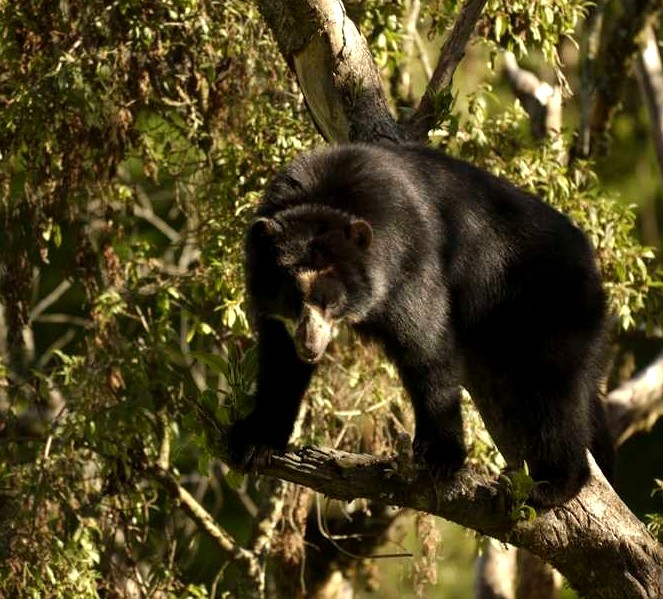
The Andean Bear is relatively thin, with a shorter nose than other bears, similar to that of a dog. This bear has a long, thick black coat, except around the muzzle, which is tawny or brown, often with white marks around the eyes that may extend to the throat.
Andean Bears are very timid. There has never been a report of a wild Spectacled Bear attacking a person. If they see you they will turn around and run or climb the nearest tree.
This bear species has a varied diet. It is the most vegetarian of the bear family but, given the opportunity, it can eat meat. In the forest they eat palmitos (hearts of palm), the soft insides of suro (Chusquea spp) (a kind of bamboo), the soft bases of huaycundos (Bromeliaceae), and various types of fruits, such as aguacatillo (Laurareae). In the paramo, they eat the soft bases of Puyas (Puya sp) and a berry-like fruit called mortino (Vaccinium sp). They will kill and eat wild animals, and there have been incidents of bears attacking cows and sheep in other parts of Ecuador.
The Andean Bear is relatively solitary. Male and female meet only to reproduce. Females begin to reproduce around four years of age. Gestation periods can vary between 5 and 8.5 months. Scientists believe the variation of the duration of pregnancy may be explained by a delayed implantation, that is to say, the fertilized egg remains in the uterus for a period of time before being implanted in the wall to continue development. It is also believed that the embryo can be reabsorbed by the mother's body, thereby preventing births. Females give birth to 1 or 2 cubs (rarely 3), probably in a previously prepared nest under enormous rocks or in the roots of trees. Cubs measure about 18 cm and they weigh from 300 to 500 g. They open their eyes around 42 days of age, and within three months of birth are able to follow their mother. In times of danger, or if they tire, they can ride on her. Mature males occasionally accompany the family group, but this is unusual. Cubs probably accompany the mother for 6 to 8 months.
Andean Bears are agile climbers, not only of trees but also of rock walls. They are also very good swimmers. They have a very sensitive sense of smell and hearing, but their vision is not very good. They emit a series of sounds in communication between mother and cubs, to show curiosity, and when they are threatened. They also make scratch marks on trees, tear off bark, and scratch their backs on certain types of trees. Any of these behaviors could also be a type of communication.
This bear species builds nests on the forest floor and in trees, a disorganized pile built with branches, leaves and unripe fruits. They make arboreal platforms of up to 6m long. These places can be used for considerable periods of time to rest, eat, or guard a feeding place. The males are bigger than the females; they can measure more than 2m and weigh as much as 195 Kg. They can live up to 35 years in captivity.
When the Andean Bear feeds on fruits, they disrupt the branches and clear the canopy, which presumably allows the bear to modify the microclimatic conditions of the lower strata, stimulating the natural regeneration of the forest. It also intervenes by dispersing the seeds of the fruits it eats, allowing the continuous recovery of the forest.
The destruction of the habitat by human intervention and the high number of bears killed has created small isolated populations. These circumstances have caused the species to be included in Appendix I of CITES and considered endangered by the Red Book of Mammals of Ecuador.