


|
|
|
Reinventing the Wheel
A new look at the maintenance work management process
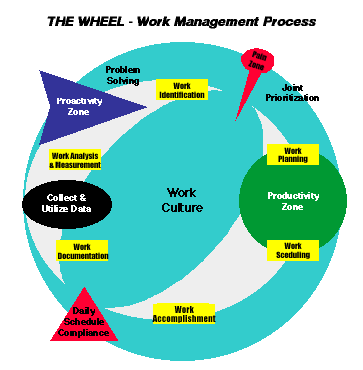
The wheel is the story of work management, not maintenance. Many departments work together to create reliability; the maintenance department is just one of them. Production, engineering, materials, and administration departments are all vital members of the work management team. The wheel needs to be reinvented to help the team understand its role in the process and the goal of the process as a whole. The pain zone The ability to declare an emergency is a big hammer for the production department. The problem with having a big hammer is that everything starts to look like a nail. Emergencies are declared for pet equipment, for spare equipment, or just to make production feel safe. A big red nail on the wheel signifies the pain zone. In terms of human reliability, the pain zone hurts for two reasons. First, the schedule is interrupted. Second, the production department makes this decision alone. When the production department is forced to decide by itself that work needs to be done, the advantage of joint prioritization is lost Decisions are not made in the best interest of the whole plant. Joint prioritization In the work identification step, an initial priority identifies the urgency of the work. The value of the priority code is to separate emergencies from nonemergencies. Though a priority code can help organize work in the backlog, it does not determine the actual order in which nonemergency work will be performed. Once work passes through the pain zone and into the backlog, the process of joint prioritization begins, and it does not end until the work is accomplished. Prioritization takes into account the impact the job has on output and the availability of labor, materials, and equipment to do the job. Joint prioritization means that departments make decisions together. Production, maintenance, and engineering departments should meet weekly to decide the order in which jobs will be done. Decisions should be documented in published schedules. Then, schedules should be kept by tagging out equipment on time, completing a design for a scheduled job on time, or starting jobs on time and doing them well so they do not require rework. Joint prioritization goes all the way through the work accomplishment step because the real importance of a particular job is determined by when the job actually gets done. Productivity zone Productivity means that:
Productivity is the result of good planning and scheduling. The planning half of the productivity zone anticipates common obstacles to work accomplishment. Key activities include job scoping and assuring parts availability. The scheduling half of the productivity zone smoothly combines prioritized jobs and resources such as crafts, extra shifts, permits, and access to production equipment. Key activities include labor availability forecasting and long-range and daily scheduling. The best way to define productivity is doing exactly the right work in
exactly the right way at exactly the right time:
Productivity is often associated with the work accomplishment step, where the job is actually done. But the amount of productivity gained in that step is small compared to planning and scheduling. Some time is lost due to late starts, early quits, poor training, or incompetence. But most lost time is due to job obstacles such as missing parts or unavailable production equipment. Daily schedule compliance Daily schedule compliance, the most important measure in work management, is the percent of actual labor hours devoted to scheduled work. Complying with the daily schedule is the payoff for being good at all the steps on the wheel. If the steps are done well, daily schedule compliance must improve. Plus, if daily schedule compliance improves, then exactly the right work is being done in exactly the right way at exactly the right time, and that generates productivity, reliability, and dollars for the bottom line. Collect and use data Climbing out of the black hole requires using data to measure performance and analyze root cause, showing the results to crafts and foremen, or making sure relevant history prints out on the next work order. When data is visibly and productively used, crafts will provide it willingly. Proactivity zone Proactive programs such as preventive and predictive maintenance,
condition-based maintenance, reliability-centered maintenance, and total
productive maintenance help identify work early and perform work just in time.
The results of being proactive are:
The proactivity zone is about avoidance rather than repair. In the proactivity zone, the cycle of emergencies is broken. In its place is a cycle of failure prevention. Proactive maintenance skips the pain zone, starts prioritizing jointly, and taps the power of the productivity zone. Problem solving The second crescent is a reminder that the wheel needs the lubrication of problem solving to turn fast and smoothly. It also says that problem solving makes the wheel solid. If problems are not solved, the wheel disintegrates. Each step of the wheel is connected with the next. Each zone is dependent on all the others. The entire work management process must be strong at every step and in every zone to achieve lowest cost reliability. Work culture Culture is people. It is the person making the decision and the people taken into consideration as the decision is made. People make decisions for technical reasons (the process) and for personal reasons (the culture). Process and culture are equally strong. If they are not aligned, they pull people in different directions. People want to do the right thing, but are confronted with limitations. Do not force them to decide between process and culture--the company will always lose. When process and culture are not aligned, people are:
Each of these interferes with work management. The static and noise of culture starts to obscure the process picture. Eventually the interference becomes so strong that the process is barely visible. Technical reasons for decisions are lost and decisions are made for personal reasons. That is not good for work management, for management credibility, or for the business as a whole because this same culture affects all the processes in the business. If the work management process is done well, lower cost reliability can be achieved, but only by aligning process and culture. |


 The goal of
work management is lowest cost reliability, which has two parts: equipment
reliability and human reliability. Equipment reliability is the final
result--where the bottom line is improved by increased production output and
lower operating and maintenance costs. Human reliability is the set of
activities that leads to those results. Success is measured in terms of
equipment reliability, but it is human reliability that is actually managed.
The goal of
work management is lowest cost reliability, which has two parts: equipment
reliability and human reliability. Equipment reliability is the final
result--where the bottom line is improved by increased production output and
lower operating and maintenance costs. Human reliability is the set of
activities that leads to those results. Success is measured in terms of
equipment reliability, but it is human reliability that is actually managed.