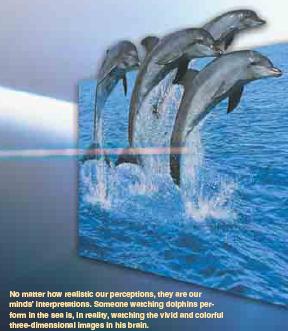
Everything we see, touch, hear, and perceive as matter—"the world" and"the universe"—is nothing but electrical signals occurring in our brain.
Matrix
the virtual reality
Many of the movies that have hit the big screen over the last few years share a common subject as part of their storyline. These films question reality or the real world, as we know it—pointing out that artificially created dream worlds or worlds produced by simulations can actually be quite realistic. Movies, sequels and TV series like
The Matrix, The Matrix Reloaded, The Thirteenth Floor, Harsh Realm, Vanilla Sky, Total Recall, The Truman Show, Strange Days, Dark City, Open Your Eyes, The Frequency, Existenz, and The One all examine the theme of just how seriously wrong we might be about what is reality and what is imagination. These films also deal with suggestions, thus far represented only as food for thought at scientific gatherings, of how these questions could affect our lives. In The Matrix, for instance, the following dialogue takes place: What is real? How do you define "real"? If you're talking about your senses—what you feel, taste, smell, or see—then all you're talking about are electrical signals interpreted by your brain. Doubtless one of the foremost reasons why these films, based on scientific explanations, captivate the attention of millions is the fact that people now question the reliability of the external world's assumptions and preconditions.Everything we see, touch, hear, and perceive as matter—"the world" and"the universe"—is nothing but electrical signals occurring in our brain.


Matter: The Other Name for Illusion, p.203)God shows the images He creates as linked to particular causes and effects. When an apple drops off a tree, for instance, it always falls to earth. It never goes upwards or remains suspended in the air. The study of these effects and the laws that God has created form fields of study in science.(

But
Matter: The OtherName for Illusion, p.204)God possesses the power to create effects without any causes. One proof of this is the way we can feel the heat of the Sun in a dream at night,even though the Sun is not actually shining down on us. (