9.3 Benefits of Further Education Courses


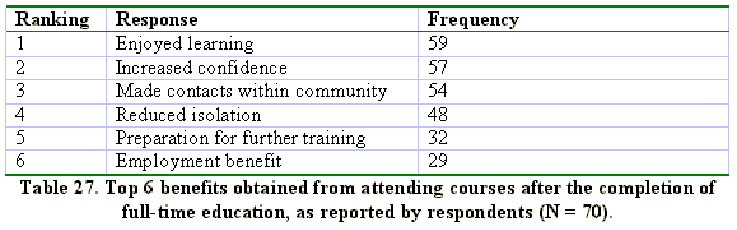
Asked to indicate which, if any, benefits that had been obtained from the educational courses attended since leaving school, the top rated choice was "Enjoyed learning" (chosen 59 times) followed by "Increased confidence" (chosen 57 times) and "Made contacts within the community" (chosen 54 times).  Four women felt they had gained no benefit from the courses they attended.  Barely making it to number 6 on the table was "Employment benefit" (chosen 29 times), a somewhat disappointing result in terms of any possible impact on levels of poverty.  That is not to say that enjoyment, increased confidence and community contacts are not important - it has to be acknowledged that they are vital, especially for women returning to work after a long period out of employment (see also Section 11.2).  However, since economic matters frequently dictate the side of the poverty line one occupies, a more focused approach to education and training might be more appropriate.  The aspect of career pathways and guidance is discussed further in Chapter 12 (specifically, 12.5 & 12.6).


9.4 Barriers to Attending Classes or Training Courses


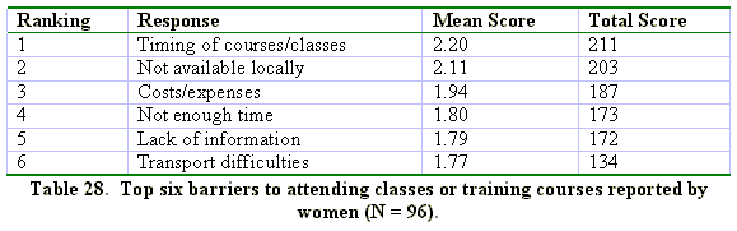
Top of the list of barriers for women in relation to attending classes or training courses (Question 40) was the issue of timing (see Table 28); women, because of their various commitments in terms of childcare, school runs and household duties, find this aspect of furthering their education a particular problem.  For some, a morning course is ideal if the children are at school, for others with pre-schoolers, an evening  course (assuming that a husband/partner/family member is available to baby-sit) is better. 

If transport is required, and it invariably is, the lack of suitable buses to make the outgoing and the return journey at the appropriate time is another headache.  If there is a family car, does the husband/partner need to get to work first?  Perhaps she is working herself, adding another barrier into the equation.  It is not surprising that "Not available locally" was number two on the list - if a woman is juggling any or all of these things in a limited amount of time, spending much of that time travelling to is not an option.  "Costs and expenses", at number 3 on the list can mean the difference between the possible and the impractical - if money is already short, and job prospects at the end of the course are uncertain (at best), the risk may not appear to be worth the effort.  The vicious circle of the poverty trap wins again! 


9.5 Women have their say: On education and training


Single mother:
"Because I didn't do my leaving, it holds me back from jobs and training"

Elderly woman:
"I didn't have the choice [to do any courses since leaving school]"

Married woman, aged 31-40:
"Courses are great but they are very basic - I would love to do them again and again"

Mother of three:
"[I feel] guilty taking time out for myself [to do courses] on top of my full time job"

Young, single woman:
"I feel too young" (offered as a barrier to attending further education classes)


arrow41_N.gif

Hosted by www.Geocities.ws

1