
Background
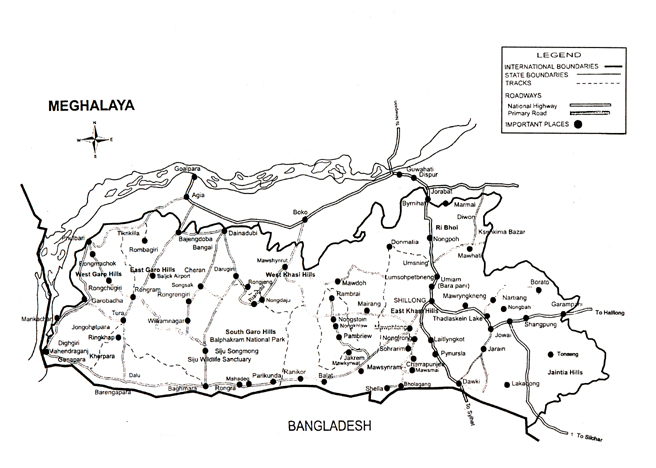
‘The abode of clouds’; Meghalaya
attained the status of an autonomous Unit of Assam on April 2nd, 1970, to attain statehood of Indian Union on January 21st, 1972. With the majority of the population primarily depending on agriculture for their livelihood, the scope of potential agricultural expansion is actually very limited. The inhabitants of the state primarily practice jhumming or shifting mode of cultivation, which again in turn poses a major challenge for the government of the state, whohave been keenly interested in propagating the modern scientific mode of agriculture.
Though this deep rooted traditional agriculture practice of the indigenous people is hard to do away with, yet the state government has made a humble beginning by introducing schemes to help the farmers to settle on cultivate lands for scientific cultivation and efforts are yielding tangible results now.
A number of hilly rivers and rivulets drain the hilly terrain of Meghalaya, which in turn generate sufficient power (electricity) for the state .It is to be borne in mind that the state witnesses the highest rainfall in the world, withits annual rainfall being around 1000 to 1270cms.The high rainfall has also enriched the state in its forest resources.
However with almost zero level of industrialization and almost no development in the infrastructure level, the state is still stagnating as far as the economic development is concerned. Complying with the post colonial structure of the rest of India, the population of the state is predominantly rural with the very basic amenities of life being away beyond reach of the common mass.
It is however unfortunate that while the rest of the country
is developing more rapidly than ever; Meghalaya with the other North Eastern
States is still stagnant in its socio- economic quagmire.
It is well accepted a fact that to respond to the call of the hour, the
state needs to indulge into more income generating activities, to build up
proper infrastructure for large scale industrialization. To say in other
words to leave no stones unturned to upgrade its socio –economic life.
It is in this context that Non- Government Organizations
have an important role to play. Fortunately for the state, the state
government has now realized the importance of these Organizations and is
encouraging the activities of the same.
In earlier times, before the influx of the modern lifestyle, handicrafts in
Meghalaya were the principal industries of the state catering to various
needs of the people from agriculture to households. Today, most of the
surviving crafts are still in contention either of the lack of better
replacements or competition or the general consciousness for using these
traditional products. Though this may present an assured picture of crafts
in the state, most of these surviving crafts are facing an uncertain future,
which can be attributed to various factors interwoven in the social,
economic and political fabric of the state.
• Lure of modernity – encouraging people engaged in crafts
to migrate to more lucrative activities
• Lack of technological intervention and knowledge – can be attributed to
conflict between modern and traditional
motivation
• Loss of cooperation among craftpersons – sharing of ideas, economic
differences
• Lack of appropriate support from development agencies
Looking at these problems from an objective viewpoint presents a vast area
of opportunities and possibilities that could be implemented so as to enable
the revitalization of crafts as lucrative economic activities. The setting
up of CFCs is evidence of the move towards this revival, a gateway to the
future.

 Back
Back 