 |
|
|
|
|
|
|
|
|
|
|||||||
|
|
|
|
|
|
|
 |
||||||
 |
||||||
|
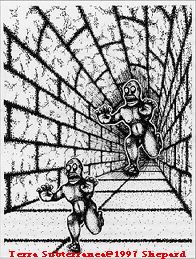
This scene depicts a larger man chasing a smaller man. Or does it?
The two men are absolutely identical. What you see is not always what you perceive. So What's Going On? This illustration by Stanford psychologist Roger Shepard suggests a three-dimensional scene with proper depth relationships. Consistent with this, the man in the background appears to be further away from you than the person in the foreground. What is not consistent, however, is that the background figure is not proportionally smaller to its identical counterpart in the foreground. When a figure normally recedes into the distance, it gets smaller, i.e., its visual angle gets smaller. Here, the background figure remains the same size (and same visual angle) as the foreground figure. Your visual system assumes that since both figures have the same visual angle, but are at differing distances, the one in the background must be larger. This demonstrates that what you see is not necessarily what you perceive. Your visual system is constantly making inferences based on constraints derived from the regularities of your visual environment. You can discover some of those normally hidden rules by playing with this demonstration. For example, if you move the background figure to the same elevation or height as the foreground figure, the size illusion disappears. This is because, on a level surface, as objects recede into the distance, not only does their visual angle get smaller, but they also rise in the visual field in relation to the horizon. |
||||||
 |
||||||
|
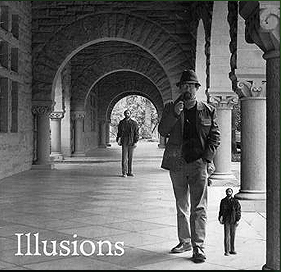
This illustration depicts two people on a level surface at differing distances.
The man in the background, although smaller, looks perfectly normal when
compared to the man in the foreground.
In the lower right, you will see that the man in the background has been brought to the same elevation as the man in the foreground. Now you have another size illusion. This illustration is the opposite of the previous Shepard illustration. In the Shepard illustration, the foreground figure (normally with a larger visual angle) is placed in the background. This causes the background figure to appear larger in comparison with the foreground figure. In this illustration, the background figure (with the normally smaller visual angle) is moved to the foreground. Another variable that needs to be considered is whether the object is perceived as resting on a ground or "floating" off the ground. This variable does affect how you perceive the size illusion. Moving the figure off the ground drastically changes your perception of the scene. An object or figure that is floating off the ground is qualitatively different from an object that is resting on a surface. The perspective background is also extremely important, as it is what suggests a scene in depth. If you remove the perspective background, the scene is perceived as flat, and you no longer perceive the size illusion, or if you do it is very weak. Changing the figure's "height" without perspective becomes meaningless, and so the size illusion will not work. (Your visual system can, however, infer a horizon, and so you can still get an effect. See the floating boxes illusion. This demonstrates that
your visual system exploits many regularities from the environment when
it determines size and distance relationships.
|
||||||