Copyright 1998-2001 István Orosz
|
|
|
| Home Page | Anamorphic art involves distorting an image on a flat plane so that its reflection on a curved surface (many different types of curved surfaces have been used) reveals the undistorted image. Anamorphic images do not necessarily have to be revealed on mirrors as in the example below. The distorted image is usually hard to discern. |
| Anamorphic art has been around since the time of Leonardo Da Vinci and was quite popular during the 17th and 18th centuries. It has been traditionally used to hide secret images or political messages in artistic works. | |
| Hungarian artist Istvan Orosz is a master at creating a new form of anamorphic art, which utilizes ambiguous images. In other words, he is using one illusion to create another illusion, which produces a rather spectacular result. | |
|
You can also click here to explore more of Orosz' art and learn more about the artist. |
|
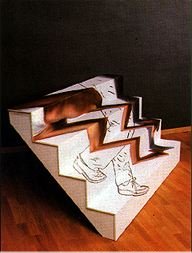
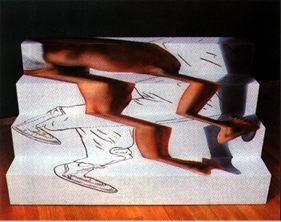
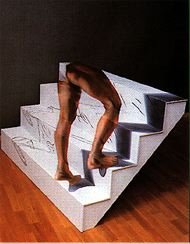
Here, in "Step" (1992) Orosz used a real three-dimensional set of stairs, which can be seen from three separate angles. There are two sets of anamorphic images here. In the first image you can see a black and white drawing of legs walking down the stairs, and in the last image you can see a color painting of legs walking up the stairs.
|
Copyright 1998-2001 István Orosz |
|
Copyright 1998-2001 István Orosz |
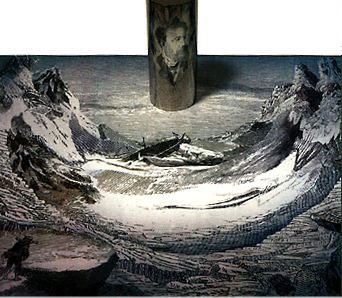
In "Jules Verne Anamorphosis" (1983), Orosz uses ambiguous imagery to create a new portrait in the reflected surface. The left example contains a scene from Jules Verne's Mysterious Island, which Orosz created in the 19th century line illustration style. When the mirror is placed correctly on the image a portrait of Jules Verne is revealed! |
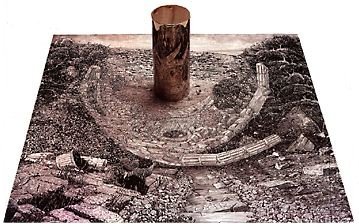
Copyright 1998-2001 István Orosz |
In this example, a Greek amphitheater reveals a minotaur in the mirror. |
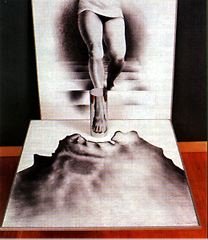
Copyright 1998-2001 István Orosz |
The foot is only revealed with a cylindrical mirror. |