
TAKE PART: London's Programme of Events for The 94th Anniversary
of The
Armenian Genocide
1915-2009 - Click Here! NEW PETITION: Online petition - Recognise The Armenian Genocide of 1915 - Click Here! What
is the Armenian Genocide? Who was
responsible for the Armenian Genocide? Armenian related useful links: Please mention www.iNFODUDE.net/ArmenianGenocide as your referer.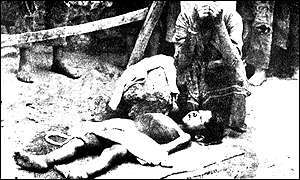 Click to enlarge >
The atrocities committed against the Armenian people of the
Ottoman Empire during W.W.I are called the Armenian Genocide. Genocide is the
organized killing of a people for the express purpose of putting an end to their
collective existence. Because of its scope, genocide requires central planning
and a machinery to implement it. This makes genocide the quintessential state
crime as only a government has the resources to carry out such a scheme of
destruction. The Armenian Genocide was centrally planned and administered by the
Turkish government against the entire Armenian population of the Ottoman Empire.
It was carried out during W.W.I between the years 1915 and 1918. The Armenian
people was subjected to deportation, expropriation, abduction, torture,
massacre, and starvation. The great bulk of the Armenian population was forcibly
removed from Armenia and Anatolia to Syria, where the vast majority was sent
into the desert to die of thirst and hunger. Large numbers of Armenians were
methodically massacred throughout the Ottoman Empire. Women and children were
abducted and horribly abused. The entire wealth of the Armenian people was
expropriated. After only a little more than a year of calm at the end of W.W.I,
the atrocities were renewed between 1920 and 1923, and the remaining Armenians
were subjected to further massacres and expulsions. In 1915, thirty-three years
before UN Genocide Convention was adopted, the Armenian Genocide was condemned
by the international community as a crime against humanity.
The decision to carry out a genocide against the Armenian people was made by the
political party in power in the Ottoman Empire. This was the Committee of Union
and Progress (CUP) (or Ittihad ve Terakki Jemiyeti), popularly known as
the Young Turks. Three figures from the CUP controlled the government; Mehmet
Talaat, Minister of the Interior in 1915 and Grand Vizier (Prime Minister) in
1917; Ismail Enver, Minister of War; Ahmed Jemal, Minister of the Marine and
Military Governor of Syria. This Young Turk triumvirate relied on other members
of the CUP appointed to high government posts and assigned to military commands
to carry out the Armenian Genocide. In addition to the Ministry of War and the
Ministry of the Interior, the Young Turks also relied on a newly-created secret
outfit which they manned with convicts and irregular troops, called the Special
Organization (Teshkilati Mahsusa). Its primary function was the carrying
out of the mass slaughter of the deported Armenians. In charge of the Special
Organization was Behaeddin Shakir, a medical doctor. Moreover, ideologists such
as Zia Gokalp propagandized through the media on behalf of the CUP by promoting
Pan-Turanism, the creation of a new empire stretching from Anatolia into Central
Asia whose population would be exclusively Turkic. These concepts justified and
popularized the secret CUP plans to liquidate the Armenians of the Ottoman
Empire. The Young Turk conspirators, other leading figures of the wartime
Ottoman government, members of the CUP Central Committee, and many provincial
administrators responsible for atrocities against the Armenians were indicted
for their crimes at the end of the war. The main culprits evaded justice by
fleeing the country. Even so, they were tried in absentia and found guilty of
capital crimes. The massacres, expulsions, and further mistreatment of the
Armenians between 1920 and 1923 were carried by the Turkish Nationalists, who
represented a new political movement opposed to the Young Turks, but who shared
a common ideology of ethnic exclusivity.
How many people died in the Armenian Genocide?
It is estimated that one and a half million Armenians perished between 1915 and
1923. There were an estimated two million Armenians living in the Ottoman Empire
on the eve of W.W.I. Well over a million were deported in 1915. Hundreds of
thousands were butchered outright. Many others died of starvation, exhaustion,
and epidemics which ravaged the concentration camps. Among the Armenians living
along the periphery of the Ottoman Empire many at first escaped the fate of
their countrymen in the central provinces of Turkey. Tens of thousands in the
east fled to the Russian border to lead a precarious existence as refugees. The
majority of the Armenians in Constantinople, the capital city, were spared
deportation. In 1918, however, the Young Turk regime took the war into the
Caucasus, where approximately 1,800,000 Armenians lived under Russian dominion.
Ottoman forces advancing through East Armenia and Azerbaijan here too engaged in
systematic massacres. The expulsions and massacres carried by the Nationalist
Turks between 1920 and 1922 added tens of thousands of more victims. By 1923 the
entire landmass of Asia Minor and historic West Armenia had been expunged of its
Armenian population. The destruction of the Armenian communities in this part of
the world was total.
Were there witnesses
to the Armenian Genocide?
There were many witnesses to the Armenian Genocide. Although the Young Turk
government took precautions and imposed restrictions on reporting and
photographing, there were lots of foreigners in the Ottoman Empire who witnessed
the deportations. Foremost among them were U.S. diplomatic representatives and
American missionaries. They were first to send news to the outside world about
the unfolding genocide. Some of their reports made headline news in the American
and Western media. Also reporting on the atrocities committed against the
Armenians were many German eyewitnesses. The Germans were allies of the Turks in
W.W.I. Numerous German officers held important military assignments in the
Ottoman Empire. Some among them condoned the Young Turk policy. Others
confidentially reported to their superiors in Germany about the slaughter of the
Armenian civilian population. Many Russians saw for themselves the devastation
wreaked upon the Armenian communities when the Russian Army occupied parts of
Anatolia. Many Arabs in Syria where most of the deportees were sent saw for
themselves the appalling condition to which the Armenian survivors had been
reduced. Lastly, many Turkish officials were witnesses as participants in the
Armenian Genocide. A number of them gave testimony under oath during the
post-war tribunals convened to try the Young Turk conspirators who organized the
Armenian Genocide.
What was the response of the
international community to the Armenian Genocide?
The international community condemned the Armenian Genocide. In May 1915, Great
Britain, France, and Russia advised the Young Turk leaders that they would be
held personally responsible for this crime against humanity. There was a strong
public outcry in the United States against the mistreatment of the Armenians. At
the end of the war, the Allied victors demanded that the Ottoman government
prosecute the Young Turks accused of wartime crimes. Relief efforts were also
mounted to save "the starving Armenians." The American, British, and German
governments sponsored the preparation of reports on the atrocities and numerous
accounts were published. On the other hand, despite the moral outrage of the
international community, no strong actions were taken against the Ottoman Empire
either to sanction its brutal policies or to salvage the Armenian people from
the grip of extermination. Moreover, no steps were taken to require the postwar
Turkish governments to make restitution to the Armenian people for their immense
material and human losses.
Why is the Armenian Genocide
commemorated on April 24?
On the night of April 24, 1915, the Turkish government placed under arrest over
200 Armenian community leaders in Constantinople. Hundreds more were apprehended
soon after. They were all sent to prison in the interior of Anatolia, where most
were summarily executed. The Young Turk regime had long been planning the
Armenian Genocide and reports of atrocities being committed against the
Armenians in the eastern war zones had been filtering in during the first months
of 1915. The Ministry of War had already acted on the government's plan by
disarming the Armenian recruits in the Ottoman Army, reducing them to labour
battalions and working them under conditions equalling slavery. The
incapacitation and methodic reduction of the Armenian male population, as well
as the summary arrest and execution of the Armenian leadership marked the
earliest stages of the Armenian Genocide. These acts were committed under the
cover of a news blackout on account of the war and the government proceeded to
implement its plans to liquidate the Armenian population with secrecy.
Therefore, the Young Turks regime's true intentions went undetected until the
arrests of April 24. As the persons seized that night included the most
prominent public figures of the Armenian community in the capital city of the
Ottoman Empire, everyone was alerted about the dimensions of the policies being
entertained and implemented by the Turkish government. Their death presaged the
murder of an ancient civilization. April 24 is, therefore, commemorated as the
date of the unfolding of the Armenian Genocide.
Are the Armenian massacres
acknowledged today as a Genocide according to the United Nations Genocide
Convention?
The United Nations Convention on the Prevention and Punishment of the Crime of
Genocide describes genocide as "acts committed with intent to destroy, in whole
or in part, a national, ethnical, racial or religious group." Clearly this
definition applies in the case of the atrocities committed against the
Armenians. Because the U.N. Convention was adopted in 1948, thirty years after
the Armenian Genocide, Armenians worldwide have sought from their respective
governments formal acknowledgment of the crimes committed during W.W.I.
Countries like France, Argentina, Greece, and Russia, where the survivors of the
Armenian Genocide and their descendants live, have officially recognized the
Armenian Genocide. However, as a matter of policy, the present-day Republic of
Turkey adamantly denies that a genocide was committed against the Armenians
during W.W.I. Moreover, Turkey dismisses the evidence about the atrocities as
mere allegations and regularly obstructs efforts for acknowledgment. Affirming
the truth about the Armenian Genocide, therefore, has become an issue of
international significance. The recurrence of genocide in the twentieth century
has made the reaffirmation of the historic acknowledgment of the criminal
mistreatment of the Armenians by Turkey all the more a compelling obligation for
the international community.
Disclaimer: www.iNFODUDE.net/ArmenianGenocide is not responsible for the content of the above external internet websites.
NEW PETITION: Online petition - Recognise The Armenian Genocide of 1915 - Click Here! www.iNFODUDE.net/ArmenianGenocide was last updated on: Monday, 7th September 2009. Educational institutions can print and/or copy this page, however, prior to doing so, please notify us by e-mailing! Thank you!
More links will be added soon. Please put
www.iNFODUDE.net/ArmenianGenocide on
your Favourites list.
Please get in touch with us, you can e-mail us:[email protected] . Thank you.
Copyright © 2000-2009 www.iNFODUDE.net All rights reserved.