Chapter 5 : Identifying & Selecting Systems Development Projects

Objectives
  1. Describe the project identification and selection process.
  2. Describe the corporate strategic planning and information systems planning process.
  3. Explain the relationship between corporate strategic planning and information systems planning.
  4. Describe how information system planning can be used to assist identifying and selecting system development projects.
  5. Analyze information system planning matrices to determine affinity between information systems and IS projects and to forecast the impact of IS projects on business objectives.
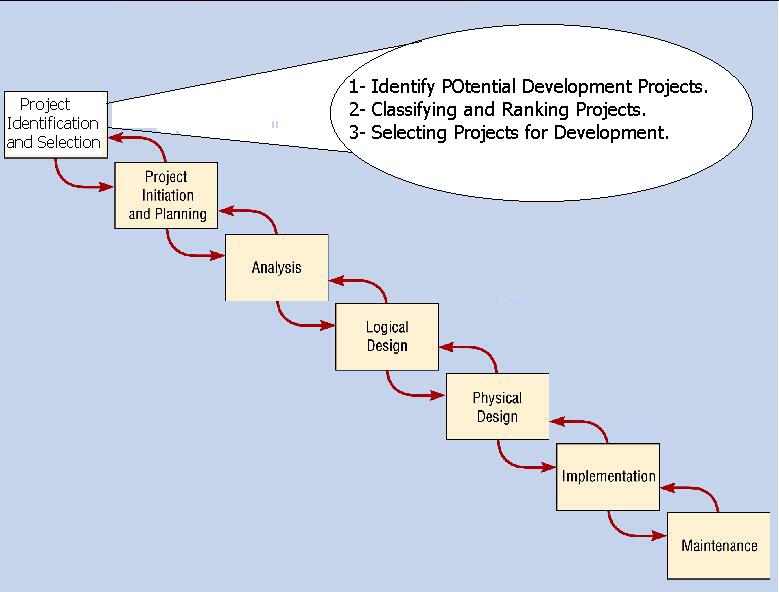
The purpose of this chapter is to introduce the first phase of the systems development life cycle-identifying and selecting systems development projects. The chapter takes the position that organizations can benefit from following a formal process for identifying and selecting projects. To do this, the chapter first overviews the corporate strategic planning process and then links this process to information systems planning. Both are presented as a three-step process. For information systems planning, the first step is described as a process in which a senior manager, a business group, an IS manager, or a steering committee identify all possible systems development projects that an organization unit could undertake. Next, projects are classified and ranked according to some criteria that are important to the organization. Finally, those projects deemed most likely to yield significant organizational benefits, given available resources, are selected for subsequent development activities.

  1. Introduction.

  2. Identifying and Selecting Systems Development Projects.
  3. Corporate and Information System Planning.


Introduction.
  • The scope of information systems today is the whole enterprise. Managers, knowledge workers, and all other organizational members expect to easily access and retrieve information, regardless of its location.
  • Non-intgrated systems used in the past (islands of information) are being replaced with cooperative, intgrated enterprise systems that can easily support information sharing.
  • The clear direction for information systems development is building bridges between these islands.
  • Obtaining integrated entrprise-wide computing presents significant challenges for both corprate and information system management.

Example: Students Affairs, Educational Affairs, Library, Research Affair,...
Projects of 4th year, how to benefit our faculty ? Case Study.


Return

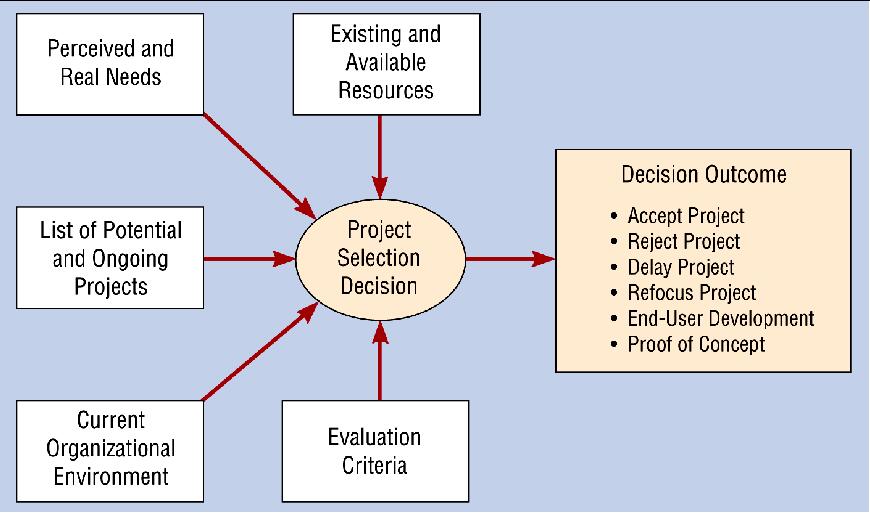
Identifying and Selecting Systems Development Projects.
Committee to identify and assess all possible systems development projects that an organization unit could undertake. this committee may be consists of:
  1. Senior manager.
  2. Business group.
  3. IS manager.
After identification, they should know: buy a ready-made (on-shelf), or build from scratch. (depending in many factors-- always, it depends.)
The Process of Identifying and Selecting IS Development Projects.


Identification and Selection consists of :
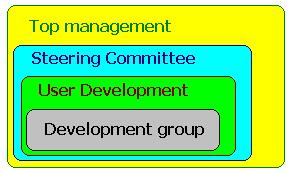
  • Identifying potential development projects (have a strategic organizational focus) - can be performed by :
    • A key member of top management.
    • A steering committee, composed of a cross section of managers with an interest in systems.
    • User departments.
    • The development group or a senior IS manager.
      Characteristics of alternative Methods for Making IS Identification and Selection Decisions
      Selection Method Characteristics
      Top ManagementGreater Strategic Focus, Largest project Size, Longest Project Duration
      Steering Committee Cross-Function Focus, Greater Organizational Change, Formal Cost-Benefit Analysis, Larger & Riskier Project
      User Department Narrow, non-strategic Focus, Faster Development, Fewer users, Management Layers, and Business Functions
      Development Group Integration with existing systems focus, Fewer Development Delays, Less Concern on Cost-Benefit Analysis
  • Classifying and ranking IS Development Projects. focuses on assessing the relative merit of potential projects. Value chain analysis: Analyzing and organization's activities to determine where value is added to products and/or services and the costs incurred for doing so; usually also includes a comparison with activities, addedvalue, and costs of other organizations for the purpose of making improvements in the organization's operations and performance.
    Possible Evaluation Criteria When Classifying & Ranking Projects
    Evaluation Criteria Description
    Value Chain Analysis Extent to which activities add value and costs when developing products and/or services
    Strategic Alignment Extent to which the project is viewed as helping the organization activities and long-term goals
    Potential Benifits Extent to which the project is viewed as improving profits, customer service, ... etc., and the duration of these benefits
    Resource Availability Amount and type of resources the project requires and their availability
    Project Size/Duration Number of individuals and the length of time needed to complete the project
    Technical Difficulty/Risks Level of technical difficulty to successfully complete the project within given time and resource constraints

    Organization Value Chain
  • Selecting projects for development.
    It is the process of considering both hort- and long-term project and selecting the most likely to acheive business objectives, In Arabic : ��� ���� ���� ....�


Deliverables and Outcomes.

The primary deliverable from the first SDLC phase is a schedule of specific IS development projects, coming from both top-down and bottom-up sources, to move into the next SDLC phase: Project initiation and Planning:


Incremental Commitment: A strategy in system analysis and design in which the project is reviewed after each phase and continuation of the project is rejustified in each of these reviews.

Many Organiztions have found in order to make good project selection decisions and provide sound guidance as issue arise in your work as a systems analyston a project, a clear understanding of overall organizational business strategy and objectives is required. This means that a clear understanding of the business and the desired role of information systems in acheiving organizational goals is a precondition to improving the identification and selection process.

Return

Corporate and Information System Planning. Although there are numerous motivations for carefully planning the identification and selection of projects, organizations have not traditionaly used systematic planning process when determining how to allocate IS resources. Instead, projects have often resulted from attempts to solve isolated organizational problems. In effect, organizations have asked the question: What procedure (application program) is required to solve this particular problem as it exists today ? The difficulty with this approach is that the required organizational procedures are likely to change over time as the environment changes.

The need for improved information systems projects identification and selection is readily apparent when we consider factors such as :
  1. The cost of information systems has risen steadily and approaches 40 percent of total expenses in some organizations.
  2. Many systems cannot handle applications that cross organizational boundaries.
  3. Many systems often do not address the critical problems of the business as a whole nor support strategic applications.
  4. Data redundency is often out of control and users may have little confidence in quality of data.
  5. Systems maintenance costs are out of control as old, poorly planned systems must constantly be revised.
  6. Application backlogs often extend three years or more and frustrated end users are forced to create (purchase) their own systems, often creating redundant databases and incompatible systems in the process.


Corporate Strategic Planning.
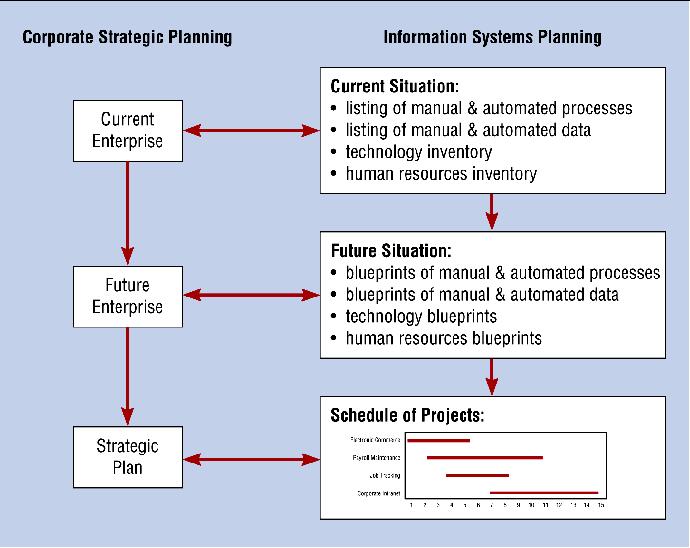
A prerequisit to making effective project selection decisions is to gain a clear idea of where an organization is, its vision of wher it wants to be in future, and how to make the transition to its desired future state. Corporate strategic planning is a three-step process:

-->Current Enterprise-->Future Enterprise-->Strategic Plan.

Corporate Strategic Planning : An ongoing process that defines the mission, objectives, and strategies of the organization.

Mission Statement : A statement that makes it clear what business a company is in.

Objective Statement : A series of statements that express an organization's qualitativeand quantitive goals for reaching a desired future position.

Competitive Strategy : The method by which an organization attempts to acheive its mission and objectives.


To make the long story short, we say: To build the most effective information systems, it is only through the clear understanding of organizational mission, objectives, and strategies that IS development projects should be identified and selected.


Information System Planning.

Information System Planning (ISP) : An orderly means of assessing the information needs of an organization and defining the systems, databases, and technologies that will best satisfy those needs.


Numorous methodologies such as Business Systems Planning(BSP) and Information Engineering (IE) have been developed to support ISP process; most contain the three key activities :
  1. Describing Current situation : using Top-Down planing which is a generic information systems planning methodology that attempts to gain a board understanding of the information system needs of entire organization.
    or Bottom-up planing A generic information systems planning methodology that defines IS development projects based upon solving operational business problems or taking advantage of some business opportunities.

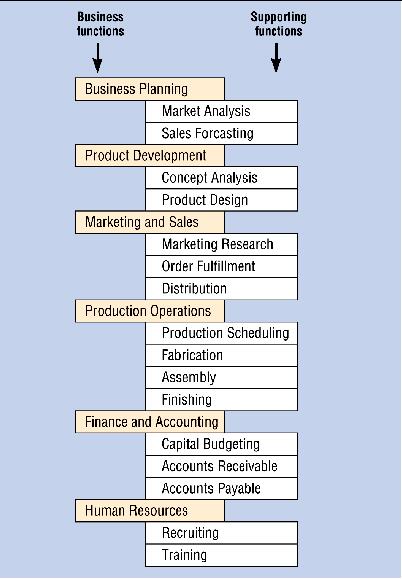
    Functional Decomposition of information systems planning information (Pine Valley Furniture).


  2. Describing the Target situation, Trends, and Constraints : In summary , to create the target situation, planners must first edit their initial lists and record the desired locations, units, functions, processes, data, and information systems within the constraints and trends of the organization environment (e.g.: time, resources, tecnological evolution, competetion, and so on). Many CASE tools provide features that will help you to make sense out of these matrices in at least in three ways:
    • Management Information
    • Matrix Construction
    • Matrix Analysis.


  3. Developing a Transition Strategy and Plan : Once the creation of current and target situations is complete, a detailed transition strategy and plan are developed by the IS planning team. This plan should be very comprehensive, reflecting both broad, long-range issues in addition to providing sufficient detail to guide all levels of management concerning what needs doing, how, when, and by whom in the organization.


Information Systems Plan:
  1. Organization Mission.
  2. Informational Inventory.
  3. Mission and Objectives of IS.
  4. Constraints.
  5. Long-term Plan.
  6. Short-Term Plan.
  7. Conclusions.

Return
Hosted by www.Geocities.ws

1