
the Bitch from the bay
Hermit sheep loses years of wool
front page
Join us at FAW? Click here!
page

just ask the Bitch from the Bay - if you dare
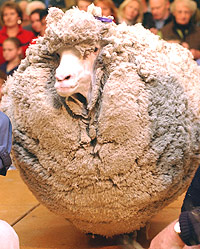
You look at the pictures of Shrek, the hermit sheep in New Zealand, who has just returned from six years in the wild, holed up in a cave, living his own life, and you think something is wrong. He's got wool elephantiasis. He's the sheep Don King. He's ovine cumulo-nimbus. He's gone for that vast wrap-aroun woolly look - was it Starsky or Hutch? - that afflicted men for a while in the 1970s, trying to look cuddly when in fact they were bastards great big
rolls of wool around their chests, with huge woolly roll-over collars and - or am I imagining this? - woolly belts to hold the whole thing in. It was one of
the first, and worst, side-effects of the feminist revolution, as if a vast cardy could somehow camouflage a man. Not, of course, that Shrek has made this fashion statement as a conscious decision. He just is as he is. The phenomenon of the hermit sheep is not unknown. From time to time, sheep become bored with the idea of being herded, drenched, shorn, poked and prodded. The quiet life, away in the wilds, private, delicate, to your own rhythms: who, really, wouldn't choose that? We've got our own hermit sheep in Scotland. She's called the Bitch from the Bay and, whenever it comes to shearing time, in July, the Bitch is the one big challenge. Not that gathering sheep on a group of islands in the Minch, with 500ft cliffs on one side and scree-strewn slopes on the other, is easy. The two or three times I've done it with the shepherds, I have been left feeling humbled and exhausted. Even for the shepherds, though, the Bitch from the Bay is a steep hill to climb. Her particular bay is right at the northern end of the islands. There are remains here of a medieval farmstead, and some other more enigmatic and older buildings, which may be as old as any habitation in the Hebrides. It has, in other words, always been a favoured spot. The grass grows thickly around these ruins and the Bitch queens it over the ancient pastures. She has not been shorn these four or five years, and her densely matted fleece looks like a diagram of a sofa with its skin removed. Bundles of grey, flaky wool hang about her. Her head protrudes from the mass, as if looking out from the opening in a tent. But the eyes are beady and the Bitch is a canny queen. She goes along with you to start with. There is no sign of independence or regal freedom. Along with the flock of her sisters, daughters, granddaughters,
nieces and acolytes, she allows herself to be herded towards the path that climbs the steep slope to the fold. The shepherds and their dogs gather behind them. Everything is going as well as it ever has. We have almost driven them up to the moorland that coats the top of the island, when, without warning, not even a backward look, the Bitch suddenly hurtles down the slope we have patiently driven them up, like a ski-champion, as John Murdo Matheson, the grazing tenant, always says. We try it again, and again. Back to the bottom, the vagabond sheep always looking to the haughty, woolly warrior queen who leads them. But the answer is always the same: the Bitch gets to stay in her bay. Only the others ever get driven to the top. Once, in desperation, Spot, one of the sweet but not entirely brainy sheepdogs, trying to get behind her, flew straight off the cliff and fell 80ft into the sea. The shepherds couldn't bring themselves to look over, but,
when they did, they saw him, wet through, on a rock at the edge of the sea, barking up at them. They rescued him by boat. And the Bitch from the Bay just smiled. We don't know because we don't see it. The world in its forgotten corners is peppered with sheep gone wild. On the islands deep in the Antarctic Ocean south of New Zealand on the Kerguelens in the southern
Indian Ocean, on the remotest of Hawaiian islands, on Boreray, Soay and Hirte in St Kilda, on the most abandoned of Norwegian islands all places from which modern life has withdrawn people have left their sheep behind. You can go shooting feral sheep for fun, if that's your bag, in Argentina. I suppose it might be reliving the historical delights of the bison shoot. In all these places, the sheep populations drift back towards a more natural state. Wild conditions select against the vast woolliness of the cultivated breeds, and the feral sheep tend to have thinnish coats that fall off each year on their own. The numbers go through savage boom-bust cycles, thriving in good years, crashing in bitter winters. The Shrek condition, in other words, is merely a reflection of what we have done to his genes. He is a tramp, a human being, or at least a human-created being, gone half-wild. Perhaps that is why he and the Bitch both seem such appealing creatures: we see in them something of our own desire for privacy and
freedom.
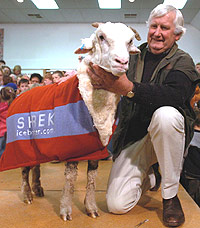
A VERY woolly New Zealand sheep that survived six years in the wild was today heading back into the hills near naked after his heavy fleece was shorn off on live worldwide television. Before ... Just a trim please. The merino wether was shorn of nearly 27 kilograms of fleece now being auctioned for the cancer charity Cure Kids. Owner John Perriam said today that after the experience the sheep, named Shrek, was in "fine fettle".
"He's quite incredible. His personality has changed, he's almost saying 'thanks mate, I want to go back to the hills now' and he was pawing at the doors of the shed this morning," Perriam told Radio New Zealand. Merinos, which produce a fine wool used in clothing, are usually sheared once a year, but Shrek had managed to avoid muster for six years until found in a remote part of Bendigo Station in Central Otago near the Southern Alps in New Zealand's South Island. Shearer Peter Casserly, 56, took more than 20 minutes to take the fleece off. "The fleece was very heavy and pulling the skin up so it would have been very easy to cut him; that's why I was only snipping away slowly. I couldn't put in many long blows," he said. Casserly, who has been shearing since he was 17, holds the world blade shearing record of 353 sheep shorn in a nine-hour day. Shrek's fleece was the biggest he had shorn. "I've never done a fleece as huge as that. It was an honour to do it too, especially when it was for such a great cause as Cure Kids; I've got eight grandkids of my own," he said.
The shearing, in the Southern Alps town of Cromwell, attracted around 200 people, and a world television audience. Perriam ruled that with a cold snap hitting the area Shrek was to be shorn by hand rather than by electric blade, thus ensuring he had a generous layer of wool remaining on him. After the shearing Shrek was taken into a heated room for the night.
After ... New look Shrek "I was thrilled with how he handled everything ... He didn't get too stressed, took everything in his stride. He deserves to be looked after," Perriam said. He added that Shrek had survived the drama well "and is now just an ordinary wether from the back blocks". Perriam said the animal would "run around the rocks this morning".
The auction was under way at www.shrekauction.co.nz. Perriam said New Zealand Prime Minister Helen Clark was among the bidders for the fleece, while bidders from around the world were after the wool.