By Chessmaniac. (11/25/05)
Several weeks ago, I found the article about Speed of light and Islam, very interesting. It seems he is a knowledgeable man in physics. But after reading his article I realized his equations (base on his interpretation of Al Quran) and also his calculation content many incorrect physical interpretation.
The detail of those articles you can found in below link:
http://www.speed-light.info/ and http://www.islamicity.com/Science/960703A.SHTML
Have you been to the website? It is very interesting, isn’t it?
I summarize as follow, he quote a Koran verse,
"GOD rules the cosmic affair from the heavens to the earth. Then this affair travels, to Him (i.e. through the whole universe) in one day, where the measure is one thousand years of your reckoning"(32:5) .
He make interpretation about that verse and put a equation as follow:
C.t=12000L or C=12000 L/t
First we have to understand the physical meaning of this equation.
C is a constant speed of light in vacuum, but the equation has 2 other parameter, t and L.
Is the value of L/t also a constant? If yes then the
equation is valid, if not then it is invalid equation.
This equation seems to be simple but it is very tricky for
people who do not understand the reality of physical meaning. The physical
meaning of the equation as follow:
The distance of light that travel in one sidereal day is
equal to the distance of moon
travel in 1000 sidereal years. One sidereal year has 12 sidereal months and one
sidereal months has 27.321661
days = 655.71986 hours.
So let we do some simple algebraic calculation, using
his propose numbers.
The moon travel on her orbit in one sidereal month is equal
to L = 2*pi*R which is equal to 2414401.918878 km
(R = 384264 km),
and sidereal day t=23 h, 56 min 4.0906 sec = 86164.0906 sec.
C=
(12000 months *2414401.9188 km/month) / 86164.0906 sec
= 336251.71245 km/sec
Wow,
this number is way out of standard speed of light 299,792,458 metres
per second. This
is a first shot!
The author, Mansour Hassab-Elnaby (MHE), propose another
approach to define L as inertia distance which moon cover in geocentric orbit
with the speed in regard of distant Star multiply by one month sidereal time
First, he turn the interest to moon’s angular velocity
with following formula:
V=2
Pi *R/T.
Equation
is TRUE if:
Because the variant of total gravitation impact, moon’s
orbit is imperfect circle. In other words, moon’s orbital has some
eccentricity. Although the moon’s eccentricity number is small, but the impact
could be seen and observe in moon’s velocity from time to time. So Moon travel
with not a constant angular velocity
MHE know exactly, if he used moon’s angular velocity
formula to calculate speed of light, he will get the same incorrect result. Then
he come up with idea to reduce moon’s angular speed by referencing to distant
Star and reasoning the Earth-Sun gravity do not give absolute speed.
Anybody who do not have a good knowledge about orbital
mechanic got easily confuse at this level. Now MHE is talking about multiple
REFERENCE FRAMES.
He do not cover the definition of REFERENCE FRAMES, either
he doesn’t know or he is doing it with purpose to confuse people and the same
time to justify his calculation.
What is reference frame? Reference frame is not different
than 3-D Cartesian Coordinate Systems. It has single origin and every place on
the frame could be charted by 3 coordinate x,y and z.
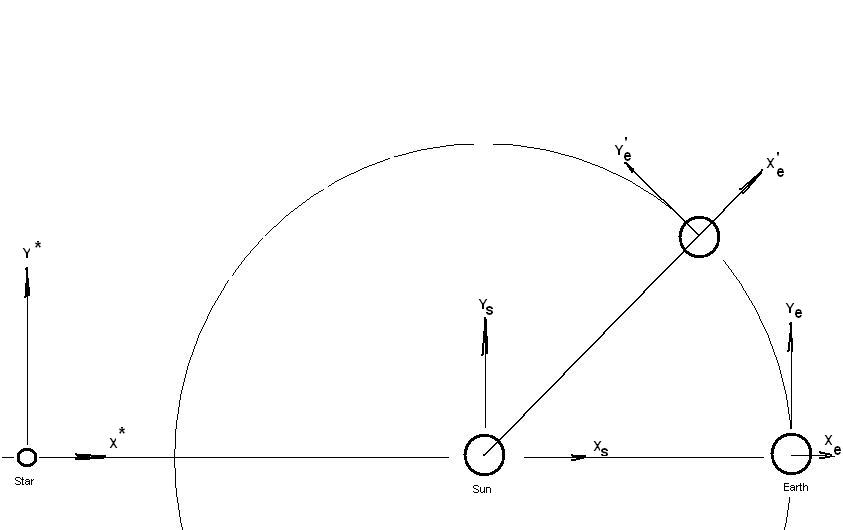
For sake of simplicity, instead of using 3-D reference frame, I will used regular 2-D reference frame. See picture 1 below.
When MHE referring to Distant Star, at least he is talking
about 3 Reference frames.
Now I will explaining about how the moon travel in one
sideral time.
I am zooming in, see picture 2, now I put the Moon in her
orbit around the Earth.
Assume, in the beginning the position of Distant Star, Sun,
Earth and Moon as depict on picture 1. They all lay on the same X-axis.
In picture 2, I put also a sketch of moon’s path that travel in 1 sideral month. The line I used is not a smooth line to indicate some distortion a long her path.
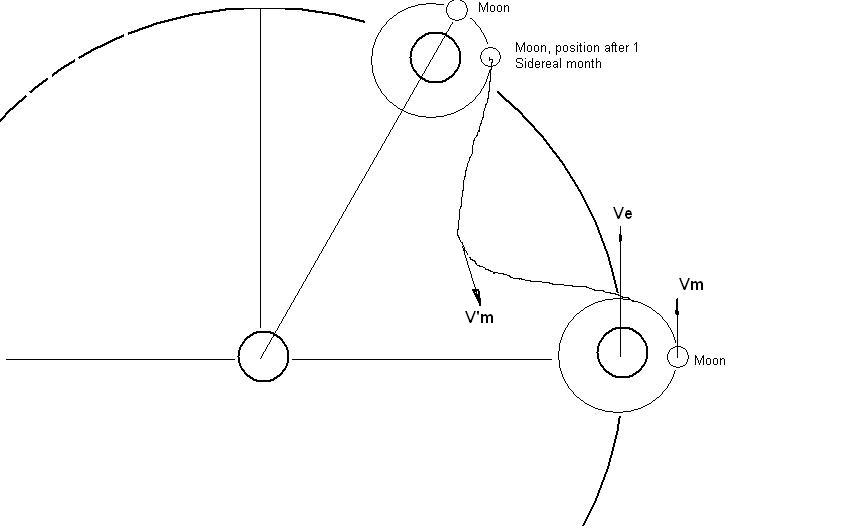
Ve is angular velocity of earth in regard to Sun Fix
Reference Frame, Vm is angular velocity of the moon in regard to Earth Orbit
Reference Frame.
Now it is clear that the velocity of moon in regard to Sun
Fix Frame is a sum of vector velocity Ve and Vm. How about vector velocity of
moon in regard to Distant Start Fix Reference Frame? It is the same, it is
vector sum too, the only different is the location of the Fix Frame.
In picture 2, I put also another moon’s vector velocity,
V’m, but it has opposite direction.
Moon has this vector about half time of sidereal month.
Now we can make a final conclusion about Moon’s velocity
in regard of Distant Star Fix Frame. If the vector velocity of Earth and Moon
are on the same direction then the total sum of moon’s vector velocity in
regard to Fix Frame became larger, but if vectors do not have the same
direction, the moon’s vector velocity is decreasing in regards of any Fix
Frames.
The explanation about reference frames is not in MHE
article, instead he introduce another parameter in order to reduce Moon’s
angular velocity. He multiply with fix variable Cos (@).
And now MHE new moon’s velocity become V’ = V.Cos(@)
What is @?
Alpha is angle change in one sidereal month in regard to
Sun Fix Reference Frame.
I quote his explanation
from above link:
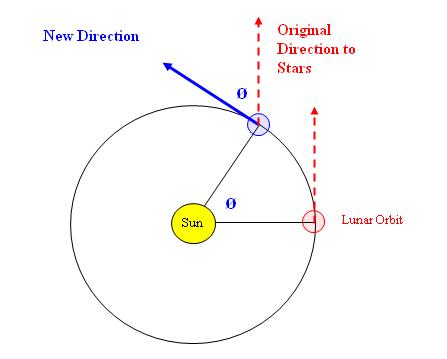
Let @ (Fig. 1) is
the angle traveled by the earth moon system around the sun during one sidereal
month of period 27.321661 days. We can calculate @ if we take into consideration
the period (365.25636 days)of one heliocentric revolution (1 year) of the
earth-moon system (Fig.l).
@ =
27.321661*360/365.25636= 26,92848
See his Figure below ! ! !
His calculation contain UNIT error ! You see, there is no
UNIT indication at the end of result. If the reader not careful, there is a
tendency to think @ is in degree unit.
WRONG ! ! ! @
has UNIT in degree/(sidereal month)
He should write more clearly about this calculation, as
follow:
@ = (27.321661(day/ sidereal month)* 360(degree/year))/(
365.25636 days/year)
Now if you put all together you see, the MHE’s modify
formula for moon’s velocity contain two mathematic errors.
MHE final equation become
C.t = 12000 V Cos(@). T
Or
C = 12000.V.Cost(@).T/t
At this point MHE try to impress reader with number.
Don’t get fool.
Look carefully on the UNIT he used, his new equation do not
have equal UNIT.
C has unit in km/s but the right hand side equation have
Unit in km/(sec. Sidereal_month)
Because @ is in (deg/sidereal_month)