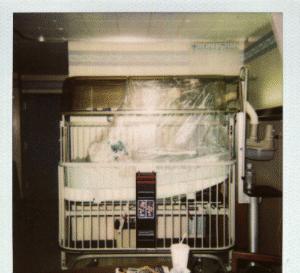
This is a picture of the oxygen tent that Cheyenne spent 2.5 days in.
I will as long as I live remember March 8th, 1997. That was the day my 6 week old baby got really sick. She saw the ER doctor that night after her breathing got very labored, he sent her home saying it was a cold, don't worry. She saw Dr. Sonnenberg the next morning, and he ordered a test for Respiratory Syncytial Virus. That night, she was in the ER again, she had severe weezing and coughing, and it seemed like she was fighting for every breath. I got Dr. Sonnenberg out of bed at 3:00 am because I was so scared. The Dr. at the hospital sent her home again, but Dr. S said to take her to his office in the morning. When we got there, he said the tests were back, that she had RSV, and he was going to admit her. I couldn't tell if I was more frightened or relieved by this news. I didn't know what was happening, but at least Dr. S knew what it was now, and he was going to help her.
We took her to the hospital, where she was placed in an O2 tent.She was in it the 11th, 12th, and part of the day the 13th. During that time, she got better every hour. When we first got there they used a pulse-ox to find out how much oxygen was in her blood, the number is usually around 95%, but hers was 82%. Every time they checked her after that, the number would be up just a little. Then the morning of the 13th, after 2 1/2 days of being in the O2 tent, and getting breathing treatments every 4 hours, she had reached 97%. With luck, it would stay up after coming out of the tent.
We got our luck. It stayed in the 92-96% range. We were going to go home the next day. It was a short time, only 4 days in the hospital, but it was one of the most stressful, terrifying times of my life. I don't think it is possible for a parent to feel more helpless than when they have to sit and wait, and watch thier small child lay in that tent. I am only glad it happened while she was small enough to not remember. My best friend, Kevin, has told me about his memories of being in one when he was 3. Only back then, the tent was only over the patients head, where the one Chey was in covered the whole crib. I will not be able to ever forget, at least she will not be able to recall those days. She came home March 14th, still breathing a little rough, but doing wonderfully. She still has some breathing problems, but we expected that, I have athsma, so we were ready to deal with her having it also.
RSV INFO...
What is it?
RSV is a common virus, that virtually every child has had by age three. All ages are susceptible, and it can occur at any time, but it is most prevalent from October-March. RSV is the most common cause of viral lower respiratory tract infections.
How is it transmitted?
RSV is passed just like the common cold, or upper respiratory infection. It can be caught by being sneezed or coughed upon, and kissing or sharing a drinking container with an infected person. An adult, or older child can be infected, but have little or no symptoms.
Re-infection can occur throughout life, but the symptoms are usually not as severe as the initial infection.
Symptoms
In the beginning: profuse runny nose, congestion, cough, for 2-3 days.
Possible: Fever, decreased appetite, sore throat, or body aches.
As it progresses: Increased coughing, shortness of breath, hard, fast breathing, decreased appetite, trouble sleeping.
Severe (probable hospitilization): Breathing greater than 60 breaths per minute, weakness, trouble catching breath, inability to eat or drink.
Who is at risk?
Infants less than 6 weeks of age, preemies, children with certain kinds of congenital heart disease, children with chronic lung disease (like cystic fibrosis), children who are immune deficient or are on immune suppressive medication for cancer.
Treatment
At home: Antihistamines/decongestants for nasal drainage and congestion, Cool mist humidifier to keep secretions loose, shrink swelling, and cool irritation in the throat and lungs and reduce cough, Anti-athsma medications to reduce wheezing, Antibiotics for any bacterial infections or compications (these will have no effect on the virus)
In the hospital: Oxygen, Ribaviran (an antiviral medication for RSV, when other meds fail, or for high-risk children)
Call your Dr. if your child is unable to eat or drink, if he is breathing 60 breaths or more a minute when at rest, if his appearance changes(blueish color to nailbeds, lips, or any change which makes you uncomfortable), or if he is using accesory muscles when breathing(called retracting, you will notice that instead of his chest rising and falling with each breath, the skin will retract between and under the ribs).
Links

Photo Albums
Wedding Album
Photo Album
Stories
Our Wedding Story
Cheyenne's Birth Story
RSV, story and info
Austin's Birth Story
Timothy's Page
Our Children
Grow with Chey
Grow with AJ
Timothy's Page
Me
My Breastfeeding Page
My Castle
Misc.
Webrings Page
Joke Page
Links Page