
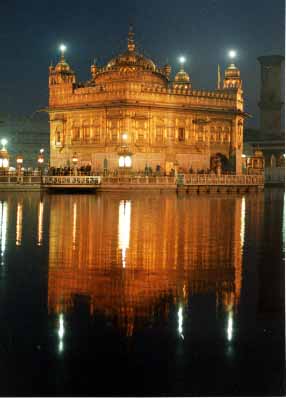
The Golden Temple is a place of extraordinary beauty and splendid peacefulness. It is a living symbol of spiritual and historical significance of the Sikh faith, which has been an inspiration for Sikhs, ever since its foundation.
Previously in history, forests and a small lake surrounded this geographical area, which was frequently visited and cherished by wandering philosophers. It is said Buddha meditated in this area and after about 2000 years, another saint named Guru Nanak Dev Ji (the first and founder Guru of the Sikh religion) visited this sacred land.
Valmiki wrote his celebrated epic, the Ramayana, near the site of the "Pool of Nectar". It was here, too, that Sita (the wife of Lord Rama) stayed during the period of her banishment. Here again, the twin sons of Lord Rama were taught the Ramayana. Yet another legend identifies this pool with the place where the whole of Lord Rama's army was destroyed by his sons, Luv and Kush, and how a jug of nectar descended from heaven to restore the soldiers to life. Other pious tanks surrounding this area are the Ram Tirth, Ramsar, Santokhsar, Ram Talai and Durgiana.
The idea of creating pilgrimage centres was proposed by the 3rd Guru, Guru Amar Das Ji, to establish places from where the tradition of the Sikh faith could be preached. The Golden Temple was the first holy shrine and became the principle place of worship and serves as a headquarters of present day Sikh affairs.
After sensing the importance of previous epics, the 4th Guru, Guru Ram Das Ji chose this particular place to construct a sanctified pool of nectar. In 1577, Guru Ji purchased the pool and surrounding land from the owners of the Tung village. Mughal Emperor Akbar volunteered to donate a dozen villages to the Guru, but his offer was politely declined. With the help of Baba Budha Ji, the tank was further excavated. The inauguration was in traditional Indian style, with the distribution of sweets and the singing of hymns and prayers. Guru Ka Mahal was the name given to the place where Guru Ram Das Ji made his home.
In 1588, the 5th Guru, Guru Arjan Dev Ji brick lined the sides and stairs of the holy tank. While the tank was under construction, Guru Arjan Dev consulted Baba Buddha Ji and expressed his wish to raise a beautiful permanent structure in the pool of nectar. Guru Arjan Dev then constructed the plan of the present Harmandir Sahib or Temple of God. It was decided by the Guru to build the temple in the centre of the tank. The leaders of the Sikh community and the devotees of the Guru welcomed the new plan.
The inhabitants and traders of Lahore did not appreciate the town plan of Amritsar. They thought that a big tank in a low-lying area would flood the entire city during possible heavy rains. This alarmed the business community of Amritsar. They approached the Guru with their fears, and were assured of the protection and prosperity of the city.
Hazrat Main Mir, a renowned Muslim of Lahore (now in Pakistan) laid the foundation stone of the temple. The dedicated followers built their houses in the neighbourhood, which quickly flourished into a small town called Ramdaspur; later renamed Amritsar. Other common names of Amritsar were Chak, Chak Chak Guru, Guru Ka Chak, Chak Guru Ram Das and Ram Das Pura.