 |
|
|
|
|
|
|
|
|
|
|
|
|
|
|
|
|
|
|
|
|
|
|
|
|
|
|
|
|
|
|
|
|
|
|
|
|
Dadabhai Naoroji |
|
|
|
 |
|
|
|
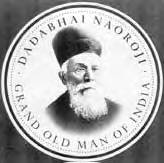
The grand old man of India , became the first Asian member of the British Parliament in 1892. He played an important role in establishing the Indian National Congress in 1865. Naoroji was one of the first leaders of the Indian nationalist movement who supported independence for India. |
|
|
|
Early Life |
|
|
|
Dadabhai Naorojiwas born to a poor Parsi priest's family in Bombay on September 4, 1825. His father, NaorojiPalanjiDordi, died when Dadabhai was only 4 years old. Dadabhai was brought up by his illiterate mother Maneckbai who gave Dadabhai the best English education possible.As a student, Dadabhaihad a knack for mental mathematics and went on to distinguish himself in Mathematics and English at the Elphinstone Institution (now College) in Bombay. At the age of 27, he was the first Indian to become a professor of Elphinstone College. He taught Mathematics and Natural Philosophy there. |
|
|
|
First Asian In British Parliament |
|
|
|
Dadabhaientered the political fray in 1852. Dadabhaistrongly opposed the renewal of the lease of India to East India Company and organized large meetings and sent petitions to the British Government in England to deny the Company a renewal. Even though the British Government did renew the Company's lease, his petitions dispelled a lot ignorance regarding India. |
|
|
|
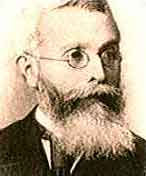
Dadabhai began free literacy classes for girls in Marathi and Gujarati. He wrote several petitions to Governors and Viceroys regarding India's problems. He felt that the British people and the British Parliament must be made aware of India's plight, so he set sail for England in 1855 with the help of rich Cama family. Dadabhai was elected to the British Parliament in 1892 from Central Finsbury as the Liberal party candidate. This made it possible for Dadabhaito work for India from within! He got a resolution passed for holding preliminary examinations for the I.C.S. in India and England simultaneously and also got the Wiley Commission, the royal commission on India expenditure, to acknowledge the need for even distribution of administrative and military expenditure between India and England. Dadabhai's efforts were rewarded in 1866 when the Secretary of State for India agreed to appoint 9 Indians out of 60 to the Indian Civil Service (I.C.S.) by nomination. |
|
|
 |
|
|
|
|
|
|
Return to India |
|
|
|
Dadabhai's fund-raising for his various projects brought him in contact with many wealthy people and rulers. One of them, Mulharrao Gaekwar, the Maharaja of Baroda was always in trouble with the British because of his misrule of his territory. Ironically, the Government had appointed an inquiry into his misdeeds. The Maharaja asked for Dadabhai's help and persuaded Dadabhaito become his Prime Minister in 1874. Within a year the whole administration was reformed and efficiency was brought to the system. His task complete, Dadabhairesigned from his position in 1875. As the years passed, Dadabhaigrew more and more disillusioned with the 'fair-minded' British. After spending years collecting statistics, Dadabhai propounded the drain theory: The inevitable consequence of foreign domination is the drain of wealth of the subject nation to the country of the rulers. |
|
|
|
Formation of Indian National Congress |
|
|
|
 |
|
|
|
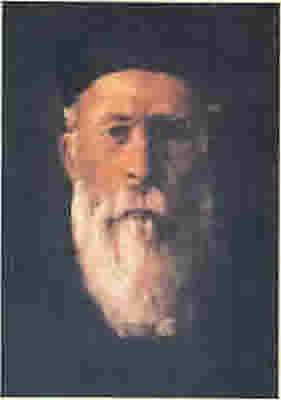
Dadabhai was key to the establishment of the Indian National Congress (I.N.C.) founded by A.O. Hume. More importantly he averted a split in the Congress between the extremists like B.G. Tilak, B.C. Pal, and A. Ghosh and the moderates. The extremists advocated the boycott of British goods and asked for swaraj (self-government). The moderates wanted to use constitutional methods to gain autonomy-not freedom. Both factions wanted an unbiased leader to chair the annual session of Congress at Calcutta in 1906. Both factions looked toDadabhai. Dadabhaicalmed both sides realizing that a fissure in the Congress would be a major setback in the freedom struggle. In his presidential speech, Dadabhaideclared that the goal of the I.N.C. for India is swaraj and the means to achieve this goal would be constitutional. |
|
|
|
|
|
Dadabhaidied at the age of 92 on June 30th, 1917. 2 months later, the Minto Morley reforms were passed in the British Parliament granting much of what Dadabhaihad been fighting for. |
|
|
|
Coin in the Memory of Dhadabhai Naoroji |
|
|
|
 |
|
|
|
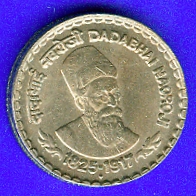
GOI Issued a Comemorative Coin in denomination of 5 Rs in the memory of 'The Grand Old Man of India' |
|
|
|
Main Page |
|