

Starring: Bill Murray, Scarlett Johansson and Giovanni Ribisi
Directed by: SophiaCoppola
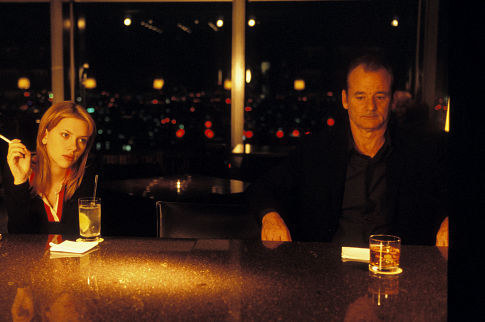
By conventional standards, not much happens during the course of this film. But by the final fadeout, the characters are no longer just two actors, but rather two seemingly real people who have allowed us as the audience to catch a glimpse into their thoughts, pain, and joy.
Bill Murray and Scarlett Johansson star in this gentle and meandering examination into the nuances of two lonely Americans who discover an unexpected connection while traveling in Japan. Murray is an aging celebrity filming whisky commericals for Japanese television; Johansson is a recent Yale grad who followed her photographer husband to Japan simply because she "had nothing better to do."
Meeting late on night in the deserted hotel bar, Murray and Johansson's characters feel drawn to each other because they sense the feelings of isolation in the other that they themselves are struggling with. They timidly begin to spend time together, and an undeniable bond begins to form between them.
A romance would seem natural in a situation like this (despite the glaring age difference), but this is where "Lost in Translation" heads in a different direction. Murray and Johansson don't jump into bed, rather, they talk, they laugh, they cry, and they simply enjoy being in the presence of another person who remotely understands their situation. Romantic feelings are always present, but are never acted upon.
There is a natural humor that develops during the course of the film as the bizarre collision of the Japanese and American cultures are compared, and Murray and Johansson's subtle comic timing perfectly capture the awkwardness of their character's situations. This isn't necessarily a lough-out-loud type of comedy; the humor comes through the astute observation of differences in people, places and cultures. Some have charged Lost in Translation with simply stereotyping the Japanese culture, but Americans are judged just as harshly. Anna Faris' starlet is a scathing critique on the shallow individuals American society places on a pedestal. But I can't help but feel that this discussion is ultimately besides the point- the focus is on the interaction and slow transformation of Murray and Johansson's characters.
Lost in Translation is director Sophia Coppola's second film, her first being the 1999 art-house hit The Virgin Suicides, starring Kirsten Dunst. Like The Virgin Suicides, Coppola gives Lost in Translation a vivid, slightly otherworldly look that is at once foreign and dreamlike, but at the same vaguely familiar. This technique allows for a striking visual contrast between the relentless activity and lights of Tokyo and the bleak isolation the main characters feel.
The film drags slightly as it nears its resolution (it's about 20 minutes too long), but I found the ending perfect in a bittersweet way. Little more than a kiss is ever exchanged between these two friends, but we get the feeling that what they have experienced during the course of this film is something deep, lasting and life changing.
Lost in Translation totally and completely worked for me- I was content to sit back, and watch this tender story unfold in front of me. Without a doubt one of the best of the year, and a must-see film.

