

Starring: Emmanuelle Riva, Eiji Okada
Directed by: Alain Resnais - Written by: Marguerite Duras
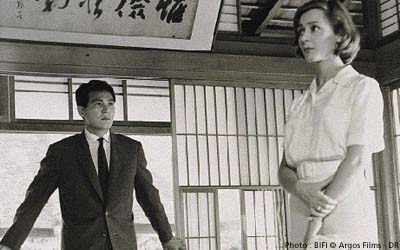
Part of Hiroshima mon amour centers on the bombing of Hiroshima in 1945, an event considered by many to by one of the most tragic events in human history. The films opens with ash lazily drifting like snow upon the bare skin of two people making love. The ash then gives way to water, and then finally to sweat. In just the first thirty seconds alone the film has made a parallel (showing the ashes we will all someday become to the sweat essential to human life) demonstrating the odd, intermingled relationship between life and death.
We hear the woman unwittingly narrarate horrific images of the Hiroshima aftermath in a flat, monotone voice, explaining the horrible things she saw. The man flatly contradicts everything she says, saying that she didn't, and couldn't have been in Hiroshima to experience the horror. Around and around these lovers go as the tragedy of Hiroshima flashes before our eyes in the form of documentary-like footage. It makes for a dramatic opening that sets the heightened and almost surreal tone that marks the film.
Though we never learn either character's name, we quickly find out that the woman is a beautiful French actress working in Hiroshima on what she call a "peace film." The man is an engineer, and it involved with politics (which is the reason why he speaks French so well). The actress, played by Emmanuelle Riva in her first starring film role, is leaving Japan the next day, her work on the film finished. In the morning they both realize that the connection between them is stronger than they could ever have imagined, and for the rest of the film they debate whether they have truly fallen in love or not.
But there's more to the story than two people from different cultures falling in love in Hiroshima. Both admit later in the movie that they are both happily married; it is obvious they are both highly intelligent, rational people, and both seem to be dedicated to their respective occupations. They go to a tea room to spend the last hours before Riva's departure. Okada begins to ask about her past, and as Riva begins to open up to her anonymous lover, her story is told through a series of elaborate flashbacks. Riva reveals that she fell in love with a German soldier in Occupied France and how she temporarily went mad after watching him die in front of her She explains the intense, forbidden love that she expected to experience only once in her life that she found with the soldier. It is then she seems to realize that her attraction to Okada is bringing out the same feelings and emotions she had experienced so passionately in her youth. Okada's character begs Riva to stay with him in Hiroshima, to not go back to France. Riva can't seem to make up her mind, her emotions torturing her, the realization of how hopeless the situation is being the only lifeline saving her from completely succumbing to Okada's wish that she stay. They play a weary dance of emotions through the gaudy neon lights of Hiroshima; by the time the screen finally fades to black their situation is no more resolved than it had been at the opening of the film.
Ever since discovering L'Annee derniere a Marienbad (Last Year at Marienbad), I've been desperate to see Resnais' earlier Hiroshima mon amour. I can say now with certainty that Hiroshima mon amour is a landmark of not only the French New Wave, or even of French cinema, but of all of cinema. It also confirms my belief that Alain Resnais is one of the most criminally underrated directors in film, unknown to even devoted movie buffs despite the fact her created two of the greatest movies ever made. With this film, which became his breakthrough onto the international scene, he achieves a balance of emotion and ideas that's breathtaking. While he would take the 'idea' aspect of film to the extreme several years later in Marienbad, Hiroshima mon amour combines Resnais' precise sense of style with intense emotions- which could make it the better film of the two (I refuse to decide between the two at this point, however).
Much credit for the success of the film should also be given to screenwriter Marguerite Duras. Her script, which won the International Critics Prize at Cannes and received an Oscar nomination for Best Original Screenplay, was hailed unaimously by critics and audiences around the world. (One original reviewer went as far as to comment that the script of Hiroshima mon amour "has raised the cinema to the level of the arts which authentically represent the movement of thought and world perception in the twentieth century.") The brilliance of Duras' script is that she weaves so many individual themes together to create a seamless whole. Hiroshima mon amour could be described as a film about bittersweet love, about the breakdown of memory, about the injustice of war. The fact it can be broken down and still be appreciated on so many levels is a triumph in itself.
The performances are intense to the point of being painful, the black and white cinematography amazing, the editing brilliant, and the score effectively understated. There are so many superb individual elements to Hiroshima mon amour that the fact it succeeded in becoming a complete whole makes its accomplishment all the more amazing.
Hiroshima mon amour is one amazing film. There had been nothing like it before, and I don't know if there's been anything quite like it since. It's a towering landmark of cinema that remains relevant and breathtakingly powerful even today. It is, in a word, a masterpiece.
(Black & White, In French)
-July 16, 2003

