OWNERS REPORT
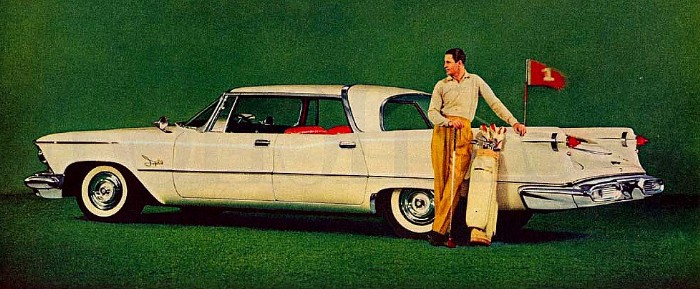
1958 IMPERIAL
from the Popular Mechanics’
National Survey
Popular Mechanics, July 1958
[Comments by Art
Railton, PM’s Auto Editor]
Imperial Owners Say Ease of handling Is
Tops
Imperial retains its styling
only minor trim changes for 1958, styling which was so enthusiastically
received last year. But this year, exterior styling places fourth
in the best-liked list of 1958 owners. First on the list is handling
ease with 54 percent mentioning it.
After handling ease comes riding comfort,
followed by power and performance. Styling, roadability and torsion-bar
suspension are next.
Here, in the words of owners of 1958
Imperials, are the reasons why they like their cars:
“The Imperial handles like
a feather, so easy, so quick.”—New Hampshire realtor.
[Delightful to drive. Steering is precise,
wheel angle excellent. It has a lightness that is exhilarating—no
sense of inertia. You feel it can turn, stop, start like a sport
car—It can’t, but you feel that it can.]
“No other car, bar none (foreign makes
included), handles anywhere near as well on the highway or can come
anywhere close to cornering as well as Imperial. It is in a class
by itself. It will corner comfortably at 110 miles per hour where
other cars will do no better than 80.”—Minnesota executive.
“Most comfortable riding car I ever
had the pleasure of driving.”—Wisconsin retailer.
“Has easy, firm ride which does not
wallow and wander in corners.”—Oregon landlord.
“Accelerates fast.”—Pennsylvania
dentist.
“Has a ‘live’ feeling found
in no other automobile.”—California fire captain.
“I like the long, low look.”—Washington
foreman.
“Styling and appointments generally
indicate good taste on the part of the designers.”—Illinois
manager.
“Roadability. No sway on any curve.”—California
retired owner. [Fine road car. Long trips
at high speeds are a pleasure on straight or winding roads. Excellent
road sense. You don’t have to “drive” constantly.]
“Torsion-bar suspension is great. Big,
powerful, capable car that won’t make you nervous when you
push it around some sharp turns and over rough patches. On high-crowned
roads it has no tendency to wander.”—Maryland foreman.
Here Are the Complaints
Almost 40 percent of the Imperial
owners have no complaints at all about their cars. The others do,
however, and the one that is mentioned most frequently is poor workmanship
[a fault that seems to be chronic in the industry].
“Too much poor workmanship
on fine details. Too much finishing left to incompetent dealers
with no facilities or for help. Torsion-aire advertising is misleading.”—California
flight test engineer.
“Body throw together. Doors improperly
fitted. Hardware of poor quality.”—California physician.
[There’s no excuse for a poor body job
in a car costing as much as an Imperial, especially when this is
the second year for the body. Lincoln has the “first year”
excuse. Imperial has not.]
Second on the complaint list is
the extreme lowness of the car and the resulting difficulty getting
in and out. After that come body rattles, electrical troubles, poor
paint and chrome and the inconvenience of the push-button shift,
in that order.
“Decidedly too low for my
passengers to get in and out of car. Too low for me, too.”—Pennsylvania
owner. [Hardest of the three to enter and
leave. Test car did not rattle. Front seat does not support accelerator
leg adequately. On long trips this may be tiring to driver, but
passenger will enjoy a smooth, relaxed ride.]
“Headroom too small for a large man.
Seat is set to recline and is hard on my back on long trips. My
’56 was more comfortable.”—Illinois contractor.
“Rear set too low and car has too many
rattles.”—Florida merchant.
“Windows not properly supported on
side when part way up, causing rattles.”—Pennsylvania
retired owners.
“Something was wrong with the electrical
system, resulting in a fire in the left rear door. Evidently it
was in connection with electric door lock or window lift. Dealer
was advised to change wiring.”—Idaho executive.
“Finish on many plated and painted
parts very poor. Rusted parts.”—Wisconsin retired owner.
“I don’t like push-button shift.
Older system on steering wheel was easier to operate.”—Ohio
physician.
“Buttons are in a vertical row and
Reverse is in the middle, so you must look to make sure you don’t
push the wrong button.”—California farmer.
“All controls are left handed and hard
to reach.”—New York builder.
“Don’t care for directional-signal
switch. Prefer it on the steering wheel. Also light, heater, wiper
switches all must be turned instead of pulled.”—New
York merchant. [Tyranny of the stylist. Can’t
think of a single advantage to push buttons except styling. Instead
of being easier than a lever, they are more awkward. Same for the
turn-signal switch.]
Suggestions for Industry
Imperial owners have some
suggestions for the auto industry as a whole that are of interest.
These are not directed at Chrysler Corporation alone, but at all
the American automotive manufacturers.
“Design and make cars first
for dependability, ease of handling and comfortable riding. Add
gadgets only after these fundamentals are assured.”—Florida
owner.
“Give more consideration to headroom
and natural seating with higher seats.”—Wisconsin executive.
“Cut down on length.”—Washington
D.C. owner.
“Don’t make cars any fancier.”—Connecticut
executive.
“Fewer sharp objects, inside and outside.”—New
York engineer.
“Industry is making a grave error in
pushing larger and more powerful cars. This may seem a contradiction
in view of the Imperial we own. However, I would be just as happy
with a smaller, less powerful car if it held the road as well and
was as comfortable to drive.”—Illinois housewife. [She
brings up a good point. If you are wealthy you must buy a big car,
even if you are small, live in a big city, with no children at home.
You still must drive a big car. As watches get more expensive, they
get smaller. Why not cars?]
“Most cars today look like back-alley
modifications, adding wings here, gadgets there and a bunch of chrome
strips.”—Florida retired owner.
“Make a luxury car with all the comfort
features, but smaller.”—Maryland physician.
More Best-Liked Features
Here, in order of frequency of mention,
are quotations by the owners describing more of the features they
like most about their new Imperials:
“Well-built car with a luxurious
interior.”—Nebraska real-state broker. [With
eyes closed you know you’re in luxury. You feel it in the
fabric and the hardware. But the inside door handles are dangerous.
With arm on door armrest, tendency is to hold onto the door handle.
In a emergency, you might pull back, opening the door.]
“I feel confident in it and relax in
utmost luxury.”—Illinois office worker.
“Has plenty of room without appearing
bulky.”—Florida sales manager.
“Terrific brakes. Very roomy for a
convertible and smart looking, especially with the top down.”—New
York interior decorator.
“I like the six-way adjustable front
seat. On a long trip I change my angle when I get tired.”—New
Jersey owner.
“Wonderful visibility. You don’t
feel like you’re sitting inside the car. You see all around.”—California
contractor.
“I like the electric door locks. Both
doors on this two-door hardtop can be locked from either side.”—Illinois
lawyer.
“Has all the conveniences you can imagine.
It has completely automatic door locks, windows, radio, antenna
and seat for ease of driver.”—Nebraska sales manager.
“I have driven 5300 miles to date and
on long trips average 16.5 miles per gallon. Operating cost are
very little more than for any of the three low-price cars, except
for the tires.”—Delaware executive.
“I like the visibility of the speedometer,
various gauges and clock.”—California retired owner.
“I like its bigness. I feel safer somehow.
And the engine is so quiet that sometimes I think it’s stalled.
What could be better?”—Michigan housewife.
“I like the Imperial because the oil
and gas expense is hardly greater than the low-price cars and I
use the car to impress people in the real-state market.”—California
real-state broker. [Who says Cadillac is the
only prestige car?]
More Complaints, Too
Here, in order of frequency of mention
by the owners, are quotations describing additional complaints.
These range in frequency from 4.7 percent down to 2.3 percent.
“The back deck of my car has
been one continuous headache. It seems impossible to keep the trunk
lid from popping up when I hit a good-size bump at a fair rate of
speed.”—Illinois sales manager.
“Transmission trouble. Howls.”—Wisconsin
supervisor.
“The hardest car to heat that I ever
had. In fact, we have never had it warm.”—California
electrician. [The only cars that seem to think
rear-seat riders get cold are Lincoln and Cadillac. Imperial still
tries to warm the rear by blowing air from the front.]
“Floor mats not fitted as well as they
could be.”—Florida salesman.
“Power steering defective. Pulley sheared
off while turning corner. Ash trays poorly planned.”—Massachusetts
attorney.
“Can’t find ash tray at night
because it is the darkest instrument panel I have ever seen.”—Maryland
executive.
“Poor placement of parking-brake release.
It could be mistaken for light switch right next to it which would
be disastrous if parked on a step hill at night. You get out of
car, notice lights are still on, reach in to put out lights and
accidentally release brake!”—California securities trader.
[With any car that can’t be parked in
gear (and the Imperial can’t) it would be safer to have a
mistakeproof release for the parking brake.]
“Places where doors join in four-door
models are wide open and ugly.”—New Jersey salesman.
“Water stays on top of the dummy spare
tire on the trunk lid and I’m afraid it may cause rust.”—New
Jersey owner.
“There is no parking gear and my car
is forever sliding down a hill when the emergency brake isn’t
on tight enough.”—California executive.
“Bad door hardware.”—Illinois
banker.
“I am inclined to think that the designer
must ride a bicycle as anyone who has driven the car could surely
have found out that the defroster will not keep steam and frost
off the windshield and that the driver can’t reach the ash
tray and cigarette lighter and that you can’t put on the turn
signal as easily as you should be able to.”—Nebraska
live-stock broker.
“Back doors on this four-door hardtop
open too hard.”—Wisconsin realtor.
[More comments: It’s a big
car, but the driver isn’t aware of it, so easy does it handle.
Vision is excellent except for minor windshield reflection in sunshine.
At night, black light illuminates dials eliminating glare and reflections.
Rest of the dash (knobs and ash tray) is unlighted. Clock in direct
line of driver’s vision—now if it would just keep time.
Center of front and rear seats useless on long trips due to lack
of padding. Too much creep in transmission. Wiper action excellent
except at end of stroke.]
That is what the
owners of the Imperial like and don’t like about their cars.
SUMMARY OF IMPERIAL OWNERS'
OPINIONS:
OVER-ALL RATING: __Excellent
82.5%___ Average 12.7%___
Poor 4.8%
|
| Best-liked Features |
What make
was traded? |
| Handling ease |
54.1% |
Imperial |
22.5% |
| Riding comfort |
47.3% |
Other Chrysler make |
27.1% |
| Power, performance |
32.6% |
Cadillac |
17.8% |
| Exterior styling |
24.0% |
Other GM make |
16.3% |
| Roadability |
16.3% |
Ford Motor make |
5.4% |
| Torsion-bars |
5.4% |
All other makes |
3.1% |
| Most-frequent
complaints
|
No trade, no answer |
7.8% |
| None at all |
39.2% |
What make will
buy next time?
|
| Poor workmanship |
15.5% |
Another Imperial |
51.2% |
| Too low, hard in, out |
15.5% |
Chrysler |
11.6% |
| Body rattles, squeaks |
7.0% |
Other Chrysler make |
0.8% |
| Electrical trouble |
6.2% |
Cadillac |
5.4% |
| Poor paint, chrome |
5.4% |
Other GM make |
2.3% |
| Push-button shift |
5.4% |
Ford Motor make |
2.3% |
| Had trouble
with engine?
|
Undecided, no answer |
27.1% |
| No trouble |
86.3% |
Have ever
owned a Cadillac?
|
| Some trouble |
11.3% |
Yes, have |
48.8% |
| Considerable trouble |
2.4% |
No, have never |
47.3% |
| What was
engine trouble?
|
No answer |
3.9% |
| Carburetor |
4.7% |
What other
car now owned?
|
| Starting trouble |
2.3% |
Chrysler |
7.0% |
| Engine noisy |
2.3% |
Other Chrysler make |
17.0% |
| How is dealer
service?
|
Cadillac |
3.1% |
| Excellent |
61.2% |
Other GM make |
12.4% |
| Average |
27.3% |
Ford Motor make |
12.4% |
| Poor |
11.5% |
Other U.S. car |
4.7% |
| Would buy
from him again?
|
Foreign car |
1.5% |
| Yes, would |
48.1% |
None, no answer |
44.2% |
| No, would not |
8.5% |
|
| Undecided, no answer |
43.4% |
AN ENGINEER'S ANALYSIS

by DALE KELLY, SAE
Registered Professional Engineer
|
Model Tested: 1958 Imperial Crown
four-door hardtop with four-barrel carburetor, dual exhausts,
automatic transmission, power brakes, steering, seat and
windows, plus air conditioning.
Rear-axle ratio: 3.15 to 1. Wheelbase: 129 inches. Tires:
9.50 by 14. Weight: 5295 pounds with gas tank half full
(56 percent on the front wheels, 44 percent on rear).
Mileage on car at time of test: 1500 miles. Barometer: 29.34
inches. Temperature: 69 degrees F. Payload: 200 lb.
|
|
ACCELERATION
TIME FROM STANDING START (in seconds)
| Ignition time for: |
0 to 20 |
0 to 40 |
0 to 60 |
0 to 80 |
1/4 mile |
| Regular gasoline |
2.5 |
5.7 |
11.1 |
18.5 |
18.35 |
| Premium gasoline |
2.5 |
5.7 |
10.9 |
18.55 |
18.3 |
| Super-premium gasoline |
No improvement
|
(Gasoline used had the following
octane ratings by Research method: Regular 90; Premium 97;
Super-premium 105.)
|
|
FUEL ECONOMY
(miles per gallon)
| Ignition timed for: |
Steady 30 m.p.h. |
Steady 50 m.p.h. |
Steady 70 m.p.h. |
Traffic Route |
| Regular gasoline |
16.3 |
14.7 |
12.9 |
8.3 |
| Premium gasoline |
16.7 |
14.7 |
12.1 |
8.0 |
| Super-premium gasoline |
No tested (see
OBSERVATIONS below)
|
(In traffic test, car makes
10 full stops per mile and is driven fast enough to average
15 miles per hour.)
ESTIMATED
AVERAGE ANNUAL GASOLINE BILL: $237 for 10,000 miles
(Based on use of regular by
75% and premium by 25% of owners)
|
SPEEDOMETER ERROR (miles
per hour)
| Speedometer reading |
20 |
30 |
40 |
50 |
60 |
70 |
80 |
| True speed |
21 |
31 |
41 |
50 |
60 |
69 |
79 |
ODOMETER ERROR (miles traveled)
Odometer registeres 99 miles for an actual distance
of 100 miles.
|
| DRIVER'S
VISION
Driver could see part of road 18
feet in front of car, full width of road 22 feet in front
car.
GROUND CLEARANCE (unloaded
car)
| Worst dip that could be clossed |
30-ft. radius |
| Worst hump that could be crossed |
25-ft. radius |
| Deepest rut that could be negotiated |
7.0 in. |
| Curb clearance for door opening |
13 in. |
|
|
MISCELLANEOUS
| Steering |
| Steering-wheel turns for 100-ft. circle |
0.80 turns |
| Curb-to-curb turn-circle diameter |
48.5 feet |
| Wall-to-wall turn-circle diameter |
51.5 feet |
| Steering-wheel turns, lock-to-lock |
3.4 turns |
| Center of gravity |
23 inches |
| Trunk capacity |
12 cartons (one cubic foot
each) |
| Water resistance |
Good |
| Splash-pan test |
No leaks. Brakes only slightly affected |
| High-pressure |
Slight leakage tops of two doors |
|
The instrument
panel carries a full set of five pointer-type instruments.
Readability at night is excellent (in daytime also) because
the instruments have special markings illuminated with
“black” light. This light is not itself visible,
but it makes the markings on the dials glow distinctly
without any glare whatever. Speedometer extremely accurate
in the important 40 to 70 range.
Accessibility in
the engine compartment is poor. The ignition-timing adjustment
is very hard to reach. You can’t check the fluid
level in the automatic transmission without removing the
air cleaner and you can’t do this without tools.
The car needs several
feet more street width to complete a U-turn than other
cars of its size.
Because no improvement
in acceleration was noted with the spark advanced for
super-premium fuel, there is no reason for using this
extra-cost gasoline. Therefore, no fuel-consumption test
was made with super-premium gas. Actually, as the test
data shows, there is little reason for using anything
but regular gasoline in this car until it becomes badly
carboned.
Power-brake reserve
vacuum was enough to provide two full applications with
the engine dead.
The gasoline tank
held 23 gallons. When the car was allowed to run out of
gas, the gas-gauge needle moved off the zero mark with
less than a gallon being added to the tank. This is a
desirable feature as you know that when the needle points
to Empty you must refuel immediately.
|