IMPERIAL
BY
Chrysler


I M P E R I A L
1 9 5 7


I n _1 9 5 7 . . .


Following 1956 sales that were off somewhat from record-setting 1955, the auto industry managed a modest rebound for ’57. But disaster loomed by year’s end, as economic recession knocked at the nation’s door.
In this season of the tailfins, those oh-so-American rear-end appendages soared taller, but had not yet reached their zenith. American cars also began a switch to quad headlamps, but they were ruled illegal (temporarily) in several states. For that reason, several ’57 makes can be found with either single or twin lights on each side.
Most domestic cars switched to 14-inch wheels, several offerd six-way powere seats, and luxury models came with electric door locks. In some cars. Speedometer buzzers sounded when a present speed was reached. Several had nonslip differentials.
Stung by criticism of Detroit’s escalating emphasis on horsepower and performance, the Automobile Manufacturers Association banned factory-sponsored racing. The AMA also resolved to eliminate a focus on speed from auto advertising.
All Chrysler products feature Virgil Exner’s second-generation “Forward Look.” Imperials get a bodyshell of their own and display curved side window glass—a first for American cars.
The 42nd National Automobile Show, the first since 1940, was held at New York’s new Coliseum in late 1956 to showcase the longer, lower ’57 models. Vice president Nixon spoke at a banquet during the show—the first on to be televised.

An average car sold for $2749, whereas the average worker now earned $4230 yearly, and median family income neared $5000. Physicians topped $22,000, while teachers stood a little below the overall average. Factory workers might expect to pull in about $2.08 an hour. Economic inflation rose a bit, but unemployment remained stable—above four percent.

The Soviet Union launched Sputnik, the first space satellite, into orbit, followed by Sputnik II, which carried a dog. America’s Viking satellite, meanwhile, exploded prior to takeoff at Cape Canaveral, Florida.

Despite popular acclaim for unceasing prosperity, a few critics had harsh words to say about the burgeoning consumer society. Director Martin Ritt made caustic observations of the suburban lifestyle in a little-noticed movie, No Down Payment. Joanne Woodward and Pat Hingle had major roles, but Tony Randall nearly stole the show with his portrayal of a desperate-for-cash used-car salesman.
All told, it was a fine year for Hollywood, with such critically acclaimed (and popular) features as Twelve Angry Men, The Bridge on the River Kwai, and Gunfight at the O.K. Corral. On a darker note, Andy Griffith shined as A Face in the Crowd, portraying a wastrel-turned-celebrity in this searing exposé of media-induced publicity.
Raymond Burr’s Perry Mason appeared on TV for the first time. So did Wagon Train and Leave It to Beaver, along with James Garner in Maverick. Dick Clark launched American Bandstand to capture the attention of teenagers after school. Half of the top shows were westerns. Studios could now use video-tape, heralding the demise of live television.
The Everly Brothers sang “Bye, Bye Love,” but their humorous ditty “Wake Up Little Sussie” was banned in Boston. Jerry Lee Lewis noted that there was a “Whole Lot of Shaking Going On,” as Little Richard belted out his tribute to “Lucille.” Debbie Reynolds hit the pop charts with her rendition of “Tammy,” and Harry Belafonte scored with the “Banana Boat Song.”
Charles Van Doren won $129,000 on TV’s Twenty-One quiz show, attracting a flury of public adoration that would ordinarily be limited to movie stars and sports figures. Elizabeth Taylor, then 24, took her next husband, producer Mike Todd (age 54).

Both the Brooklin Dodgers and New York Giants moved to california, to the distress of their zealous fans.

Parents worried about Asian Flu, while kids played with Slinky and Hula Hoops, and Sony issued a pocket-size transistor radio.

One-third of new cars, according to a new study, were purchased by middle-class families, earning $5000 to $7500 per year. More than two-third of them were bought on credit. After all, an older car didn’t look proper in the driveway of a neat suburban house. Not when every other home on the block flaunted a late-model sedan or statin wagon.
To no one’s surprise, moderate-income families were even more likely to buy cars on time—as did nearly 90 percent of young shoppers. Not even the prospect of increased credit, though, would help the auto industry through the rocky economic seas that lay immediately ahead.



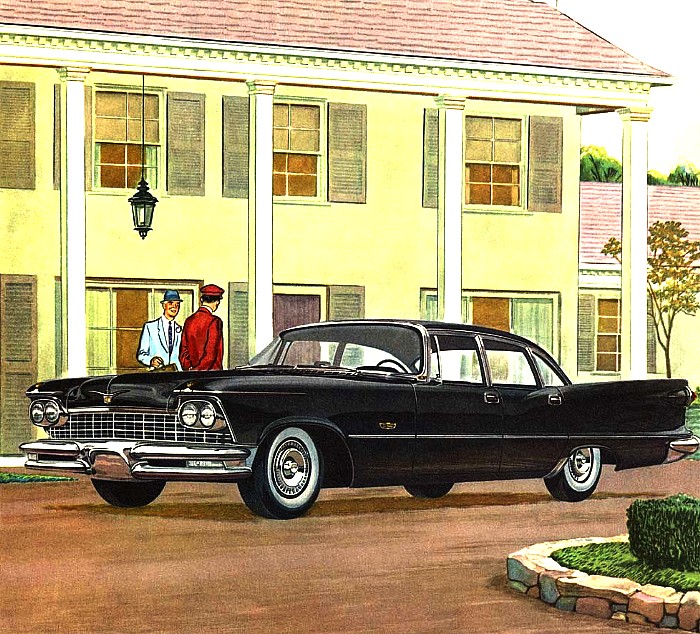
(IM1-4) 1957 Imperial LeBaron Sedan 4-door


IMPERIAL


By James Whipple
Car Life, May 1957


Chrysler Corporation shot the works in designing and engineering the 1957 Imperial, which represents the first major style change since the car made its debut as an independent make.
With a price range of $4,700 to $5,600 at the factory (including automatic transmission and power assists), Imperial comes squarely into competition with Cadillac and Lincoln as a full-fledged car.
As soon as we compared the Imperial with the ’57 Chrysler we realized that it was a completely different car rather than a longer wheelbase version of the Chrysler New Yorker with different grille and trim. Every body panel, strip of trim and piece of glass in the ’57 Imperial is new; not one duplicate of a Chrysler part.
Only the massive 392 cubic inch FirePower V-8 and the new three-speed TorqueFlite transmission are shared with the Chrysler New Yorker. The Imperial’s chassis and suspension is basically the same as that found on all ’57 Chrysler Corporation cars, with ball-joint-and-torsion-bar front suspension and asymmetric, outboard-mounted rear springs. However, the Imperial frame is its own, designed for the car’s 129-inch wheelbase and 224-inch overall length.
Although these dimensions are longer than the Chrysler’s, they represent a reduction in both length and wheelbase over last year’s Imperial, which was 229 inches overall and had a wheelbase of 133 inches. The result of the shortening job has been to eliminate the eight-passenger limousine and sedan from the line.
This does not mean that the Imperial is cramped by anyone’s definition of the term. With the front seat moved as far to the rear as possible, there’s still leg-stretching room for six-foot plus passengers in the rear seat. This roomy rear compartment is found on the four-door hardtops as well as the full-fledged sedan.
Chrysler executives evidently felt that the limousine market was so small that it did not warrant the extra expense of two chassis of different wheelbase with different-sized bodies. Nor did they feel that it warranted limiting all models to the longer wheelbase necessary for the eight-passenger cars which are more difficult for the owner-driver to maneuver.
The ’57 Imperial looks like a much bigger car than last year’s even though it is shorter. There are two reasons for this; one is the finned, “Flight-Sweep” styling with its unbroken line from headlights to tail-light which makes the car look longer, the other is the fact that the ’57 is four inches lower and 2½ inches wider. The car appears to be tremendously wide, but once behind the wheel we felt no greater psychological hazard maneuvering in close quarters than in any other luxury car.
The ’57 Imperial is the first of the large luxury cars to produce a really low-slung sedan. (Imperial is 56.7 inches high compared to 59.1 for Cadillac and 60.2 for Lincoln.) the lowering job was done with no sacrifice of interior headroom. Door dimensions remain ample although it is necessary to stoop a bit more when climbing into the car.
Seating positions have given way somewhat in the interest of maintaining sufficient headroom in the lowered car. Rear seat passengers in the ’57 Imperial will find that their knees are higher because the cushion has been placed closer to the flor than in the ’56 models. With six-way power control the front seat can be adjusted to any height and position comfortable to the driver.
Some luxury car owners may find the lower seating position a bit different, but few if any will find it uncomfortable.
As far as looks are concerned, we think that the Imperial is outstanding among the cars of the upper-medium and luxury-price groups. It is the sleekest of the really large cars, with a tremendous amount of passenger space enclosed in a very smooth and graceful body shell.
Vision is excellent from the power-adjusted front seat which permits drivers of short or tall stature a comfortable, relaxed driving position. The windshield of the Imperial tested showed some distortion at the sharply-wrapped lower corners.
It’s probable that this distortion problem will be eliminated later in the model run as been the case with wraparounds in the past.
The door and rear quarter windows provide better-than-average vision for a conventional sedan. This is because the frames are extruded aluminum enabling thinner sections than conventional pressed steel frames.
These side windows also represent as “first” for American production cars, as the glass is formed in a gentle curve inward to top of the frames. This permit a tapered effect from door to roofline with a correspondingly narrower roof and a wider view of the scenery for all passengers.
Once under way, the Imperial proves the superior combination of handling, stability and ride inherent in the lower center of gravity and Chrysler Corporation suspension systems.
Imperial has a flat ride with almost no tossing or pitching on very sharp bumps.
The performance of the Imperial belies its great weight and bulk. The 325 horsepower V-8 driving through three-speed TorqueFlite transmission will snap the 4,800-pound sedan from a standing start to a true 60 mph in just ten seconds.
Action in the middle speed ranges is equally fast, especially when the acceleration is made below the maximum “kick-down” of second gear.
With TorqueFlite you can hold the Imperial in second by depressing the “2” button on the panel. The car will then operate in second regardless of the throttle opening until the automatic upshift point is reached at 70 mph. The engine and transmission are satisfactorily quiet.
Operation of TorqueFlite on the Imperial is about average in the luxury field. The positioning on the transmission control buttons in a long line on the edge of the instrument cluster hood is a good deal less convenient than the compact grouping in the control head at the left corner of the windshield found on all other automatic transmission-equipped Chrysler products.
Power steering was very satisfactory on the Imperial, principally because there is more resistance to turning than on other Chrysler car; it’s not as easy to swerve the wheel more than you intended to. Also, the front wheels have greater caster action and tend to return to straight-ahead position as you complete a turn.
The push-button directional signal switch on the Imperial was a source of considerable annoyance because it cannot be switched off except by turning the steering wheel for a considerable distance in the reverse direction. This means that when moving out to pass another car at cruising speeds you can’t stop the blinking lights unless you swerve the car sharply. The only other alternative is not the use the signals. This is the sort of engineering “goof” that is all the more surprising when it appears on a top-of-the-line luxury car.
There were a few loose ends in the finishing of the car that spoiled the otherwise high standard of the workmanship. Door latch and window lifts rattled considerably in both front door when we traveled over bumpy roads or rough surfaces. There was some leakage into the trunk after driving through a steady rain, and the springs in the back seat cushion popped whenever a passenger shifted his weight.

SUMMING UP: Imperial is the most rakishly-styled luxury car in America—a car with excellent interior room, vision for driver and passenger and the steadiest ride in its class. Performance is second to none, although not quite the smoothest. Quality of workmanship falls a bit short of the standards of perfection expected in an automobile of this price.


IMPERIAL is the car for you
If . . . You appreciate sleek, beautiful lines and a car that’s dashing and elegant without being flashy, bulky looking or overtrimmed with chrome.
If . . . You want a really big, roomy car that has the most powerful performance in its field.
If . . . You would rather have a car that’s extremely steady when rounding curves or traveling over bad roads at high speeds than a car that soaks up all road vibration yet sways and rolls on turns.
If . . . You want a car that’s generous in every dimensions yet as easy to maneuver as one of the low priced cars.


IMPERIAL CHECK LIST


5 checks means top rating in its price class


Performance
Imperial checks out as the most powerful performer in the luxury field. Acceleration time from 0 to 60 is just 10 seconds. TorqueFlite transmission is very responsive in the passing range.
Styling
The new Imperial stands out as the sleekest, most gracefully-styled of the large luxury cars. The design makes the car look lower and longer than it really is yet provides superior vision, good headroom and luggage space.
Riding Comfort
Lower center of gravity and new Chrysler Corporation suspension system gives the Imperial the steadiest ride at high speed of any of the luxury cars. However, the car does not absorb vibration from rough road surface quite as well as the other big luxury cars.
V
Interior Design
Shoulder, hip and legroom in the new Imperial is more than ample. Headroom is satisfactory even in extremely low car. Seating positions are lower than other luxury cars but very comfortable. Vision is the best in the luxury group while luggage space is above average.
V
Roadability
In its class, Imperial has the edge, giving a very stable, flat-cornering ride at high speeds on rough roads as well as taut control of rebound on sharp dips and bumps.
Ease of Control
An excellent power steering system, responsive engine and transmission combination, plus easy-acting power brakes make the Imperial a very happy car to operate in parking lots or on superhighways.
V
Economy
With its large (392 cu.in.) engine and heavy weight, Imperial cannot be expected to be an economical car as far as gasoline mileage is concerned. Like all other 1957 luxury cars it uses premium grade gasoline. TorqueFlite transmission doesn’t have as favorable a high gear ratio as one of the other luxury cars.
V
V
Serviceability
Normal service operations are no more difficult on the Imperial than any of the large luxury cars. Imperial spark plugs are buried in valve covers but are easier to reach than some others.
V
Wormanship
Quality of workmanship on the Imperial has improved since the first cars appeared (they had “orange peel” paint and misfit window frames) but it still falls below that found on another of three luxury cars.
V
V
Value per Dollar
Imperial is a soundly engineered well-built car with styling that will stay “up to date” for several years. In the past, Imperials have depreciated faster than some other luxury cars.
V
_Imperial overal rating . . . 4.1
.1


IMPERIAL ROAD TEST


Motor Life, October 1957


Most Beautiful Car of the Year was the little many people felt the new Imperial deserved after seeing all the 1957 models last fall and winter.
That opinion like this were not just passing ones is evidenced by the tremendous sales reception Imperial has received since then. In fact, it is the most improved car of the year in that respect!
At the end of the first five months of this year, well over 14,000 Imperials had been registered by proud buyers—as compared to something over 4,000 for the same period in 1956. That was good enough to vault from 18th to 15th position in the sales race.
A sales gain of that nature is a pretty good indication that the car in question is a desirable one!
A major factor in Imperial’s 1957 success story, of course, is the undeniably good looks of the car. Its sweeping, long and low lines give a graceful appearance not always achieved in an automobile of this size. It’s a big car—and looks it—but its designers managed to avoid the excessively bulky, almost clumsy appearance that is all too often a characteristic of king-sized luxury jobs.
Nor is this impression of gracefulness lost when you ride or drive in an Imperial.
The big 392-inch V-8 puts out such ample quantities of power and torque that the Imperial is clearly the best performer in its class. Yet the car’s nearly two and one-half tons are propelled along so smoothly and effortlessly that it’s hard to realize it goes as well as it does.
There is little clumsiness about its handling qualities either. Despite the fact that Imperial has one of the longest wheelbase of any standard 1957 model, it is surprisingly easy to drive. Obviously it is not as nimble as low-priced cars with wheelbases of from 18 inches to two feet less.
Cornering characteristics are excellent and it is surprisingly maneuverable in view of its bulk. It is at least as good as any current U.S. car of nearly similar size and is far superior to some of its competition. In fact, it makes some cars in the medium price class look silly in this respect.
It’s often been said that no car is perfect, however, and that is true of the Imperial. It has flaws—most are merely minor annoyances, but others are rather serious.
Into the latter category fall complaints about quality. The expensive radio didn’t play properly. Weather-stripping came loose, the trunk was poorly sealed, one door handle was defective.
It must be granted that this particular car came out of the factory and was promptly put into service as a company courtesy car, so it didn’t get the normal dealer pre-delivery check.
Other complaints noted during the test were not so important and conceivably would be eliminated by greater familiarity with the car (although the test period covered more than a week and 1000 miles.)
The pushbutton turn signal control was not nearly as convenient as a normal column-mounted lever. It was located at lower left side of the dash, requiring the driver to mover one hand from the steering wheel to signal a turn. In addition, the control is a single button pivoted in the center and it was sometimes hard to hit it correctly, without a downward glance, to signal the direction in which the turn was to be made.
Transmission pushbutton controls, grouped in a line at the far left side of the instrument cluster, seemed to be less convenient to the driver than other pushbutton setups.
Getting back to the plus side, it would be unfair to leave out mention of the absolutely tremendous vision driver and passengers have in an Imperial. The windshield, curved back at top as well as around the sides, makes it easy to spot overhead traffic lights and signs set high above the road. Passengers liked the way they could get a virtually unobstructed look at the scenery in almost any direction.
The Imperial did not prove to be overly thirsty. In fact, gas mileage was good for a car of this size. It averaged about 15 mpg on the highway at cruising speeds of 55 to 60 mph—and with much stop and go driving through small towns on the route. Overall city and highway average was just under 14 mpg.
The test car was equipped with three-speed TorqueFlite automatic transmission, full-time power steering and power brakes—all three are standard items and are included in the base price quoted in the data panel. It also had power seats, power windows and similar options which have come to be the same as standard on cars of this class, except that they add to the price!
The TorqueFlite unit was as smooth as most of its type—torque converter with auxiliary gearsets—in going through its shift points. It is a much more satisfactory unit than the two-speed transmissions Chrysler formerly used. Being able to select second gear manually (below approximately 70 mph) is an aid in decelerating for corners and downhill grades.
Full-time power steering is a necessity on a car of this size at almost any speed. If any sort of medium-fast steering response is desired. The Imperial steering seemed to have more self-centering action after turns than some Chrysler products tested in the past.
All in all, it’s not difficult to see why Imperial is attracting a record number of buyers this year after driving one. The attractive appearance catches your admiration at first and the car’s other sterling qualities hold it as you become acquainted.
The most irritating thing about the car was the assembly defects. It certainly would not have taken much to correct them, however, so they detracted nothing from the intrinsic character of the Imperial.
Even if this automobile is not changed greatly in the next year or so, it seems likely that it has a winning combination—one that will keep winning it new friends and customers.


IMPERIAL TEST DATA

Test car
Imperial two-door hardtop
Basic price
$4735.50
Engine
392-cubic-inch ohv V-8
Carburation
Single, four-barrel
Horsepower
325 @ 4600 rpm
Torque
430 @ 2800 rpm
Length
224 inches
Width
81.2 inches
Height
56.7 inches
Front tread
62 inches
Rear tread
60 inches
Wheelbase
129 inches
Shipping weight
4650 lbs
Transmission
TorqueFlite (torque convertory)
Acceleration
0-30 mph
4.1 seconds
0-45 mph
7.1 seconds
0-60 mph
10.4 seconds
Speedometer corrections
Indicated 30, 45 and 60 mph
are actual 29,43 and 56, respectively


1957 IMPERIAL: Models

 
Weight
Price
Production
IM1-1 (wb 129.0)
  sedan 4-door
4,640
4,838
5,569
  Southampton hardtop sedan
4,780
4,838
7,157
  Southampton hardtop coupe
4,640
4,736
4,595
IM1-2 Crown (wb 129.0)
  sedan 4-door
4,740
5,406
3,472
  Southampton hardtop sedan
4,780
4,838
7,157
  Southampton hardtop coupe
4,755
5,269
3,888
  convertible coupe
4,830
5,598
1,167
IM1-4 LeBaron (wb 129.0)
  sedan 4-door
4,765
5,743
1,659
  Southampton hardtop sedan
4,900
5,743
821
Crown Imperial (wb 149.5)
  limousine 4-door
5,960
15,075
36
1957 engines: Type and cid
bore x stroke
bhp
availability
V-8, 392.0
4.00 x 3.90
325
S-all


1957 IMPERIAL: Links


Hosted by www.Geocities.ws

1