Mechanix
Illustrated, August 1956
“Luxury, top performance” is Tom’s verdict on this
280-hp prestige car.
By Tom McCahill
“Exclusive Imperial” measure a
long 229 in.
Imperial, according to Webster’s
Dictionary, means quite a few things including “supreme, superior,
of unusual size or excellence.” To the Chrysler Corporation,
as very TV-viewer has plainly heard, it also means “exclusive.”
Chrysler’s “Exclusive Imperial” is their answer
to GM’s Cadillac Eldorado and Ford’s Continental, meaning
it is the top hack in the Chrysler barn. How does it compare with
the others? Placing these three on a pedestal for investigation brings
out many interesting facets.
The Imperial won’t give
way an inch in quality or comfort to the other two except that the
Continental’s chrome-work has a slight edge and both it and
the Eldorado are more expensive. (factory delivered prices, roughly:
Imperial 2-door hardtop $5,400; Eldorado $6,700; Continental $9,600—Editor)
In performance the Imperial is quite a few blocks ahead of the others.
In appearance these three top-level cars are as different as George
Gobel, Clark Gable and Jimmy Durante. (It’s up to you to figure
out which one is Gable.) The outstanding style gimmicks, as you all
know, are the Continental’s tire mount, the Eldorado’s
Space Cadet tail fins and the Imperial’s now-famous Sparrow-Strainer
taillights, which means all three cars have rear-end features that
make them distinctive.
My personal opinion of the
Imperial’s looks, which may not agree at all with yours, is
that this is undoubtedly one of the handsomest cars ever built in
America—depending on the paint job. I have never seen a car
that can change its character quite as much as this one does through
various combinations of colors. To me, some of the two-tone jobs only
look like distant cousins of the same car in a solid color. Color
combinations actually give the impression of changing the design of
the entire automobile.
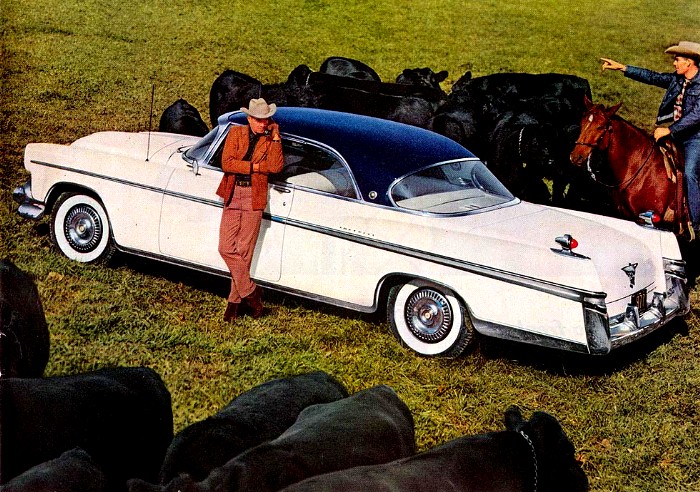
My test car was a solid white
two-door hardtop and though this might be garish on some lesser automobiles,
on the test car it seemed to give even more meaning to the name Imperial.
The upholstery was the finest grade white leather with nylon tapestry
trim. It made you wonder on opening the door, “When are the
harem girls that must go with this Sultan’s barouche?”
The hood line, the most modern of the top-price three, slopes down
so that your eyes can get a sizeable bite of the road immediately
ahead. This vision is not cluttered with any gee-gaws to distract
the driver. The only forward ornament on the car is good old Herman
The Coot in jump position—and he can only be seen by walking
around front.
This is a big car—make
no bones about that. It has a wheelbase of 133 inches, an overall
length of 229 and an overall width of 78.8. It hits the scales, dry
as a bar car going through South Carolina, at 4,530 pounds.
As this is an important entry
in the race for America’s Top Prestige Wagon, my tests were
a lot longer than I usually make and covered over 5,000 miles in extreme
conditions that varied from 18 inches of snow to tropical late-spring
heat in the Florida Keys. In my many years of driving, at times in
some pretty fancy cars, I’ve never driven anything that received
more voluntary compliments than this one. At the Angler’s Club
in Key Largo where I went for some shooting (dig that, shooting at
an Angler’s club), it created quite a sensation among the Continental
and Eldorado Set.
One day in the Keys when the
temperature was pushing 100. I snapped the air conditioning on to
Full and felt like a rich Greek gambler as I tooled up a roasting
US#1. In a snowstorm that dumped 18 inches on my New Jersey mountain,
I found this big car had a lot better traction and plow-through than
many other American models I have driven in the last few years under
such conditions. The power plant is Chrysler’s big 354-cubic-inch
mill developing 280 hp. The transmission with pushbuttons has been
changed on the Imperial models of just a few months ago. On the late
model ’56 Imperials an extra third speed has been added which
gives it a lot more flexibility and dig than when it was first introduced.
Engine-wise, this is basically the same car as the Chrysler New Yorker.
The original models, due to their extra size and weight, were not
up to the New Yorkers in traffic light get-way. With the addition
of this third-speed button control the big Imperial will now out-nose
the New Yorker by just a whisker in fact passing or in getting away
from an angry mother-in-law on a motorcycle. These Imperials, when
properly tuned, will get up to a full 120 mph and will cruise at 80
with no more effort than it takes to down a milkshake.
The proof of any car’s
real roadability comes in putting it over the road. I left Florida
one night on my northern test leg with the car loaded like a paddy
wagon after an Irish wedding. Hour after towards New York with all
the comfort of riding in the lushest Pullman. In hard turns and bends
I found it biting in and holding on like a bat in a wind tunnel.
Jim McMichael who was behind
me in my own car finally found out the real reason for the Mars-type
taillights. On this trip we ran mile after mile with almost zero visibility
through smoke caused by a series of forest fires that came right up
to the road’s edge. Jim told me, when we stopped for coffee,
that those taillights stood out like Gina Lollobrigida in a Boy Scout’s
suit. When this lights were first introduced on the original Imperials
they resembled moose antlers on a canary. They are now a distinctive
trademark of the car and a useful one, too.
Due to the full-time power
steering, this is the easiest-handling-and-controlling car of mastodon
proportions that I’ve ever driven in city traffic where you
grunt and groan two feet at a time. Whether you like power steering
or not, in traffic with a big car it’s real great. If you’re
going to have power steering, then go all the way and have it full-time,
like Chrysler’s. Anything less is like playing catch with an
ice cub to save the price of an air-conditioning unit. There was a
time when guys with little wives never expected them to drive big-sized
family buckets because the sheer physical strength needed just to
park would have developed her into an Olympic discus-throwing champ
in a matter of months. As all you old-time readers know, I’ve
been a booster of small cars for many years and haven’t wavered
from this point one inch, even now. But when we do have big cars it’s
nice to know that from a physical output standpoint there is no difference
in the handling, regardless of size.
I still get in a lot of arguments
regarding power steering and specially Chrysler’s full-time
power. The arguments usually center around the fact that “you
don’t get the road feel” that you do without power steering.
This is absolutely true and no argument could change it. You do get
more road feel without power steering. But after several thousand
miles with full-time power steering, if you’re a good driver
you become sensitized to this new effortless method and suddenly you
find you have as much road feel and knowledge of what’s going
on as you ever did, only the sensation is coming to you differently.
It’s like a piston pilot of many years’ experience going
into jets for the first time. It’s a different feel but the
end result is the same—and much faster. For real competition
and hard road driving I would still prefer non-power steering and
a correctly-balanced car. However, power steering has advanced and
after more than 50,000 miles of driving cars so equipped I’m
finally convinced that there is a definite place for it. Especially
in luxury liners where ease of operation is more important than how
the car could get through White House Corner at LeMans at full throttle.
In summing up, the Imperial
is a full-bore luxury car, jammed full of goodies for everyone who
has the price and is not interested in winning the next steeplechase
at Belmont. There isn’t a car made in America today offering
more interior luxury, combined with top performance, than the new
Imperials. Mechanically they are sound, gutty and reliable, using
the same power plant as the world record-holding Chrysler 300 tamed
down for civilized use.
SPECIFICATIONS
Model tested |
1956 Chrysler Imperial hardtop
|
ENGINE
|
Type |
V-8 |
Valves |
OHV |
Bore x Stroke |
3.94 x 3.63 inches |
Maximum torque |
380 ft-pounds @2800 rpm |
Brake horsepower |
280 @4600 rpm |
Compression
ratio |
9.0 to 1 |
DIMENSIONS
|
Wheelbase |
133 inches |
Overall length |
229 inches |
Front tread |
61.3 inches |
Rear tread |
60.4 inches |
Width |
78.8 inches |
Height |
60.4 inches |
Weight |
4,530 pounds |
Standard tire
size |
8.20 x 15 |
Gas tank |
20 gallons |
PERFORMANCE
|
0 to 30 mph |
4.2 seconds |
0 to 50 mph |
8.2 seconds |
0 to 60 mph |
9.8 seconds |
0 to 70 mph |
13.9 seconds |
Top speed |
115-120 mph |
Speedometer
error |
At 60 mph on speedometer, actual
speed 59.7 mph |