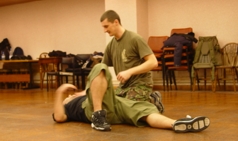
The other way one can be immobilised is to have a joint or combination of joints twisted or pushed outside of the normal range of motion. The resulting body tension and possibly compliance are the result of what many martial arts call 'joint locking'. It is very difficult to apply a joint lock effectively; the limb has to first be captured and then the correct direction of movement applied. However once a lock is on, resultant tension can increase rapidly and must be dealt with. When learning, this can be achieved by breathing in short, rapid pants and results in a controlled relaxation, giving room to manoeuvre and preventing injury through tension. By following the path the pain dictates, you will be able to come out of the lock or find some way of preventing the lock from continuing in its intended direction - creating or finding an obstacle for example. Once learnt, these actions can be taken pre-emptively - a close range 'grab and escape' drill.
Other, more creative locks will immobilise the joint as well. In such circumstances, it is good to remember that only one limb has been immobilised - the rest of the body can help by striking, moving or supporting the joint in some way.
It also helps greatly to pay attention to form. Many locks and takedowns function by first breaking the form of the skeleton through tension or leverage on open joints (i.e. the person is no longer upright or balanced) so that the muscles are forced to take the load. In this situation it is difficult to move or even remain standing. However if the form is restored, often the lock or technique is broken.
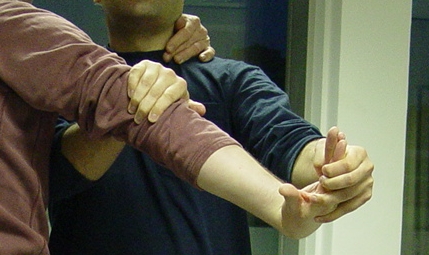
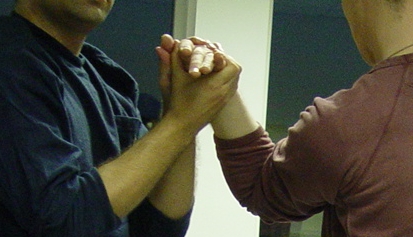
Chokes and strangles are another area to work in when considering close contact. Most chokes and strangles are very effective in situations of limited mobility, but can take time to set up and apply. Some chokes rely on the clothing while others use the forearm or even the shin. Strangles largely use the hands. Escaping from these situations can be very difficult because of the short period of time afforded once the technique is applied. Most escapes are made by creating space within the choke by squeezing a shoulder into the space available or by small joint manipulation. Keeping the form or restoring the form as quickly as possible is essential. A good example of this is seen in the so called 'guillotine' choke, where the victim is bent right over toward the choke, with the head at waist level. Affecting an escape from this position is difficult as dropping the hips can increase the intensity of the choke. In such a situation, one has to explore other movements; if the aggressor's hips are forcibly moved away from the head, the stability of the position is greatly reduced and escape may be possible by reaching for the persons head with the closest arm. Once the form is restored, the choke disappears. Generally, it is best to recognise the potential to be choked and work pre-emptively.
Rules
The other advantage a Systema exponent may utilise is to work outside the assumed rules of such a situation. For example sport arts like Judo forbid striking, touching the face, and limit use of the feet, leg joints and clothes. So called 'no-holds-barred' type encounters allow certain types of striking but prohibit small joint (wrist, fingers, and ankle) manipulation. A position which is considered most disadvantageous is to be under 'the mount'. This is where your opponent is sitting on your chest facing you, and may punch downward at will. However we can see that manipulation of the ankles, arms and attempting to climb up all disrupt their balance to the point of 'dismount'.
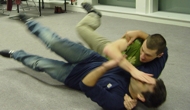
To pin or quieten a person within a grappling or post-take down situation is to limit contact to one or two points without heavy or restrictive use of the bodyweight. This distance tends to stop a wrestling match developing. We then apply what could be considered 'active' restraint rather than 'passive' restraint (where you lie on top of the restrained). Active restraint can be achieved by applying pressure to the body where a movement begins, thus stopping the potential escape before the movement gathers momentum. Because you are not laid on your opponent you are free to look around and move if necessary. An additional effect of this type of work is that the person progressively becomes exhausted and calmed through a feeling of helplessness.