
Habitats
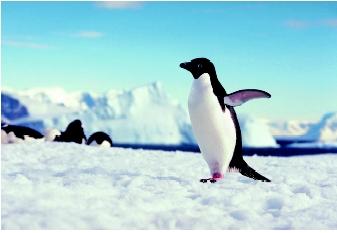
Penguins generally live on islands and remote continental regions free from land predators, where their inability to fly is not detrimental to their survival.These highly specialized marine birds are adapted to living at sea - some species spend as much as 75% of their lives at sea. Penguins are usually found near nutrient-rich, cold-water currents that provide an abundant supply of food.Different species thrive in varying climates, ranging from Galápagos penguins on tropical islands at the equator to emperor penguins restricted to the pack ice of Antarctica.
Adult penguins usually disperse from breeding rookeries to feed in coastal waters. Studies have found that adult emperor, Magellanic, and Humboldt penguins travel long distances between feeding and breeding grounds.Young birds usually disperse when they leave their colonies and may wander thousands of kilometers. They generally return to the colonies where they were hatched to molt and breed. |
 |
|
Nutrition
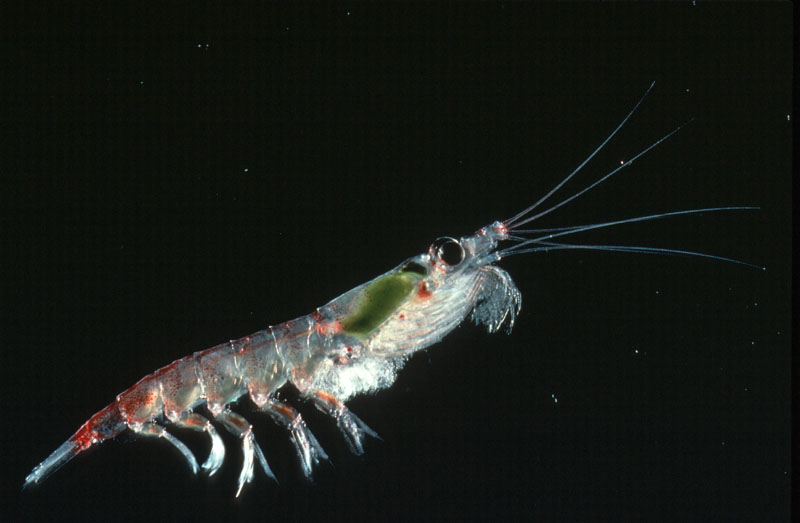
Penguins eat only sea-food. Their favorite food includes fish (especially anchovies), squid and krill. Penguins catch food with their beaks and swallow it whole while swimming. Penguins have a spiny tongue and powerful jaws to grip slippery prey.Every year, penguins will go through fasting periods (a period of time when they don't eat). Before fasting begins, penguins eat a lot and build a layer of fat in their bodies, which will provide them with energy during the fasting period.
|
Predators
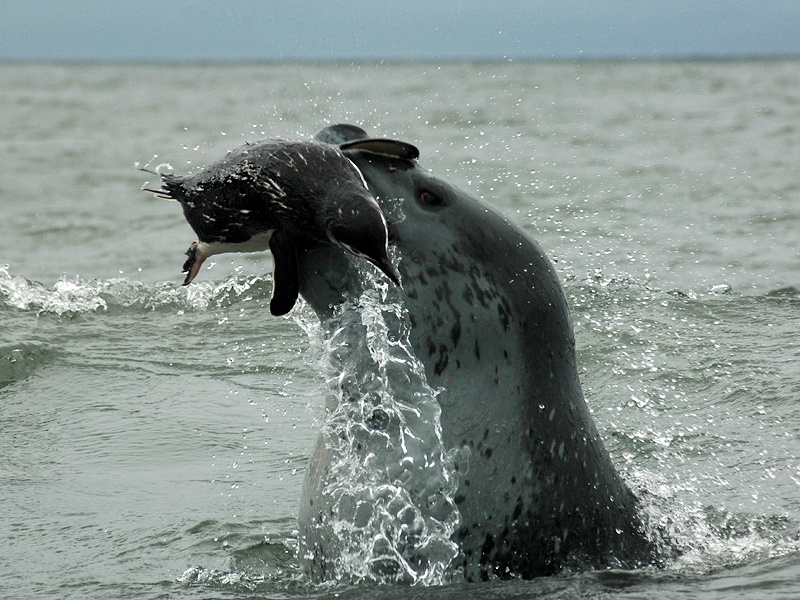
Natural enemies of the penguin include seals,killer whales, and, in the case of young chicks and eggs, several species of seabirds. One type of seabirds,Skuas
pose a potential threat to the unguarded nest or chicks. Another type is,a sheathbill, they
interfere with the feeding of penguin young and food is dropped onto the ground and the result is a happy sheathbill and a hungry penguin chick. The third type is Caracaras,
wait for nests to be left unattended before snatching chicks in a hawk-like manner. One of the most deadly predators for a penguin, is a leopard seal. The seal can be harmless in land but, in warter they pose as a deadly predator. |
 |
 |
Penguins life cycle
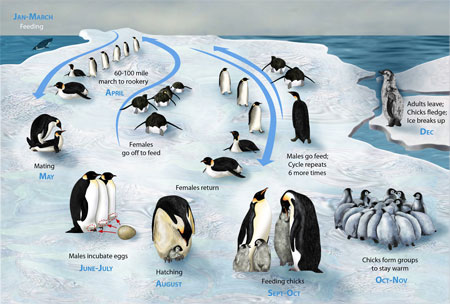
Every year, female and male penguins get together to mate. Penguin mothers lay one or two eggs in a nest. The nest can be made of grass, a circle of stones, or a burrow under the ground or ice. The penguin mother and father take turns incubating the eggs, which takes between one and two months, depending on the species. The chick then chips it way out of the egg. When the chick grows up, it finds a mate, which it usually keeps for life.
|
Penguin characteristics
In addition to these countershaded colors (common to all species), different species have specific colors for some body parts.Like all birds a penguin has a bill or beak . It is mainly used to catch food, but is also used to preen the penguin's feathers. Size and sharpness of the bill vary with the species. Species that mainly eat fish have longer, thinner bills, while species that mainly eat krill have shorter, thicker bills.A penguin doesn't have teeth. Inside the bill there are spiky spines pointed towards the throat that help in swallowing living food. Penguins also have tongues, however these are not often seen since they are short.Penguins have very short legs, which are used under water for steering. On land it's not easy for a penguin to walk. Waddling seems to be the easiest way to walk with short legs (in fact this has been researched by scientists). In addition, some species displace themselves by hopping over the ground.Although you don't see them, penguins do have knees and upper legs. They are completely enclosed within the penguin's body. The upper leg is oriented horizontally. In contrast to other birds (whose feet are placed in the middle of their body) a penguin's feet are set all the way back, causing an upright stand.All penguins have webbed feet, an adaptation to their aquatic lifestyle. They also have sharp claws.
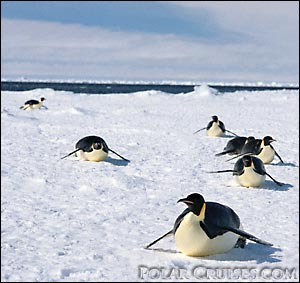
Emperor penguins that are standing still, rest only on their heels. They point their feet in the air, minimizing contact with the cold ice.
|
 |
Resources
- Wikipedia.com
- coolfacts.com
- Patrickdepinguin.com |
|
|