Background of the
Nepalese & Tibetan Carpets
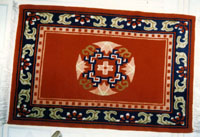
The latest and best stockiest of Nepali/Tibetan carpets in the latest Designs and Color combination, in all sizes, raging from 60 x 90 to 350 x 450. You will find all your requirements under one roof.
Historical perspectives on early nomads, culture and carpets on the Tibetan frontier:
The Tibetan frontier, the area on the another edge of Tibet also the old silk rout, has had a lost association with weaving and carpets making, /since the4 first nomads venture onto the Tibetan steps and started raising sheep and yaks, perhaps 3,000 or more years ago, their very existence depended on spinning and weaving skills for survival. These talents continue, in an intact legacy even now among urbane Tibetans.
The Tibetan Frontier was an important crossroads for trade; even two millennium ago, with well established caravan routs liking ch8ina, Tibet, India and Europe. The movements of nomadic people and traders on the steppes of Central Asia had a major effect on the later historical development of dynastic and kingdoms throughout the region. These tribal circulations and trading caravans would also have influenced waging land carper making traditional. Since the beginning of Tibetan civilization. Tibetans were exposed to various Central Asian carpets and weaving center, weaving techniques moved also the Tibetan Frontier linking cultures and people/Overtime. Various ethnic influences and trend aware absorbed by Tibetans and incorporated into the formation of their own unique aestheticsyle. An allegiance that is finally starting to be better appreciated.
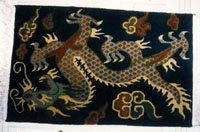
Understanding the myriad ethnic composition, movements of peoples, and historical development on the Tibetan frontier region is helpful in discerning the evolution of the carpet making tradition in Tibet. In the process of learning about the assortment of peoples adulteries Tibetan were in contact with from early on, one acquires, a greater appreciation for the richness, vitality, and heritage of Tibetan carpets, which have their own singular identity.
Early weaving
The origin of weaving in the Tibetan Frontier
region are linked to the beginning of Chinese history in the area of the
Upper Yellow River –the region where the great Bend of t4h Yellow River
comes flowing down out of the steeps as the loess highland and onto the
great plains of china. This fertile area, in local’s proximity to the vast
grassland and steppes of both eastern Tibet and Mongolia, is now generally
believed to be the cradler of Chinese civilization. Before a separate line
of "Chinese" culture and history began to develop in the Yellow River Basin
in the Xia Dynasty (2000-1600 BC), primitive peoples would have been
scattered throughout the region. Early weavings skills were developed from
the braiding and weaving of fishing nets. Baskets and mats among these
Neolithic tribes, Pieces of primitives looms, that resemble back strap looms
in use today by Tibetan nomads, have been found in western china that are
7,000 years old. It was in the Yellow River region during the Shang period
(1600-1027 BC) that intensive agriculture evolved in china, Wheat was
introduced from the Middle east and expanding agriculture led to the rise of
walled cities and " a sophistication" created a grow sin demand for finely
woven materials especially silk. Silk waving in china dates back to about
4000 BC and silk fabrics have been found in western china that are over five
thousand year old. By the Xia dynasty, woven fabrics were already valuable
trade item in china but it was only late the shang period that treading of
silk became widespread, silk weaving became and industry during the Zhoiu
period (1027-256 BC) with government departments to organize the gathering
of raw material and the managements of spinning, dyeing and weaving.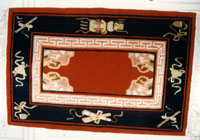
There is something special about the Nepalese Tibetan carpets, something which draws the buyer, and makes the "Tibetan" Carpets of the other countries seem like poor imitation, people often ask what makes the Nepalese –Tibetan carpet unique. In work, it’s the texture. The look. A special glow of the colors and special richness of the pile. It arises from almost alchemical combinations of handwork, dyes and washes which unleash the natural beauty and strength of high quality wool. The results is a warm, harmonious texture that people want to walk on, sleep on, live with. The Nepalese –Tibetan carpet is a living folk tradition, rooted in antiquity, which continuers to mirror the minds of its creators, In each carpet is revealed the hand of the spinner, the hand of the weaver and the vision of the designer. This is what Thomas L.Guta calls "Texture Tradition" of Tibet, and is the key to carpet making in Nepal. It cannot be reproduced anywhere else.
Carpet making in Nepal is in no sense a mechanical process, so mechanical indicators of "Quality" such as knot count or pile height are in themselves of little value, the look of the Nepalese-Tibetan Carpet arises from an indefinable combination of workmanship and material and its creator is as mysterious as the origin of the carpet in Tibet. For textural quality to appear out of chaos of hands and wool, the spinning, dyeing, weaving, trimming and washing mush be combines perfectly and they are combined by hand.
Hand spinning enhances the natural resilient character of the long stapled, lustrous Tibetan wool. The high quality dyes bond with Tibetan wool in special way, creating unique coloring rich and alive, harmonious and warm, When properly done there is a life and depth in these carpets that is missing in the cold, metallic look of machine spun, machine woven carpets, Subtle gradations of color flow through the carpets fields, analogous to the limitless hues of nature itself. The patterns and colors of the Nepalese Tibetan carpet seem to come alive, in a woolen ground as rich and fluid as a field of wheat or a tiger’s coat, In the experts hands of the Nepali weaver, the warp, weft and unique Tibetan knotting system form the textural foundation of the carpet, Here tensioning and proper knot ration and proportion maximize the remarkable tensility o Tibetan wool forming the field upon which colors can play.
While stylizations of ancient design continue, the Nepalese Tibetan carpet also display the unfettered creativity of modern design which allow the texture, color and abrash to come to the fore, Careful trimming and embossing bring the designs out the carpet to meet the eye and finally, special wash makes the entire creation shimmer like the moon on water. All of this unique in the modern carpet world. It is the spirit of the people that has kept this singular tradition alive. Having come over the Himalayan with the Tibetan refugee, the crafts of the weavers and spinner have been passed on to a whole generation of enterprising people of many backgrounds from their hands spinning and weaving, trimming and dyeing comes the special look that makes the Nepalese- Tibetan carpet unique.
Price is as follows:
- 60 Knots= US$ 55/Sq.M
- 80 Knots= US$ 75/Sq.M
- 100 Knots= US$ 100/Sq.M
- 100 Knots= US$ 150/Sq.M (Vegetable Dye)
Note: 10 % of the profit goes to the NGO (Meet Nepal), which work for street children, woman empowerment, and victims of HIV/AIDS.
For more Detail Please contact us:
Mr. Samden Sherpa

P.O.Box No: 13561
Tel #977-1-255441
Thamel, Kathmandu.
Nepal.
E-Mail: [email protected]
And about the Beauty + Hair Saloon.( Image )
Image has been one of the best place for those who are conscious on beauty. Our well trained beauticians are always ready for satisfying our invaluable customer. For to be a handsome personality please visit us.
Our service are as follows:
Hair cutting, Hair colouring, Henna colouring , Perming, Face Massage( Aroma,Herbal,Ayurvedic), Face Bleaching ,Waxing , Henna Painting in hand and Legs, Piercing ears and nose, Manicure, Padicure, Hair Treating, Body Massage and also different kind of Therapy to stay young and charm Like Water Therapy , Aroma Therapy, Color Therapy.
For more detail Please contact us:
Ms. Shraddha Thapa

P.O.Box No : 13561
Tel #977-1-255441
E-Mail: [email protected]