|
For the complete article, click here.
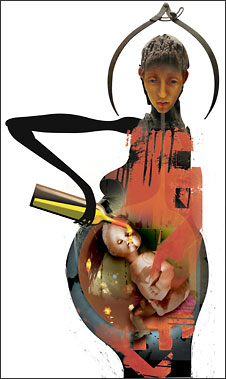
Stopping fetal alcohol syndrome: Women who drink need treatment If you've ever cringed while watching a pregnant woman take a drink, perhaps it is because you've seen the warning labels on bottles of alcohol or read Michael Dorris' book, "The Broken Cord," about his son's struggles with fetal alcohol syndrome. Maybe you've seen a public service announcement, a high school science textbook or a magazine article about FAS. Perhaps you keep up with the news and know that just a few weeks ago, the U.S. Surgeon General updated a 1981 warning advising pregnant women and those who might become pregnant to abstain from drinking in order to prevent the birth defects caused by prenatal alcohol exposure. Absent from this warning was a call for increased services (including insurance coverage for treatment) for alcohol-abusing women. The most serious effect of prenatal alcohol exposure is fetal alcohol syndrome. People with FAS often have problems with learning, memory, attention span, communication, vision and hearing. They struggle with difficulties in school and have problems getting along with others. Thousands are born with the condition each year, adding to an already large population of FAS-damaged individuals. The modern history of FAS began in Seattle in 1973 when medical researchers at the University of Washington reported that alcohol was a teratogen, an agent that causes birth defects. The announcement was greeted with understandable skepticism. If alcohol exposure in utero harmed fetuses, why had no one noticed before? Alcohol, critics correctly pointed out, had a long history of use and abuse. In fact, credible medical reports about the effects of alcohol on fetuses had been appearing for a century -- but to little notice. Physicians and the public paid attention in 1973 because they had learned, dramatically, that the womb was not a barrier protecting the fetus. Revelations in the 1960s about birth defects caused by thalidomide and by a rubella epidemic quickly educated the public about fetal health. Subsequently, the women's health movement brought women's alcoholism out of the shadows with demands for new research and treatment protocols. With these changes in knowledge and attitude, the federal government sponsored studies and issued a warning. In 1977 the National Institute on Alcohol Abuse and Alcoholism declared that when pregnant women consumed six or more drinks a day, they significantly raise their risk of bearing a child with birth defects. By 1981 the warning broadened when the acting Surgeon General cautioned pregnant women and those thinking of becoming pregnant "not to drink alcoholic beverages." A number of cities and states promptly took action to prevent FAS, mandating that warnings appear in places where alcoholic beverages were sold. Then, in 1988, Congress passed legislation calling for warnings on alcoholic beverages. The labels, warnings and cautionary publicity proved effective in reaching millions of women who subsequently chose to abstain from drinking during pregnancy. Others, especially those with severe drinking problems, often failed to heed the warnings. Rates of FAS did not decline. Shortly before the bottle labels appeared, America's only "failure to warn" case against an alcoholic beverage manufacturer began in Seattle. The issue in Thorp v. Jim Beam revolved around the questions of whether Michael Thorp had FAS and, if so, whether the company should be held responsible. Discussions of the trial reflected larger cultural questions. Were alcoholic beverage manufacturers to blame when their products were misused? Did manufacturers have a duty to warn against misuse? Were pregnant women alone responsible for the health of their fetuses or did society have a responsibility as well? In this case, the jury found in favor of the distilling company, but the questions raised during the trial continued to be debated. A few years after the Seattle trial, public concern about crack cocaine brought new attention to the problem of substance abuse by pregnant women. Media attention to crack-using pregnant women unfortunately moved accounts of FAS from public health reporting to crime news. |
Relation to text Teratogens are any substance taken in or condition felt by the mother during her pregnancy that could affect the child and increase the risk of prenatal abnormalities. And example of this is Fetal alcohol syndrome (FAS), which is caused by the mother's drinking alcohol during pregnancy. This manifests in the child in several ways like abnormal facial traits, slow physical growth, and retarded mental development.
Another less intense form of FAS is fetal alcohol effects (FAE). FAS and FAE are the two leading teratogenic causes pf birth defects and mental retardation.
|
|
