 |
|
|
|
 |
|
|
|
| You're 14 - 15 weeks along |
 |
 |
 |
 |
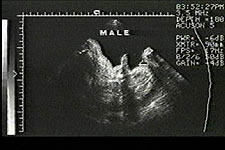 |
| It's a boy |
| 14 - 15 weeks |
| weight: 90 - 100 gm |
| length: 13 - 15 cm |
| Landmarks |
| The top of the uterus can now be felt above the pubic bone. This means you will start to "show." |
| Your baby can hear your voice and heartbeat. |
 |
| Heart beat is easily heard with a hand held "Doppler" machine. |
| The growth pattern of you baby is changing. During the first trimester, weeks 1-12, your baby's head grew rapidly. Now its thighs start to grow rapidly in length. They will grow an average of 5 cm per month. Soon you will feel them move. |
| Fetal nutrition |
| By the 14th week the placenta is well developed. It has four main functions: 1) It brings oxygen to your baby and takes carbon dioxide away. 2) It brings nutrition, electolytes, fatty acids, carbohydrates, and vitamins to your baby. 3) It brings your antibodies to your baby. One class of your antibodies, called IgG, pass through the placenta to your baby. Thus giving protection from infections. But these antibodies don't protect your baby from Chickenpox or Whooping cough. So please avoid any contact with anyone who has one of these infections. 4) It produces progesterone, the hormone that maintains pregnancy. It also produces HCG which is a growth hormone-like chemical. |
| So you are 14 -15 weeks along. You are 2 -3 weeks into the second trimester. That means you are one third the way there! Most women find the second trimester very exciting. The morning sickness leaves. The belly starts to show. The baby starts to kick. So enjoy this trimester. Enjoy watching and feeling your baby kick. |
| Although most of the lab test were done early in the first trimester, there is one that needs to be done at 16 and 18 weeks gestation. It is the Alpha-Fetoprotein (AFP) test. It is a test that checks if your babies spine has formed properly. Sometimes the spinal cord doesn't form completely. Two defects can occur. The first is called Spina Bifida and the second is called anenchephaly. Spina Bifida is a defect in the lower spinal cord. The cord does not close completely so there is a bulge of nerve tissue in the small of the back. Anechephaly is a defect of the head where the back part of the skull does not develope. (The chance of these occurring is 1 in 1000) AFP testing is offered to all women who are 16 - 18 weeks along. It is a screening test for spinal cord problems. It is a simple blood test taken from your arm. Since it is a screening test, other tests like ultrsound or amniocentesis may be needed if the test is high. The test is most accurate up to 18 weeks. This will give you time for counseling about continuing the pregnancy or terminating it if the baby's condition is grave. Remember that the AFP is only a screening test. There are many conditions that can cause a false + test. The most common is "poor dates." An ultrsound is always done to establish dates if the AFP is abnormal. Ask your doctor about the AFP as well as other tests for Down's syndrome. |