Welcome
to Iloilo, Philippines ( Part 2 )
General
Information
::::
Location and accessibility ::::
Located
238 statute miles from Manila, Iloilo is the gateway of the Western
Visayas Region. The province comprises the southeastern part of Panay
Island. Iloilo is 55 minutes by plane from Manila, 30 minutes from Cebu,
90 minutes from Puerto Princesa, Palawan, and one hour 45 minutes away
from Gen. Santos City. Should you opt to go by sea, Sulpicio Lines,
Negros Navigation and Aboitiz have ships plying from Manila (19 hours),
Cagayan De Oro City (16 hours), Zamboanga City (14 hours), Cotabato
(26 hours), Bacolod (a 2-hour ferry service), and Guimaras (a 20-minute
ferry pumpboat service).
Natural boundaries, such as mountain ranges with peaks as high as 7,000
ft., lie between Iloilo and Antique on the west and Capiz on the north.
Mainland Iloilo is composed of plain interspersed with upland portions.
The capital, Iloilo City, rests between the Iloilo and Batino rivers
which from the angle of a nose. This location is the root of the province's
old name, ilong-ilong which means "noselike".
::::
Climate ::::
The
climate is tropical, with two pronounced seasons: rainy from June to
Septmeber and dry, from October to May.
::::
Language ::::
Hiligaynon
(Ilonggo) is the major dialect, although English and Tagalog
are also widely spoken and understood, especially in urban areas.
::::
Political Subdivision ::::
Iloilo
is made up of the city and 43 municipalities, and divided into five
congressional districts. Iloilo province has 1,720 barangays.
::::
Major Industries ::::
Iloilo
province is primarily the commercial and trade center of Western Visayas,
with commercial, industrial development and rural banks, financial and
investment houses, insurance companies, and realestate agencies and
developers. Nevertheless, agriculture is the province's main source
of livelihood. In fact, Iloilo's production of rice, sugar and mango
has made it one of the country's top agricultural producers.
Fishing is the second biggest industry, for Iloilo has rich fishing
grounds. This is the site of the Southeast Asian Fisheries Development
Center which conducts researches on the spawning of milkfish and prawns;
and the University of Philippines (Miag-ao) which is the center of marine
and aquatic studies in the Philippines. The multi-million peso Iloilo
Fish Port also helps maximize the production of inland and deep-sea
fisheries in Western Visayas.
The Iloilo Commercial Port Complex, the first island pier in the country,
is a multi- purpose port terminal which caters to both domestic and
foreign containerized and convention sites.
Cottage industries include pottery, ceramics-making, weaving, woodcraft
and handicraft.
Transportation, tourist and telecommunication facilities
Shipping campanies, bus and taxicab operators, car rental agencies,
travel and tour operators will help you on your way to any point you
wish to go. The PAL office at the domestic airport will help you make
arrangements for connecting flights to your next destinations. Should
you find yourself in a fix, contact the mearest Departmant of Tourism
information booth.
Iloilo has six major hotels and numerous pension houses to accomodate
tourists, and which may also serve as convention sites.
Shopping complexes, restaurants, native food centers, sports and recreational
facilities are ready to enter to your shopping, dining and leisure needs.
Here's a tip : to those who wish to go on a gastronomical adventure
may visit the native reataurants along Villa Beach, downtown Iloilo
area or along Diversion Road. You may also get up before dawn and visit
the Iloilo Fishing Port, when the fishermen unload their catch; there
are many food stalls willing to cook the dripping - fresh seafood for
your sumptuous meal. Most establishments open for business at 8 AM;
close at 5 PM (government offices), 3 PM (banks), and 7 PM (most commercial
establishments). Post offices, telegraph and telephone companies ensure
that you are constantly in touch with the world. Iloilo's ideal location
makes it easy for people from neighboring provinces to avail of these
facilities.
::::
Philippine s' Southern Gateway ::::
Iloilo
province, and its beautiful city, ranks as one of the country's foremost
centers of culture, industry and trade. Located on the southwestern
tip of Panay Island between the Iloilo River and the Guimara Strait,
its attributes as the repository of architectural and artistic legacies,
as the promising point of progress in aquaculture, and as a trove of
unexplored tourist attractions give it an allure so bewitching as not
to be missed.
Iloilo is the cradle of early Philippine civilization. The telltale
marks of such cultural influences live on in the century-old houses,
the period churches, the colorful festivals, and in the enterprising
bloodline of its people. Iloilo has a glorious past as the land's great
sugarbowl and the locale of the haciendas of the old rich - whose scions
and daughters turned down the centuries into the dons and donas of powerful
economic dynasties.
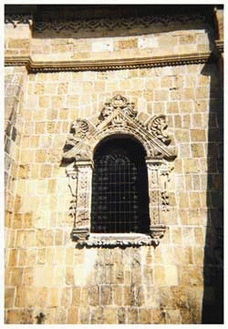
Some of the testimonies to this awesome heritage are the churches. Nowhere
else can church tours prove so rewarding. The Miag-ao Fortress Church
is a grand example of a medieval bastion church with onrnate floral
designs on the facade; another colossal monument is the San Joaquin
Church and cemetery known for its bas relief featuring the Castilian
and Moorish wars, while its cemetery is picturesque for its hexagonal
chapel with rose windows and twin-tiered balustrades that lead to its
entrance; meanwhile, three staircases lead to the historic rock; whereas
the Rennaissance - inspired Molo Church and orphanage, the Asilo de
Molo, are unique for their architecture as well as for a rare product,
hand-embroidered barong Pilipino in pina cloth; the Pavia Church is
a red brick and coral windows cases and rightfully deserves a place
in one's travelogue. These churches are no farther than two hours' distance
from each other.
Iloilo's is a byword for its famous festival - the Dinagyang, a local
mardigras. Held every January in honor of the Infant Jesus, the festival
is a major tourist attraction. Another even Iloilo is known for is the
Paraw Regatta. Which is participated in by local and foreign sportsmen.
Iloilo is a trove of historical sites. Tour the province's famous sunset
strip, Fort San Pedro or the flower-decked La Villa Rica de Arevalo,
site of the Hispanic governance. Or one can visit another historical
landmark, Plaza Libertad in the central city district where the flag
of the Philippine revolutionaries was first raised upon Spain's final
surrender. Old paintings, tapestries, furniture and memorabilia may
be viewed in the Museo Iloilo and also in private galleries deeo in
the heart of the city.
Iloilo may be relished by nature trips to its delightful beaches that
are best for swimming, snorkeling and other water sports.
Igbaras, an hour and fifteen minute's drive from the city is sure to
captivate visitors with its waterfalls, climbing hills, crystal caves
and springs. Another cave haunt is Dingle, only 35 minutes from the
city proper - it also boasts of a number of religious shrines and healing
springwaters. Sicogon Island and the Islas de Gigantes are nearby isles
which are laced with shimmering sands and deep blue waters that teem
with marine life and corals. Pavia, a ten minutes drive by jeepney,
is noted for its red brick Church while memories of the past may be
evoked by visits to Janiuay, where ruins of abbeys, cemeteries and watchtowers
still stand to mesmerize the traveller. For a view of grand mountain
canyons, a drop-by at Bucari Mountain Ranges in Leon 28 kilometers away
is simply thrilling.
Visits to the colleges of agriculture in Leon and Lambunao, and the
fisheries college of Barotac Nuevo. Show that the province is a hive
of economic progress.
Today, Iloilo still reigns as the gateway to the Visayan belt. Its riches
are more plentiful than ever on the combined merits of industrial significance,
historical antiquity and natural poetry.
END
|

![[ Photos ]](images/photos.gif)
![[ Mini - Maps ] NOT ACTIVE YET](images/mini_maps.gif)
![[ Hotels & Events ]](images/Hotels_Events.gif)
![[ Links ]](images/Links.gif)
![[ E-mail ]](images/e_mail_me.gif)