Basic GPS theory is rather simple. First of all, when your GPS receiver picks up a satellite,
it figures out how far away the satellite is. It does this using pulsed RF transmissions.
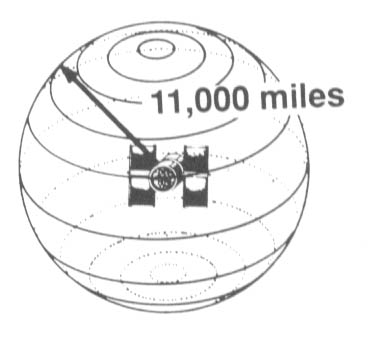
Now, let's say that you have found a satellite and figured out you are 11,000 miles from
the satellite:
1. Your possible position is limited to any point on the surface of a 11,000 mile diameter sphere.
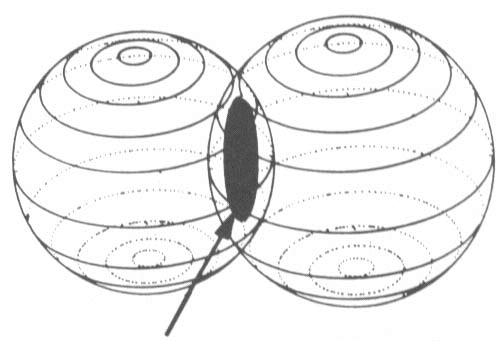
2. With 2 satellites, your position is limited to a circle points.
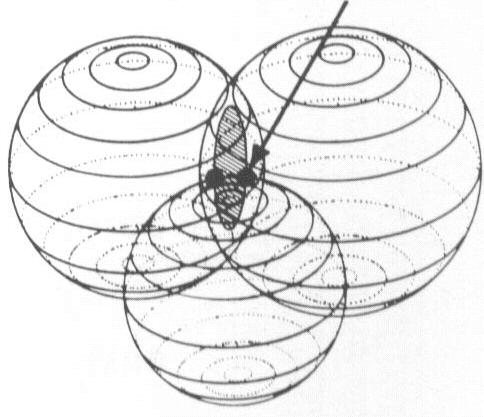
3. With 3 satellites, your position is limited to 2 points, one of which will be unstable
and is discarded since it will be moving rapidly in comparison to the other which is your
position.
Remember that these spheres that represent your possible positions, will contract and
expand as the satellites move away and toward you. If you were to increase the size of
the sphere without the satellites moving away from you, an inaccurate nav solution would
be resolved. Since the system relies on distance between the receiver and satellite and the
distance relies on time based calculations, inaccurate time calculations would will
produce inaccurate distance calculations, which will result in an inaccurate navigation
solution. This is why the satellites are equipped with multiple atomic clocks and the
receiver, if not equipped with an atomic clock, is equipped with a very accurate clock.
ARN-151 LRUs
R-2325 - The RPU (Receiver-Processor Unit)
AE - The AE
Basic Troubleshooting
The ARN-151 system is pretty simple. Most problems can be solved by changing
either the RPU or even the AE, and the GPS test can help steer you toward
the right LRU. Just be sure to check out your antenna lines and connections
if you're getting an AE fault.
And remember, just because the GPS test comes up with a fail, this doesn't
mean the system isn't good for flight. More often than not, GPS will fail,
yet the system isn't written up and the FOM drops to 1 quickly. When
checking out a system that's been written up, the first thing you should
do is enter accurate date and GMT information, then run the GPS test, and
then finally, go to the DATA page (since test will put it in NAV automatically)
and watch. If you don't get any satellites whatsoever after 15-20 minutes, you
may have a problem. I say may, because you must remember that GPS is a line
of sight system. If the aircraft is parked too close to a hangar, you may not
be able to get any satellites. Not to mention, your geographical position
may not be suitable for proper satellite communication. And on a smaller scale,
anything immediately blocking the antenna (like rotor blades) can cause
problems as well.