Traditional Dances
Dancing is a good way to stay in touch with your roots. It's an important part of our Hispanic/Latino heritage. Our ancestors celebrated special occasions, festivals, and holidays with traditional dances and music. Most traditional Hispanic dances were influenced by African and European rhythms and melodies. Dances are a blend of culture and tradition. Ask your parents or grandparents about who in the family would know traditional dances they grew up with. Can they teach you? The following dances are some of the more well known in hispanic countries.
|
|
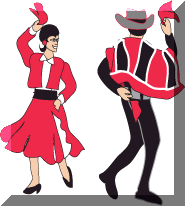
Cueca is the national dance of Bolivia and Chile. It is a very expressive and playful dance in which a man tries to a get a woman's attention. Each person holds a handkerchief in the right hand and waves it around and around! It's a lot of fun to dance cueca with a group of people.
Cumbia is a traditional dance from Columbia it combines African rhythms and Hispanic melodies. In a folk setting, the women wear long and flowing brightly colored skirts or checkered skirts. Men wear no shirts, a sombrero, a machete to the side, a red scarf, and a pair of white rolled up pants. Today there are many ways to dance cumbia. You can combine it with other salsa dance steps to make it more fun!
|
|
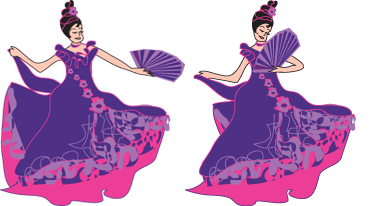
Flamenco
is a traditional Spanish folk dance. It was born in Southern Spain and
combines guitar, song, and dance. The Arabs, and Indians contributed to the
molding of the modern day dance. It's a very beautiful but complicated dance to
learn.
|
|
Jarabe Tapatío
is the official Mexican dance otherwise known as the Mexican Hat Dance. The man
wear the typcial outfit of the Jalisco horsemen or charro.The woman, the china,
wears a bright sequined skirt and a delicately hand-woven shawl.
Mambo has its origins in Cuba. This dance is a fun combination of swing and Cuban music. It also has some African, Cuban, jazz, hip-hip, and ballet influences. Mambo became very popular here in the United States in the 1950's in New York and Miami. Fans of mambo were called "mambonicks"!
Rumba
comes from Cuba and is influenced by African rhythms. It became popular in
the United States in the 1930's. The basic step is quick-quick-slow,
quick-quick-slow and is danced in 4/4 time. This is a good dance for beginning
dancers because it is danced slowly. You can try it as a breather between salsa
and merengue!
Samba was born in Brazil. It's danced during the street festivals and celebrations such as Carnaval! There are many versions of the Samba. Some of the most popular versions include: Carioca, a Baion, Conga, Mesemba, a Batucado, and Carnivale.
Tango is one of the most complicated dances. It has its origins in Buenos Aires, Argentina. Like many other traditional dances, tango is influenced by African rhythms. There are many styles of tango: Argentinean, French, Gaucho, and Internationa
Merengue
is the national
dance of the Dominican Republic, and also to some extent, of Haiti.
Merengue is a combination of two dances, the African and the French
Minuet, from the late 1700's - early 1800's. The black slaves saw the ballroom
dances in the Big Houses and when they had their own festivities started
mimicking the "masters' dances". But the Europeans dances were
not fun, they were very boring and staid, so over time, the slaves added a
special upbeat (provided by the drums), this was a slight skip or a hop.
Cha-Cha
Originally known as the Cha-Cha-Cha. Became popular
about 1954. Cha Cha is an offshoot of the Mambo. In the slow Mambo tempo, there
was a distinct sound in the music that people began dancing to, calling the step
the "Triple" Mambo. Eventually it evolved into a separate dance, known
today as the Cha Cha. The dance consists of three quick steps (triple step or
cha cha cha) and two slower steps on the one beat and two beat.
Salsa is
not easily defined. Who invented salsa? The Cubans, Puerto Ricans? Salsa is a
distillation of many Latin and Afro-Caribbean dances. Each played a large part
in its evolution. Salsa is similar
to Mambo in that both have a pattern of six steps danced over eight counts of
music. The dances share many of the same moves. In Salsa, turns have become an
important feature, so the overall look and feel are quite different form those
of Mambo. Mambo moves generally forward and backward, whereas, Salsa has more of
a side to side feel.