 |
| A L I P A S H A O F J A N I N A |
| Byron Child Harold, Lord George Gordon |
 |
| This article is dedicated in remembrance to Dr. Astridhis Kolia, an Arvanitis or Albanian, of Epirus, who got mysteriously murdered by the Greek secret Police. When Dr. Astridhis Kolia openly declared himself as an Albania, he was murdered by Greek government. |
| By: Edited by: S.K.-Shkupjani Q.K. from Shkupi March 10, 2006 |
 |
| News Albania Kosova Ilirida Plava & Gucija Valley of Morava History Literature Music Terror Human Rights |
| News Albania Kosova Ilirida Plava & Gucija Valley of Morava History Literature Music Terror Human Rights |
| Page 2 |
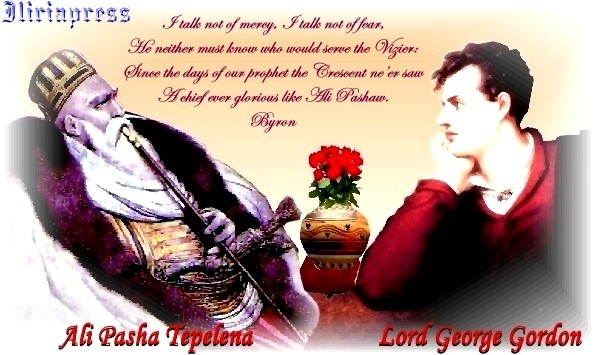 |
| Byron met several times with Ali Pasha of Tepelena, and he was a privileged guest and enjoyed a great respect from Ali Pasha. According to Hobhouse, Ali Pasha was civil and urbane in the entertainment of his guests, and requested them to consider themselves as his children. It was on this occasion he told Lord Byron, that he discovered his noble blood by the smallness of his hands and ears. Byron wrote a poem about Ali Pasha Tepelena, the Vizier of Janina: |
| I talk not of mercy, I talk not of fear,
He neither must know who would serve the Vizier: Since the days of our prophet the Crescent ne�er saw A chief ever glorious like Ali Pashaw. Byron |
| Albania and Albanians left a great impression on Lord Byron. Ali Pasha refused to give a portrait, and Ali put up a formidable resistance that Lord Byron immortalized in poems and letters. In the other side, Byron feared Ali. In his letter to his mother, Byron described Ali Pasha as, �His Highness is a remorseless tyrant, guilty of the most horrible cruelties, very brave, so good a general that they call him the Mahometan Buonaparte ... but as barbarous as he is successful, roasting rebels�� |
| In his notes, Byron wrote, the Albanians "struck me forcibly by their resemblance of the Highlanders of Scotland, in dress, figure and manner of living. Their very mountains seemed Caledonian, with a kinder climate. The kilt, though white; the spare, active form; their dialect, Celtic in its sound..." When in 1810, after my friend, Mr. Hobhouse, left me for England, I was seized with a severe fever in the Morea, these men saved my life by frightening away my physician, whose throat they threatened to cut if I was not cured within a given time. To this consolatory assurance of posthumous retribution, and a resolute refusal of Dr Romanelli's prescriptions, I attributed my recovery. I had left my last remaining English servant at Athens; my dragoman was as ill as myself; and my poor Arnaouts (Turkish name for Albanians) nursed me with an attention which would have done honor to civilization. |
| In marble-paved pavilion, where a spring
Of living water from the centre rose, Whose bubbling did a genial freshness fling, And soft voluptuous couches breathed repose, ALI reclined; a man of war and woes. Yet in his lineaments ye cannot trace, While Gentleness her milder radiance throws Along that aged, venerable face, The deeds that lurk beneath and stain him with disgrace. Byron |
| The Albanian territory that was ruled by Ali Pasha counted 1.5 million populations, and a union with Kara Mahmoud Pasha would create a strong Albania, perhaps, a world superpower of that time. A strong Albania was viewed as a threat for Europe and world especially for French and English. Therefore, the British kingdom ordered Byron to help Greek people. Even though Byron liked Albanians a lot, he respected the orders of his kingdom as a true patriot. Byron wrote a lot about Albanians; he was inspired by Albanian hospitality and genuine honesty; Byron admired Albanian bravery and courage. Byron made a portrait wearing Albanian clothes. The fabulous painter of London, Thomas Phillips, painted two copies of the portrait of Byron in Albanian clothes in 1835 and 1840. This portrait now is in the British Embassy in Athens. Byron wore the Albanian clothes with dignity and high respect. He praised the Albanian clothing and with a respect talked of clothing being the most magnificent in the world. Byron wrote only the true reality that he was seeing. Under the directives of his kingdom, Byron helped the Greek independency. The number of Greek population was very low when Byron visited Balkans. In the entire Balkan peninsula, only 300 000 Greeks could be found that time. The real and true name of these people was Gypsy from the ancient time. The people of Balkan Peninsula were calling the people or immigrants who arrived from Egypt in the short form as �Gypsy.� They were dark and some were black. The immigrants spoke the broken Latin. In ancient time the Latin language was the language of Romans and universal language that all countries were using for bilateral relation. The wealthy in order to be different from the poor and the others started to use the Latin language. Their servants started also to learn this language, but they spoke the broken Latin. This broken Latin language later was known as a Greek language, and with the modification of this language, today is known as a Modern Greek language. In the entire Balkan Peninsula, people were speaking a language that is known today as Albanian language. Especially, the militaries were strictly bound to this language. This can be confirmed even today by using the names or toponomy of the places. For example, �Nish� means one in Albanian language; �Bukuresht� comes from two words bukur- means beautiful, and resht - means row; �Thessalonica� Te - means to, salon means saloon, and ika - means run; �Qystendil� from the Albanian words qysh-that means how , te- means where, and dil � means exit, how and where to exit; and other toponomy. |
| After his return from the grand tour, Byron eventually took his seat at the House of Lords in 1811. The first speech in front of the Lords was on February 27, 1812. In his speech, Byron strongly supported Luddits and social reforms. In addition, he advocated the rights of the Roman Catholics living in the Kingdom. Involved deeply in politics at this time, the famous poet, started an affair with Lady Caroline Lamb. She fall deeply in love with him. Byron enough famous with his extravagana and flamboyant life had chances for other love affairs, and he ended this love relationship with her. Lady Caroline Lamb was emotionally wounded from this end, and she never recovered. She persued him until her death. Byron dedicated poem to her,�Remember me.� Lady Caroline Lamb always described Byron by as "mad, bad, and dangerous to know.� |
| In 1813, Byron spoke against the death penalty to Ludditees, and he did not support the Frame Breaking Bill in the House of Lords. His political experience and views were expressed on his poems such as, � Song for the Luddites ,�published in 1816, and �The Landlords' Interest� published in 1823. Byron since early childood wanted to visit Balkans. The good stories and mythology were the prime cause Byron to visit the Albanian lands. With his friend John Cam Hobhouse, spent two years in Balkans. On this tour, the first two cantos of his epic poem Childe Harold's Pilgrimage were prepared. The first two cantos of �Childe Harold's Pilgrimage� were published in 1812, and were received with warm welcoming. The two countos are nothing more than Albanian people stories and songs. In the first two Cantos of Child Harold, Byron expressed his vision of Man's power in the Future learned from the Albanian lyrics or peoples� songs that appeals to strengthen the heart and the respect for Manhood. |