 |
 |
| A L I P A S H A O F J A N I N A |
 |
| This article is dedicated in remembrance to Dr. Astridhis Kolia, an Arvanitis or Albanian, of Epirus, who got mysteriously murdered by the Greek secret Police. When Dr. Astridhis Kolia openly declared himself as an Albanian, he was murdered by Greek government. |
| The Origin of Ali Pasha |
| In the beginning, Nasif spoke the Albanian old language full of Turkish expressions, and other words that could not be understandable from the people of Tepelena. After one year, Nasif improved his Albanian language. By dancing, singing, and translating from Albanian to Turkish language, Nasif gathered enough money to build a small house. The people of Tepelena were against his idea to build a house in Tepelena; they did not want the stranger to be settled in their village. However, Nasif resisted and built the house in the village. Nasif was very intelligent and a good man. He helped to everyone. People of Tepelena saw to Nasif a genuine honesty, and agreed he to get married with a girl of Tepelena. Nasif got married with a beautiful girl from the village. They lived happily until the end of their lives. One empty pore left in his heart. Nasif never found who the relatives of his grand grand mother were, and he had no way to find out. |
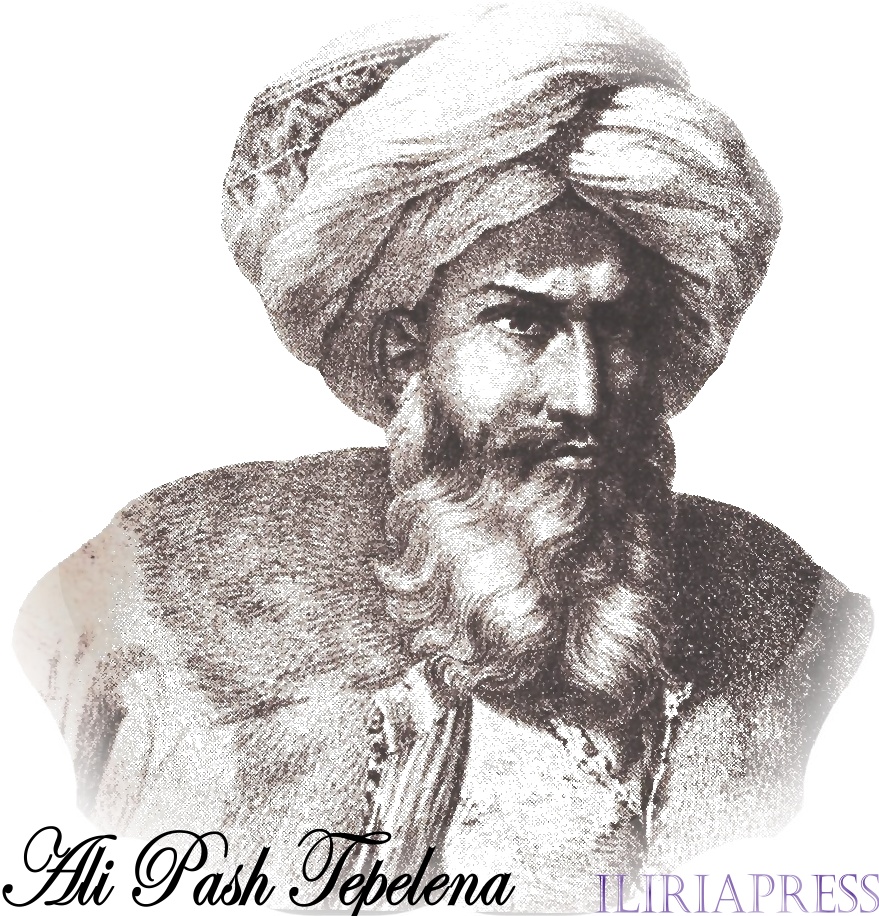 |
| Nasif left one son called Hussein who managed to marry a lame girl of a Bey in K�lcyra. She gave a birth to a son Mustapha, and he was allowed from her family to have a title Bey. Mustapha Bey had a son Sali. Sali had two sons Miftar and Beqir. Myftar had three sons, and Beqir only one son, Islam Bey. Myftar was able to fight the people who were attacking and stilling from the villages. Myftar volunteered himself in action against the Venetians in the island of Corfu. He was a great and successful warrior. In 1716, Myftar was betrayed by his own soldiers who were Turks and Greek, and he was defeated in the battle. In the island of Corfu, the Venetians made a trap and through e net over Myftar. Myftar was captured and crucified alive. Later, the Albanian soldiers found and destroyed the Venetians. The soldiers that betrayed Myftar were killed too. The Ottoman Turkey declared Myftar as a martyr of the Turkish Empire. Myftar and Beqir had daughters, and they are listed in the Ottoman Turkish diaries. Because of their political importance to the Turkish government, the names of the daughters are buried in the archive and never published. Their names are anonymous for the readers, but not for the Turkish archives. |
| The youngest son of Myftar was called Veli. He was very good-looking, joyful, and an adventurer man. He wanted entertainment and parties a lot. Veli spent without limit. When he did not have enough money, Veli started to rub the villages, perpetrated criminal behaviors, and build a bad reputation for himself and his family. His older brothers, holding titles Beys, had good reputation in the region and other places. They were having a privileged respect. They started to get angry and mad on Veli. Veli continued to socialize with gangsters of the time by building a bed reputation for him and his family. The other Beys of the region, especially their enemies, were laughing on Veli and his brothers. Veli�s brothers got very mad, and they threw him out of the house. Veli did not care; he continued his joyful life. His brothers were angry at him because he was not changing. They started to ignore, and they did not speak to him. One night, the enemies went to the house of Veli�s brothers and locked the doors and set the house in fire. Velis brother were murdered, and Veli was blamed for this action. People thought that Veli has revenged his brothers for throwing him out. Islam Bey of Tepelena revealed who burned the house of his cousins, but he did not range a war against them in fear that he will lose the power and experience the same. Islam Bey decided to trust the village of Hormova to his cousin Veli. The neighboring Beys in collaboration with Venetians and Russian, and Gypsy or Greek terrorists, the enemies of Islam Bey, found their way easier of dealing with Veli than with Islam. They organized rioting in the region of Islam Bey. Islam Bay arrested the rioters and gangsters, and he punished them. |
| However, the neighboring Beys paid a lot of money for their release. The Beys and some Gypsies or Greeks paid a sum of money to the same gangsters to riot and set the house of Islam Bey in fire. Islam Bey was murdered, and the Beys or the enemies, in fear to be revealed, complimented Veli to Sultan in Istanbul. Sultan appointed Veli as the Pasha of two tales. Later on, Veli revenged the Bays and the Greek terrorists. All the Beys and Gypsies or Greek terrorists that perpetrated the crime were killed. Veli Pasha was a man of good heart, and he was nice to the widow and four children of his cousin, Islam Bey. Veli Pasha was married and had four children. Veli Pasha was a good and a progressive governor who allowed prosperity in his region. He felt in love with a beautiful girl, Hanka. She was the daughter of Kurt Pasha of Berat. Veli got married with Hanka. Hanka was a woman of great moral and high force of character with a little gentleness as Tamora, Queen of Goths. �When Goths were Goths, and Tamora was queen.�(William Plomer pg. 20) Veli and Hanka had two children, Ali and Shainsha. Veli Pasha was so generous and so nice with people and with orphans. He helped to everyone, and he released the poor from the taxes. He had mercy for everyone. The Beys and the people were happy and liked Veli Pasha. He was the only Pasha in the entire Ottoman Turkish Empire to release people from the taxes. Veli Pasha the father of Ali Pasha died having not too much wealth. In 1753 Veli died at age of forty-five as a poor Pasha leaving two widows and six orphans. |
| By: S.K.-Shkupjani June 23, 2002 Revised: March 10, 2006 Edited by: Q.K. From Shkupi (Skopje) References �Ali Pasha �- Sabri Godo. Book published in 1993 in Tirana, Albania. � The Diamond of Janina� - William Plomer. Book published in 1970 in London, United Kingdom. |
| Page 2 |
 |
| News Albania Kosova Ilirida Plava & Gucija Valley of Morava History Literature Music Terror Human Rights |
| News Albania Kosova Ilirida Plava & Gucija Valley of Morava History Literature Music Terror Human Rights |
 |
|
| Courtesy of Iliriapress |