 |
| A L I P A S H A O F J A N I N A |
 |
 |
|
 |
| Courtesy of Iliriapress |
 |
| This article is dedicated in remembrance to Dr. Astridhis Kolia, an Arvanitis or Albanian, of Epirus, who got mysteriously murdered by the Greek secret Police. When Dr. Astridhis Kolia openly declared himself as an Albania, he was murdered by Greek government. |
| Ali Pasha and Kara Mahmud Pasha |
| Kara Mahmud Pasha was the Pasha of Shkodra (Scutari). He was a son of a royal family. The territory governed from Mahmoud Pasha was very big, and it was bigger than Ali Pasha�s territory. In the territory of Mahmoud Pasha, 2.75 million people lived. From the entire population, Albanians were 88.5%, and the reset were of different nationalities. Mahmoud Pasha in appearance was tall man with a dark hair, and very handsome. Therefore, the Turks were calling him black. Kara means black. Mahmoud bravery and courage was very well known to all. According to the stories, Mahmoud was a little younger than Ali Pasha. They new each other, and they were very good friends. Ali Pasha and Kara Mahmoud Pasha met each other few times near the city of Durres. They and the soldiers were singing patriotic songs that dealt with the heroic wars of Skenderbey. |
 |
| In 1787, Turkey was at war with Russia and Austria, and Ali, having done so well in Thessaly, was given an important command under Grand Vizier, who he joined with his army of Albanians. In the course of the campaign a young relation of Ali was taken a prisoner by the Russian and during the negotiations for his release Ali and Potemkin met and exchanged presents, and took opportunity to discuss the future. ( William Plomer, pg 44). In this meeting. Ali Pasha and Potemking spoke for relationship or acceptance of independent Albania by Russian kingdom. Ali did not want to see any of his friend or his soldier to be prisoner. He paid a huge sum to the Russians for releasing or freeing his soldier. Ali Pasha did not like Russians at all. Before the war was over, Ali was ordered to take part in an expedition against rebellious Kara Mahmud Pasha of Shkodra. The individual had taken advantage of the war, and of fact that the part was fully occupied with the conduct of it, to do a little land-grabbing on his own, and had occupied several strongholds belonging to his Bosnian neighbors and to the Venetians. Nor had he tried to set up an independent principality on grand scale to include part of Albanian. Part of Bosnia, Montenegro, and Northern Macedonia. Ali felt sympathetic toward Mahmud, rather unwillingly helped to besiege him in Shkodra, and returned to the war as soon as he could. (William Plomer, pg. 45). |
| Instead of attacking Mahmud, Ali attacked his enemies. Kara Mahmud Pasha was the governor in his territory, and it would be very easy for him to declare independence because his territory was huge, and the population was high. Kara Mahmud Pasha as a ruler of all that territory could easily proclaim himself as King. Ali Pasha wrote a letter to Kara Mahmud Pasha by telling him that he had attacked from south. But, he could not help to Kara Mahmud Pasha. It was the only thing he could do for him. At the end of the letter he wrote, �The only way you to survive is your standing.� ( Sabri Godo, pg 40). |
| Ali with 3000 soldiers occupied the city of Kor�a and surrounded the city of Ohri. Ali ordered the castle of Ohri to be surrounded. He promised a lot of gold for the first soldier who is going to get on top of the walls. The castle of Bushatli of Rumelia could not resist the attack from three sides. In one side was the army of Jusuf Arap, in the other side was the army of Armatols, and in one side Ali with his body guards. The nephew of Bushatli of Rumelia was defeated and his head was cut off and sent to Istanbul. (Sabri Godo, pg. 39). |
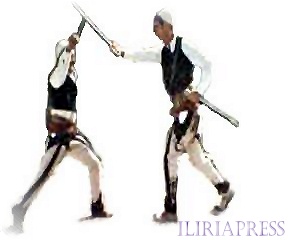 |
| It was a joined idea of both Pashas to create a united and independent Albania. They always helped each other, and they always were together against Turks, Russians, and French. Ali Pasha and Kara Mahmud Pasha were Albanians, and they were proud to be always surrounded by the Albanian boys. It is said that entire phrases from Homer may be regarded even today as typical Albanian expressions, and as in their language so in their life archaic virtues were to be found. (William Plomer, pg 21). |
| The mixture of dirt and splendor and the confusion of ranks and customs made a strong impression on Dupr�, but most of all he was struck by the material bearing and athletic build of the men, and by the bold, proud beauty of their heads which, he felt, needed only antique helmets to make them seem like the heads of the heroes in Homer. (William Plomer, pg. 236). �In general, the Albanians are of high stature, observed the Baron de Vaoudoncourt, �strongly muscular, and thin waisted. (William Plomer, Pg.21). Their profile is handsome... and tends to form the real Grecian Features.� The general impression was one of alertness, and prevailing type had fresh color, lively and expressive grey eyes, thin arched eyebrows, bony foreheads and high cheekbones, Their mouths were small, their necks were long, their back straight, their chest broad and elevated, and their arms and legs well made. They all could make their own clothes, which Byron called �the most magnificent in the world� . . . they were agile and athletic in their gait being used all their lives to climbing mountains and their energy and enthusiasm made a strong contrast with the slowness and sedateness of their overlords, the turbaned Turks...(William Plomer, pg 22, 23). Those were the soldiers of two friends and Albanian princes, Ali Pasha and Kara Mahmud Pasha. Both had one wish: one united Albania. |
| By: S.K.-Shkupjani June 23, 2002 Revised: March 10, 2006 Edited by: Q.K. From Shkupi (Skopje) References �Ali Pasha �- Sabri Godo. Book published in 1993 in Tirana, Albania. � The Diamond of Janina� - William Plomer. Book published in 1970 in London, United Kingdom. |
 |
| News Albania Kosova Ilirida Plava & Gucija Valley of Morava History Literature Music Terror Human Rights |