 |
| A L I P A S H A O F J A N I N A |
 |
 |
|
 |
| Courtesy of Iliriapress |
| This article is dedicated in remembrance to Dr. Astridhis Kolia, an Arvanitis or Albanian, of Epirus, who got mysteriously murdered by the Greek secret Police. When Dr. Astridhis Kolia openly declared himself as an Albania, he was murdered by Greek government. |
| Hanka, Mother With a Broken Heart |
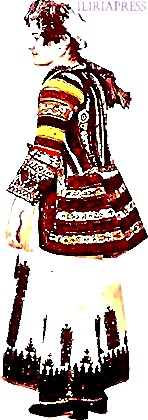
| Ali Hysein was born in 1743 in the village of Tepelena, Albania. No one exactly can say in which month he was born. No one remembered what month was when Ali Pasha was born. Some stories say that he was born during a cold winter day, and some say that he was born during a shiny spring day. His father was the youngest son of Myftar Aga, Veli Pasha, and a pasha of two tales. His mother was Hanka, the daughter of Kurd Pasha of Berat, Albania. As a child, Ali was very lively and restless trouble maker. When his father was present, Ali had enjoyment with no limits in his playground. He could do anything that his heart wanted. His father, Veli Pasha, was having equal behavior with all his children, and he loved them equally. The only barrier to his playing was his mother, Hanka. Hanka forced her son, Ali, and her daughter, Shahinsha to learn reading and writing. She made possible for her children to get the best education in that time. The mother, Hanka, was the one who disturbed and disrupted their restless games, and she compelled them to learn. |
 |
| When Veli Pasha died, Ali was only twelve years old and Shahinsha was only ten years old. The children had enough time to play and love their father, Veli. The mother was young, and she had to experience the biggest pain in her heart. Now, she was a widow with two children. She had responsibilities to raise her children, and for her that was the most important task in her life. Hanka and the widow of Islam Bey did not agree in many things. While the children were playing, they were fighting and biting each other. There were ten children and threw widow women in one house. The fight was transferred to grown up ladies. The pressure mounted every day. Each lady was dreaming her son to be the next Pasha to heritage the authority of the two tales. Each lady was protecting her own orphans. Ali and his sister were protected only from their mother, Hanka. They became unloving children in the castle. After all the bitter fights and disagreements, Hanka decided to move from the castle. She settled in her village, Karnian. The Islam�s widow did not stop her propaganda against Hanka. The local Beys, Gypsy or Greek terrorists, and others enjoyed the scenes of the cold war between the two widow women. The widow of Islam Bey was siding with the other widow of Veli Pasha, and she was supporting Veli Pasha�s widow�s sons to heritage and share with her sons the title of Pasha. After few weeks, the French and Gypsy or Greek terrorists gave to the children of Veli Pasha something to eat. One by one, the four children of Veli Pasha died. They were poisoned, and the palace where they lived was put on fire. The Islam�s widow mad a huge propaganda and she said that Hanka had killed the four stepchildren. In addition, she blamed Hanka for organizing all the robbery, and other criminal behavior. The people of the area believed that Hanka really did this. Hanka was young and beautiful women with a strong moral. Many people wanted her, and she had numerous offers of marriage. She did not want to remarry, and Hanka remained a widow for the rest of her life. Only Veli remained in her heart. People of the area started to gossip. They created a lot of stories such as,�The bodyguards were those that shared not only her anxieties but her bed.� (William Plomer, pg 31) This was not true at all. Hanka returned to Tepelena as the queen in her castle. |
| She heard the gossiping from the village of Hormova, and ordered the taxes to be increased in this village. She thought to be the best to stop the gossiping. In addition, Hanka took over the control of the village of Kakos from the Beys of the village of Gardhiqi. (Sabri Godo pg.8) In spit of this, the Beys of the Village of Garthiqi with the people of the village of Hormova started rebellions against Hanka. One night, Hanka was captured and mistreated. The people of Hormova note only mistreated her, but they bit, maltreated, and raped her. Hanka was badly wounded, almost, she died. She was sworn never to forgive to people of Hormova, and she was sworn to revenge them. Later in the life, Ali Pasha not only revenged, but he massacred the people of the village of Hormova and Gardhiqi. |
| In order to avoid any experience like in the village of Hormova, Hanko was moving very often from place to palace. Sometimes, the palaces were burned down by the local people after she left. She did not forget those too and made her children to promise her for revenging all those bad people before Hanka died. Before Ali got married, he and her mother Hanka had a long dialogue. She told to Ali, �The power belongs to the person who knows to get, the wealth belongs to a person who knows how to increase the wealth, and whose lags shrivel from fear deserves to die.�(Sabri Godo, pg 20) Ali later days said, �I owe everything to her. Twice she gave me my life, as a man and as a ruler. She kindled my imagination and showed me my destiny.� When Ali seized the city of Trikala, he got bad news. His mother was very ill, and she was calling on Ali. Hanka, the lady of Epirus was seriously sick. Ali rushed to Tepelena immediately. Hanka spends her last moments in having her will read to her by her daughter Shainshah. She expressed in it the wishes that Ali and Shahinshahe should at the earliest possible moment do their best to exterminate the people of Gardhiqi and Hormova, and added a curse in this if they should fail her in this. She had also ordered to make a pilgrim to Mecca for the repose of her soul. (William Plomer, pg 46). Later, Ali Pasha paid people to perform a pilgrimage for his parents. This kind of behavior is allowed in the Muslim religion. Hanka left a brave son, Ali Pasha, that today every Albanian proudly mention his name. |
| By: S.K.-Shkupjani June 23, 2002 Revised: March 24, 2006 Edited by: Q.K. From Shkupi (Skopje) |
 |
|
 |
| News Albania Kosova Ilirida Plava & Gucija Valley of Morava History Literature Music Terror Human Rights |