 |
 |
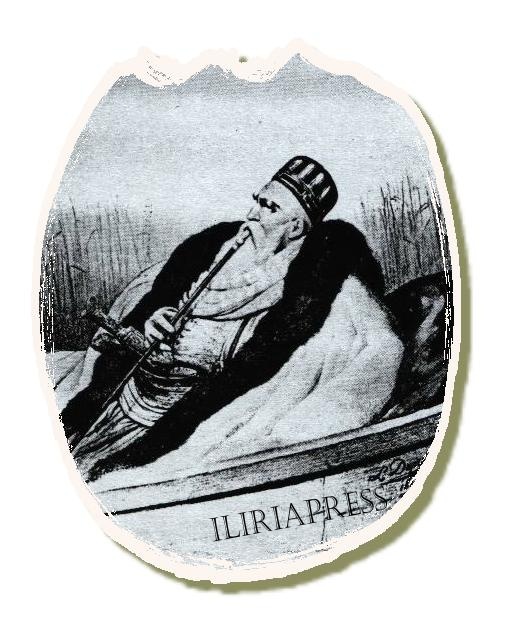
| A L I P A S H A O F J A N I N A |
 |
| This article is dedicated in remembrance to Dr. Astridhis Kolia, an Arvanitis or Albanian, of Epirus, who got mysteriously murdered by the Greek secret Police. When Dr. Astridhis Kolia openly declared himself as an Albania, he was murdered by Greek government. |
| The Origin of Ali Pasha |
| When the Ottoman Turkey arrived in Balkan, the Islam faith knocked on the door of the people of Balkan. The Ottoman Empire known with the policies and laws of holy Koran did not use force to convert people to Islam. The Ottomans have studied culture, tradition, folklore of the people, and by giving a lot of wealth in peaceful way expended Islam among the people in Balkans. The Ottomans carefully have studied the Albanians. The Albanians were of high virtue. They were genuine, honest, courage and brave, heroic with war fighting capabilities, and trustworthy. Therefore, the expansion of this religion among Albanian was hard and long process. The exercise mostly practiced by Ottomans was the trust of Albanians. The Ottoman official in a diplomatic way was asking an Albanian whether is trustworthy and can he be trusted. The second question was, �Promise me that you will do a good thing for Sultan and for me?� A na�ve mountainous man was confirming that he is trustworthy, and he promised that will do a good thing without knowing what. The Albanian native accepted the religion because he has already promised and given his word and trust. He had given his word and trust to the Turkish officials and there was no going back. Betrayed, laid, and mismanaged, the Albanian man was returning home with a new religion. He told to his family that they do not have to do the same what he has done because they have not given their trust and word. When the father was declaring himself as a Muslim now, the children accepted this religion in peaceful way. Every Albanian who converted to Islam was given a lot of gold and wealth by Ottoman Turks, even thou never asked for it. The trust and gold were the main factor of converting. In this way, Islam was accepted by Albanians even though Albanians never were good religious people. The new generation practiced Islam, and got educated. Today, this religion governs among many Albanians. Islam in science and philosophy is recognized as modern and progressive religion in peace and mutual respect. |
| After Albanians were known as warrior people, the Ottoman Turks started to steal and kidnap Albanian children for their own Janicher Army. Based on Albanian courage, bravery, heroism, honesty, and capabilities of the good warriors, the Ottoman Turkey found soldiers by kidnapping many children all over Albania. Sultan was not happy from the small number of the children, and forced the askers to attack and destroy not protected mountainous villages. The parents were murdered and children were sent in Turkey. The childhood of the orphans continued in military institutions all over Ottoman Turkey Empire. All the children were raised in the military institutions in Turkey. When the orphans grew up, they became military officers. It is believed that 85% of the orphans became high ranking officers of Ottoman Turkey. They were sent in many wars. Many of those Albanian children became high-ranking officers, and many of them died in the wars of Ottoman Turkey. Some of them experienced fatal injuries, and they died in wars. Some of those Albanian children, the officers of Ottoman Turkey got injured and disabled in these wars. |
| The handicapped soldiers lived in different places under miserable condition without being assisted or helped from the government and Sultan. Left behind without any relatives, they died being wounded and poor, and far away from their native land and country. Their unfortunate lack made them very poor causing death without a family, lonely with a wish to return to their native land Albania. The wish never fulfilled, but remained as a black dot in their hearts. They died with an unrealized wish; a wish to return to beautiful Albania. Many of the Albanians who managed to finish long term military service returned to Istanbul and got married with Albanian woman raised in the Turkey. Some of the Albanians had to create families with woman of other nationalities such as Egyptian, Armenian, Syrian, and other. The beauty of Albanians took the heart and the mind of the wealthy Turkish young woman, who was doing everything in her power to get married with Albanian man. The Ottoman Turkey was happy because of these marriages; they thought were implanting the Albanian courage and bravery to the Turks. Many Albanians that were living in Turkey averted those kinds of marriages, and they did everything their sons not to perform the military service. They paid a lot of money to avert this obligation. Some of them changed their names, and some were changing their living places or towns. When the traveling conditions got better, many Albanians were going back to Albania, Kosovo, Shkup, Manastir and other places in order to avoid the long year�s military service. The progressive Albanian families that were opposing the Turkish assimilation insisted to their children to get married only with Albanians. Always married with Albanian, they tried to maintain their traditions and customs, even though, they were living in Turkey among Asians. However, some of the Albanians returned to Albania and Albanian territories. |
| The family of Hysein Hysein was one of those progressive families living in Turkey, but they were opposing the rules of the Ottoman Turkey. The son of Hysein, Nasif, ignored and hated the rules of Turkey. This family hated as much the Ottoman Turkey, and in spite of this, they did not accept the Islam but Shija religion of Iranian people or Persians. They were dervishes, a Muslim sect of Shija. His father Hysien was also married with an Albanian woman. As any other Albanian, Nasif Hysein wanted to return to Albania even though born and raised in Turkey. The young man, Nasif, ignored the Turkish military service invitation, and went into hiding. Later, he traveled from places to places in order to avoid any arrest. The absence of Nasif in his village made impression to the local Bey that he went to serve the Sultan. Because Nasif was not an eminent person, the Ottoman Turkey did not bother looking for him. In order to make his living, Nasif got employed in a circus carnival from Egypt presenting in Ankara. He learned to dance. The skill he learned, from a circus carnival from Egypt, made his living. Dancing and his dervish monk appearance made his living very well. He traveled as an entertainer, and he with his dancing made possible to travel to Albania; a long year wish. While he was a child, Nasif heard a lot of stories from his grandfather about Albania. His grandfather told him that his grand grandfather was kidnapped in the village of Gardhiq in Albania and brought in Turkey, where he got married with a girl that was from Tepelena and brought to Turkey. Nasif heard a lot of good thing about the village of Tepelena and very shocking stories about the village of Gardhiqi from his grandfather. |
| The trip to Albania was realized by a cargo Ship. The destination of the cargo ship was Port of Durresi in Albania, and this city was the first city the foot of Nasif to step in Albanian soil. Like a dancer and artist in a musical group, he had a chance to see the cities of Butrint, Dures, Tepelena, and other Albanian cities. He and the musical group were entertaining the wealthy and Turkish officials all around Albania. The village of Tepelena, Nasif, wanted mostly; therefore he always asked the service men how to find Tepelena. While traveling around Albania with his musical group, Nasif found the village of Tepelena after long and tired search. The village of Tepelena is located on the rocky peninsula above the river Vjosa. Surrounded by vineyards which produce a remarkable wine, Tepelena is overlooked by the huge and wild mountain heights. People of Tepeleni were mild and not violent. Peasants were cooping with the winds and rainy storms that caused floods. |
| Page 1 |
 |
| News Albania Kosova Ilirida Plava & Gucija Valley of Morava History Literature Music Terror Human Rights |