 |
| A L I P A S H A O F J A N I N A |
| Byron Child Harold, Lord George Gordon |
 |
 |
| This article is dedicated in remembrance to Dr. Astridhis Kolia, an Arvanitis or Albanian, of Epirus, who got mysteriously murdered by the Greek secret Police. When Dr. Astridhis Kolia openly declared himself as an Albania, he was murdered by Greek government. |
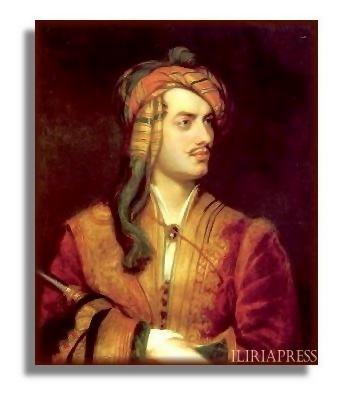
| Lord, George Gordon in Albanian Clothes |
 |
| By: Edited by: S.K.-Shkupjani Q.K. from Shkupi March 10, 2006 |
 |
| News Albania Kosova Ilirida Plava & Gucija Valley of Morava History Literature Music Terror Human Rights |
| News Albania Kosova Ilirida Plava & Gucija Valley of Morava History Literature Music Terror Human Rights |
| Lord George Gordon Noel Byron, 6th Baron Byron was the most important and leading figure in Romantic Movement, and he is considered the greatest European poet and satirist. Byron�s books are world widely red, and his books remain to be someones favourite books. Born to a Scottish Heiress, he was the son of Captain John Byron known as �Mad Jack� and Catherine Gordon of Gight, Aberdeenshire, Scotland. John Byron squandered away the family�s wealth, and the huge debt followed by the severe censure of society caused him and Catherine to move in France. From the unsolved issues and the pressure from their creditors led them to live in hiding for few months. Because they wanted their son to be born in the English soil, they returned to London. George Gordon Noel Byron was born on January 22, 1788 in London, United Kingdom. From his birth, Byron suffered from talipes or a malformation of the right foot causing a slight lameness. This was an agony of lifelong misery to him. Knowingly that with proper care it might have been cured, it conspired to hurt the pride and sensitiveness of the poet. It is a story of a childhood cruelly maltreated and neglected followed by fierce temptations and domestic tragedies. His father died when he was quite young. After the death of his father, his mother, Catherine, was tied up in the lawsuits. Byron's mother Catherine had to sell her land and property to pay her husbands debts. This caused Catherin to return to Aberden as the impoverished widow, and live on here small salvage fortune. Byron�s childhood was brought up in meager conditions subjected alternately to the excessive tenderness and malicious desire of his mother. Catherine was a spoiled aristocrat woman of violent temper, and a burning passion for social progress. After years of poverty, Catherine with the spirit of revolt had no proper guiding of her volcanic and intelligent little boy. He was in Calvinistic way raised. The circumstances of this Calvinistic early life explain the spirit of revolt that was his lifelong characteristic. |
| The poet had two last names, and he used only one at any given time. Gordon was the baptismal name and not surname. He was baptized at St Marylebone Parish Church, to honor his maternal grandfather George Gordon of Gight, who committed suicide in 1779. This grandfather was a descendant of King James I. The father of Byron, John Byron, took the surname Gordon in order to claim his wife's estate in Scotland. It is believed that John Byron married Catherine Gordon just for her wealth, which wealth he deserted. Byron was registered at school in Aberdeen as George Byron Gordon. In 1794, the death of a cousin made the poet to become heir-presumptive to the title of the estate. On May 21, 1798, his great-uncle, the fifth "wicked Lord" died. At the age of ten, he inherited the English family title, becoming George Gordon Byron, Baron Byron of Rochdale. |
| Becoming the 6th Baron Byron, he inherited Newstead Abbey in Nottinghamshire, England, and took up residence at the family seat, Newstead Abbey. Nevertheless, Byron did not live long in this estate because it was rented to Lord Grey de Ruthyn. The second last name of the poet was Noel. In order to inherit half of his mother in law estate after her death, the poet had to fulfill her will requirement to change to her last name Noel. Therafter, he was George Gordon Noel Byron, Lord Byron. The royalty title in the Byron�s family starts few centuries beck. When the rich Priory of Newstead Abbey, in Nottinghamshire was given to Baron Family from Henry VIII in 1500, the Baron Family received full recognition among the royals in British monarchy. In addition, the ancestors were descent soldiers sacrificing and giving genuine and honorable service to the military, the country, and the king. In 1600, they were honored with extraordinary military service in the civil war. In the 18th century, Barons� found themselves to be distinguished seamen, spendthrifts, and debauchees. The paternal grandfather of George Gordon Byron was Vice-Admiral John "Foulweather Jack" Byron, known as the officer who navigated the entire globe. Vice-Admiral John Byron was the youngest brother of the 5th Baron Byron, known as "the Wicked Lord", the descendants of King Edward III . Byron was a low ranking royal title and it comes from the English words,�My man in London.� Byron was a servant, who represented his boss in London. Byron was titled the person responsible for the management of the royal palace, work the land of the royalties, and contribute in law and policy enforcement of the monarchies in that region. Sometimes, Byron socialized the king. This title has been found in different kingdoms such as Spanish, Germans, and other kingdoms. In the German language, it means �A free warrior.� |
| At early age, Byron attended the English School at Aberdeen Grammar School. In 1801, he attended Harrow. For four years, he will attend Dulwich school and Harrow at the same time. His academic achievements were neither the highest nor the lowest. The teenage atmosphere in the school with sensitiveness about his lameness did not stop him of being a great friend. He made several close friends while at school. Energetic and talented Byron was chosen to represent Harrow during the very first Eton versus Harrow cricket match at Lords. After 4 years at Harrow, he proceeded to Trinity College, Cambridge. While attending Trinity College, Byron had enough time to spend on reading the history and fiction. Mostly, he liked the ancient history of Balkans. At this time, Byron was living extravagantly. It is a story of a boyhood of splendid genius and a truly noble nature followed by desultory, passionate daydreams, and intense study. |
| Suffice to say that the story of a youth spent in folly, stained though not ruined by desire of egoism. This caused the need for self-determination, which he sought in three main directions, love, action, and poetry. He grew up and became a handsome man. His friends and neighbors encouraged him to publish his poetry. In 1806 at the age of 18, he published his first poetry, "Fugitive Pieces" printed by Ridge of Newark. The book contained poems written when Byron was fourteen years old. Nevertheless, the book was recalled and burned because of amorous verses. Reversed and expended, the book reapeared after one year as �Poems on Various Occasions.� The culminating book,�"Hours of Idleness," a collection of previous poems and recent compositions, provoked severe criticism from the Edinburgh Review. This pushed Byron to publish his first satire"English Bards and Scotch Reviewers" as a reply to Edinbourg Review. The book is about heroic couplets reminiscent of Pope, which book created him considerable fame and shortly went through five editions. |
| Byron left England in 1809 for a grand tour through Spain, Portugal, Italy, to Albania where he spent time there in Athens, todays Greece. This was customary for a young royal man. Byron did not have sympathy for French and Napoleon, therefore he avoided the war-torn countries by French soldiers. Lord Bryon became a member of the House of Lords in 1809. Ali Pasha Tepelena, Albanian Pasha, ruled the southern part of Albania. Ali Pasha known as the Lion of Janina had attracted the attention of the most distinguished personalities of the time, so that Byron and John Hobhouse, were curious to meet him. The first time Byron saw the mountains of Albania in the distance, reminded him in the ancient history and mythological stories and he wrote those moving lines:
Land of Albania! Let me bend mine eyes On thee, thou rugged Nurse of savage men |
| Lord George Gordon was the only British and European monarch to have courage to travel to Albania. He new very well the ancient history of Albanians and wanted to meet them. Albanian territories under rules of Ottoman Empire and segregated were forbidden places for Europeans. Albania of Ali Pasha of Tepelena and Albania of Kara Mahmoud Pasha were unknown and dangerous, restricted, and taboo places for Europe and Europeans. In that time, Albanians and Ali Pasha were known as great and ruthless warriors. |