 |
| A L I P A S H A O F J A N I N A |
 |
 |
|
 |
| Courtesy of Iliriapress |
 |
| This article is dedicated in remembrance to Dr. Astridhis Kolia, an Arvanitis or Albanian, of Epirus, who got mysteriously murdered by the Greek secret Police. When Dr. Astridhis Kolia openly declared himself as an Albania, he was murdered by Greek government. |
| The War of Ali Pasha With Suljas |
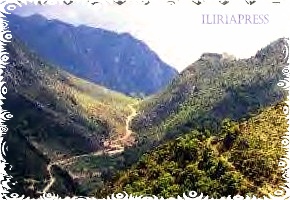
| In order to survive in the occupied territories, the Port and Sultan, always, created troubles, wars among Pashas, political rebellions, hatred, and other miserable political unrest that prolonged the life of the Empire. In Epirus where Ali Pasha was ruling, the mountains of Thesprotia and Suli region stood as the flag where the rules and laws of Ottoman Turkey did not take place. The region of Suli with dark wood forest was a natural fortress where the most spectacular scenarios in the Balkans happened. In the region of Suli, the settlement consisted of a few villages on a plateau about two thousand feet above the river Acheron, or the black River, which flowed through a darkest and deepest of the glens of Epirus. The villages on the plateau itself, which could only be reached by one step and narrow passage three miles long, had even something gentle and domesticated in their appearance, for there were cultivated terraces planted with corn and vegetables and fruit trees, and amongst in them stood houses, small square buildings with pitched roofs and two Stories, the lower used as a store or stable, and the upper containing two or three rooms. As for the people, perhaps 12 000 in number, they had a character and traditions of their own. (William Plomer, pg 59). Suli regions existed since ancient time, and it was mentioned in Mythology with its dark wooded romantic and scary panorama. In general, the people of Suli had many points in common with other mountaineers of Albania and Epirus, but they were not different than the other Albanians that lived in the mountains. |
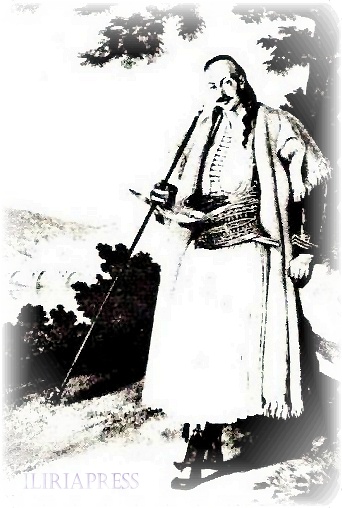 |
| Oh! Who is braver than a dark Suliote, In his snowy camise and his shaggy capote? To the wolf and vulture he eaves his wild flock, And Descends to the plain like a stream from the rock Byron |
| Males were conscripted and trained in arms from the fare, skirmishes and sorties and stratagems, sudden attacks and quick retreats. They were renowned for their courage. (William Plomer, pg.60). Here we see the equal characteristics of other Albanians. When a male child is born to an Albanian household, the oldest member of family or the father of the child wraps the child with the national flag and puts a firearm under, and prays the god for this male to become a brave and a warrior. |
 |
| Geration to generation this was performed since ancient Illyrian and Hellenic culture or civilization. When a child grows among Albanians, he will be learning how to defend, attack, and how to war. As Byron mentioned several weapons not seen elsewhere, the same arms are still present and in use among Albanians of Shkupi (Skopje), particularly in the region of Derven Gorge that is located between Shkupi and Tetova. The tools are used in the daily life for cutting trees, wood, meat, and also it is used as defending arm that immediately becomes an arm of the warrior. In the village of Gerchec near Shkupi, the villagers do not go out of their houses without �Kmese.� The weapon or the tool was described in ancient time from variety writers. |
| This kind of tool and weapon in Albanian is called �Kmesa.� The Suli region and Suliots still use proudly the same weapon. This kind of tools and weapons are found only among Albanians. |
| The people of Suli or Suliots still live proudly in the same region, and as always, they still speak Albanian language. There are 31 tribes among the Suliots, and each tribe has its own leader. The leaders of the tribes form the assembly or the leadership of Suli. Every each Suliot or Suljas was a god for his family and his house. (Sabri Godo, pg 71, 72). On feminine frailty the Suliots were just as hard as the Albanians and on the slightest suspicion of adultery women were sewn up in sacks and thrown over the cliffs into the Acheron. (William Plomer, pg. 60). One French known artist, Louis Dupr�, visited Janina and Corfu in March 1819, and he made some drawings of some Suljas, particularly he draw the portrate of on of the leaders, Photo Xhavellas. Louis Dupr� described the Suliots. They were both very much struck by the likeness, and the model was very demonstrative and tried to convey by gestures his pleasure and astonishment. Then he suddenly took from his belt one of those little portable silver writing-sets which were often proudly carried by Albanians when just literate, and wrote his name at the side of his portrait. �Phot Suli�. (William Plomer, pg. 234). |
| The Suljas lived in their mountainous villages bound by the Albanian laws and customs based on the canon of Lek Dugagjini, and they worked and lived proudly in Suli. They did not want the Ottoman Turkey, and they did not pay the taxes to the Ottoman Turkey. Some of them were poor, and found their living by sealing from other people around Janina. The Russian and French agents and terrorists in priest�s uniform were visiting Suli, and expending their propaganda and terrorist mission among Suliots. They were teaching the people of Suli how to steal, sabotage, and how to perpetrate other criminal actions in Janina. The people of Suli were religious people and they believed the priests and their propaganda stories based on faith and God. A Russian priest was killed after an attempt to rape a widow in one of the villages in Suli. |
| The children of the widowed woman killed the Russian priest and threw him in the river of Acheron. The Suliots believing in word of god of the priests many of them volunteered to commit actions against the Ottoman Turkey and wound Ali Pasha. Ali Pasha was a friend one time with some Suliots, and he relieved them from taxes. Ali Pasha never took taxes or any other monetary tribute from Suliots. The frequent stealing and attacks of government caravans, rubbing of the houses, and other sabotages achieved the limit of the tolerance of the Pasha. Ali Pasha was getting angry and anxious about Suljas and their terrorist mission originated by the French and Russian terrorist priests. Ali Pasha punished some people from Suli, and the chiefs of the tribes in Suli got anxious on the behaviors of the government and the Pasha. |
| Page 1 |
| Page 1 |
 |
| News Albania Kosova Ilirida Plava & Gucija Valley of Morava History Literature Music Terror Human Rights |