IIT– JEE CHEMISTRY
SYLLABUS
“IIT – JEE 2004 ”
The Syllabus for JEE-2004 is modified. It is common for the Screening Test and the Main Examination
chemistry
Physical Chemistry
General topics:
The concept of atoms and molecules; Dalton's atomic theory; Mole concept; Chemical formulae; Balanced chemical equations; Calculations (based on mole concept) involving common oxidation-reduction, neutralisation, and displacement reactions; Concentration in terms of mole fraction, molarity, molality and normality.
Gaseous and liquid states:
Absolute scale of temperature, ideal gas equation; Deviation from ideality, van der Waals equation; Kinetic theory of gases, average, root mean square and most probable velocities and their relation with temperature; Law of partial pressures; Vapour pressure; Diffusion of gases.
Atomic structure and chemical bonding:
Bohr model, spectrum of hydrogen atom, quantum numbers; Wave-particle duality, de Broglie hypothesis; Uncertainty principle; Quantum mechanical picture of hydrogen atom (qualitative treatment), shapes of s, p and d orbitals; Electronic configurations of elements (up to atomic number 36); Aufbau principle; Pauli’s exclusion principle and Hund’s rule; Orbital overlap and covalent bond; Hybridisation involving s, p and d orbitals only; Orbital energy diagrams for homonuclear diatomic species; Hydrogen bond; Polarity in molecules, dipole moment (qualitative aspects only); VSEPR model and shapes of molecules (linear, angular, triangular, square planar, pyramidal, square pyramidal, trigonal, bipyramidal, tetrahedral and octahedral).
Energetics:
First law of thermodynamics; Internal energy, work and heat, pressure-volume work; Enthalpy, Hess’s law; Heat of reaction, fusion and vaporization; Second law of thermodynamics; Entropy; Free energy; Criterion of spontaneity.
Chemical equilibrium:
Law of mass action; Equilibrium constant, Le Chatelier’s principle (effect of concentration, temperature and pressure); Significance of DG and DGo in chemical equilibrium; Solubility product, common ion effect, pH and buffer solutions; Acids and bases (Bronsted and Lewis concepts); Hydrolysis of salts.
Electrochemistry:
Electrochemical cells and cell reactions; Electrode potentials; Nernst equation and its relation to DG; Electrochemical series, emf of galvanic cells; Faraday’s laws of electrolysis; Electrolytic conductance, specific, equivalent and molar conductance, Kohlrausch’s law; Concentration cells.
Chemical kinetics:
Rates of chemical reactions; Order of reactions; Rate constant; First order reactions; Temperature dependence of rate constant (Arrhenius equation).
Solid state:
Classification of solids, crystalline state, seven crystal systems (cell parameters a, b, c, a, b, g), close packed structure of solids (cubic), packing in fcc, bcc and hcp lattices; Nearest neighbours, ionic radii, simple ionic compounds, point defects.
Solutions:
Raoult’s law; Molecular weight determination from lowering of vapor pressure, elevation of boiling point and depression of freezing point.
Surface chemistry:
Elementary concepts of adsorption (excluding adsorption isotherms); Colloids: types, methods of preparation and general properties; Elementary ideas of emulsions, surfactants and micelles (only definitions and examples).
Nuclear chemistry:
Radioactivity: isotopes and isobars; Properties of a, b, and g rays; Kinetics of radioactive decay (decay series excluded), carbon dating; Stability of nuclei with respect to proton-neutron ratio; Brief discussion on fission and fusion. reactions.
Inorganic chemistry
Isolation/preparation and properties of the following non-metals:
Boron, silicon, nitrogen, phosphorous, oxygen, sulphur and halogens; Properties of allotropes of carbon (only diamond and graphite), phosphorus and sulphur.
Preparation and properties of the following compounds:
Oxides, peroxides, hydroxides, carbonates, bicarbonates, chlorides and sulphates of sodium, potassium, magnesium and calcium; Boron: diborane, boric acid and borax; Aluminium: alumina, aluminium chloride and alums; Carbon: oxides and oxyacid (carbonic acid); Silicon: silicones, silicates and silicon carbide; Nitrogen: oxides, oxyacids and ammonia; Phosphorus: oxides, oxyacids (phosphorous acid, phosphoric acid) and phosphine; Oxygen: ozone and hydrogen peroxide; Sulphur: hydrogen sulphide, oxides, sulphurous acid, sulphuric acid and sodium thiosulphate; Halogens: hydrohalic acids, oxides and oxyacids of chlorine, bleaching powder; Xenon fluorides; Fertilizers: commercially available (common) NPK type.
Transition elements (3d series):
Definition, general characteristics, oxidation states and their stabilities, color (excluding the details of electronic transitions) and calculation of spin-only magnetic moment; Coordination compounds: nomenclature of mononuclear coordination compounds, cis-trans and ionization isomerisms, hybridization and geometries of mononuclear coordination compounds (linear, tetrahedral, square planar and octahedral).
Preparation and properties of the following compounds:
Oxides and chlorides of tin and lead; Oxides, chlorides and sulphates of Fe2+, Cu2+ and Zn2+; Potassium permanganate, potassium dichromate, silver oxide, silver nitrate, silver thiosulphate.
Ores and minerals:
Commonly occurring ores and minerals of iron, copper, tin, lead, magnesium, aluminium, zinc and silver.
Extractive metallurgy:
Chemical principles and reactions only (industrial details excluded); Carbon reduction method (iron and tin); Self reduction method (copper and lead); Electrolytic reduction method (magnesium and aluminium); Cyanide process (silver and gold).
Principles of qualitative analysis:
Groups I to V (only Ag+, Hg2+, Cu2+, Pb2+, Bi3+, Fe3+, Cr3+, Al3+, Ca2+, Ba2+, Zn2+, Mn2+ and Mg2+); Nitrate, halide (excluding fluoride), sulphate, sulphide and sulphite.
Organic chemistry
Concepts:
Hybridization of carbon; Sigma and pi-bonds; Resonance and hyperconjugation; Shapes of molecules; Structural and geometrical isomerism; Optical isomerism of compounds containing up to two asymmetric centers (R,S and E,Z nomenclature excluded); IUPAC nomenclature of simple organic compounds (only hydrocarbons, mono-functional and bi-functional compounds); Conformations of ethane and butane (Newmann projections); Keto-enol tautomerism; Determination of empirical and molecular formula of simple compounds (only combustion method); Hydrogen bonds: definition and their effects on physical properties of alcohols and carboxylic acids; Inductive and resonance effects on acidity and basicity of organic acids and bases; Polarity and inductive effects in alkyl halides; Reactive intermediates produced during homolytic and heterolytic bond cleavage; Formation, structure and stability of carbocations and free radicals.
Preparation, properties and reactions of Alkanes:
Homologous series: Physical properties of alkanes (melting points, boiling points and density); Combustion and halogenation of alkanes; Preparation of alkanes by Wurtz reaction and decarboxylation reactions.
Preparation, properties and reactions of alkenes and alkynes:
Physical properties of alkenes and alkynes (boiling points, density and dipole moments); Acidity of alkynes; Acid catalysed hydration of alkenes and alkynes (excluding the stereochemistry of addition and elimination); Reactions of alkenes with KMnO4 and ozone; Reduction of alkenes and alkynes; Preparation of alkenes and alkynes by elimination reactions; Electrophilic addition reactions of alkenes with X2, HX, HOX and H2O (X=halogen); Addition reactions of alkynes; Metal acetylides.
Reactions of benzene:
Structure and aromaticity; Electrophilic substitution reactions: halogenation, nitration, sulphonation, Friedel-Crafts alkylation and acylation; Effect of o-, m- and p-directing groups in monosubstituted benzenes.
Phenols:
Acidity, electrophilic substitution reactions (halogenation, nitration and sulphonation); Reimer-Tieman reaction, Kolbe reaction.
Characteristic reactions of the following (including those mentioned above):
Alkyl halides: rearrangement reactions of alkyl carbocation, Grignard reactions, nucleophilic substitution reactions; Alcohols: esterification, dehydration and oxidation, reaction with sodium, phosphorous halides, ZnCl2/conc.-HCl, conversion of alcohols into aldehydes and ketones; Aldehydes and Ketones: oxidation, reduction, oxime and hydrazone formation; aldol condensation, Perkin reaction; Cannizzaro reaction; haloform reaction and nucleophilic addition reactions (Grignard addition); Carboxylic acids: formation of esters, acid chlorides and amides, ester hydrolysis; Amines: basicity of substituted anilines and aliphatic amines, preparation from nitro compounds, reaction with nitrous acid, azo coupling reaction of diazonium salts of aromatic amines, Sandmeyer and related reactions of diazonium salts; carbylamine reaction; Haloarenes: nucleophilic aromatic substitution in haloarenes and substituted haloarenes – (excluding Benzyne mechanism and Cine substitution).
Carbohydrates:
Classification – mono-, di-,
and polysaccharides (glucose, sucrose and starch only); Hydrolysis of sucrose.
Amino acids and peptides:
General structure and physical properties.
Properties and uses of some important polymers:
Natural rubber, cellulose, nylon, teflon and PVC.
Practical organic chemistry:
Detection of elements (N,S, halogens); Detection and identification of the following functional groups: hydroxyl (alcoholic and phenolic), carbonyl (baldheaded and ketone), carboxyl, amino and nitro; Chemical methods of separation of mono-functional organic compounds from binary mixtures.

IMPORTANT FACT ABOUT ORGANIC CHEMISTRY
It is very important that you understand electron-dot formulas, the nature of chemical bonds and hybridization before studying Organic Chemistry...you cannot possibly understand reactions, reaction mechanisms, stereochemistry and the reasons why things happen if you don't understand bonding!
So, you have to command now on three topics as given above
electron dot formula
chemical bonding
hybridization
on these topics completion you will feel a lot of confidence in chemistry either organic or inorganic.
Concept 1
Bonding and Hybridization
Chemical Bonds
Chemical bonds are the attractive forces that hold atoms together in the form of compounds. They are formed when electrons are shared between two atoms. There are 3 types of bonds...covalent bonds, polar covalent bonds and ionic bonds.
The simplest example of bonding can be demonstrated by the H2 molecule. We can see from the periodic table that each hydrogen atom has a single electron. If 2 hydrogen atoms come together to form a bond, then each hydrogen atom effectively has a share in both electrons and thus each resembles an inert gas and is more stabile. The 2 electrons that are shared can be represented either by 2 dots or a single dash between the atoms.

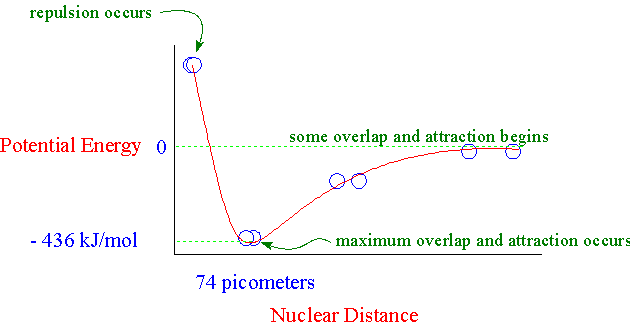
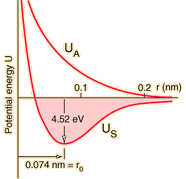
Valence bond theory describes a chemical bond as the overlap of atomic orbitals. In the case of the hydrogen molecule, the 1s orbital of one hydrogen atom overlaps with the 1s orbital of the second hydrogen atom to form a molecular orbital called a sigma bond. Attraction increases as the distance between the atoms gets closer but nuclear-nuclear repulsion becomes important if the atoms approach too close.
There are 3 methods of showing the formulas of molecules. Molecular formulas show only the types and numbers of atoms in the molecule. Structural formulas show the atoms in their correct placement in the molecule and allow for distinguishing isomers. Electron-dot formulas are similar to structural formulas but also include all of the non-bonding outer electrons. Knowledge of electron placement allows us to understand not only the shape of molecules but their chemical character. If we understand the chemical character of a molecule, we can predict how it will react with other molecules without having to blindly memorize reactions.
Drawing Electron-Dot Formulas
Let's first study the rules for drawing these structures.
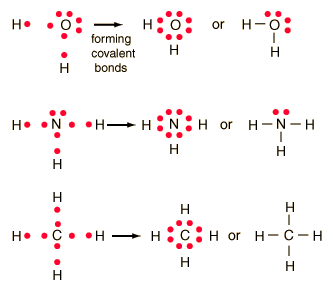
1. The first electron-dot formula we will try will be CH4 (methane).
2. Now let's try a compound that has non-bonding electron pairs, H2O (water).
3. Next we should try an ion with a negative charge, HO- (hydroxide ion).
4. How about an ion with a positive charge, NH4+ (ammonium ion).
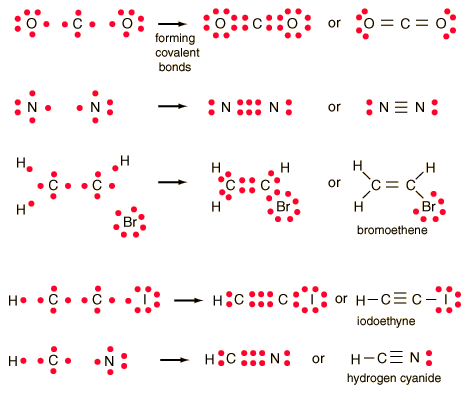
5. Finally, let's draw a compound that requires multiple bonds, O2 (oxygen).
Additional Problems...show formal charges on the atoms that have charges. When a formula contains more than a single oxygen atom, it is rare to have oxygen-oxygen bonds (except with peroxides, oxygen and ozone) so don't have your structures show oxygen-oxygen bonds. Some of these are isoelectronic species...can you pick them out?
H2S hydrogen sulfide
Br+ bromine cation
N2 nitrogen
HCN hydrogen cyanide
NC- cyanide anion
BF4- boron tetrafluoride anion
SO42- sulfate anion
PO43- phosphate anion
ClO41- perchlorate anion
CO32- carbonate anion...Note that the bicarbonate anion looks like the carbonate with a hydrogen attached to one of the oxygen atoms.
NO31- nitrate anion
If you are planning to take Organic Chemistry, understanding how to draw and use electron-dot formulas is essential if you wish to succeed in this course...your understanding of reactions and reaction mechanisms, reactivity of compounds and the stereochemistry of molecules all depends on the material discussed in this tutorial.
Exceptions to the Octet Rule
It is very important that you understand the basics of what we have just covered before worrying about exceptions. In almost all cases, the elements in the first and second periods are used for electron-dot formulas. There are important exceptions but these are not as common.
Elements in groups IA, IIA and IIIA do not follow the "octet rule" that we used for the above problems. When we write the electron-dot formula for BF3, the boron will not have eight electrons and that is just fine...it helps us understand its chemical character.

Some elements having low-energy d-orbitals also form exceptions to the "octet rule" in that more than eight electrons are accommodated around the central atom. The central atom in most of these compounds will be bonded to highly electronegative elements such as fluorine, oxygen and chlorine. A surprising element in this group is the inert gas, xenon. If xenon is exposed to fluorine gas in the presence of light for several weeks it can form XeF2, a colorless crystalline solid.
Let's try to draw the electron-dot formula for SF4 (sulfur tetrafluoride). Note that sulfur is in the 3rd period and thus does have d-orbitals available.
Transition metals offer a unique problem in that they have several common oxidation states so we tend to not write electron-dot formulas for their compounds.
Resonance
Resonance theory is one of the most important theories that helps explain many interesting aspects of chemistry ranging from differences in reactivity of related compounds to physical properties such a the absorption of light by molecules. The electron-dot formula for many of the compounds and ions presented us a choice when we placed 4 electrons between 2 of the atoms in the formation of double bonds. The carbonate and nitrate anions are examples of this problem. You may have wondered why your structure differed from the structure drawn in this tutorial in where the double bond was located. It turns out that it doesn't matter! Let's draw two electron-dot formulas for ozone, O3 placing the double bond in the 2 possible locations.
The same concept holds true for nitric acid and, in this case, the charge is evenly distributed among the 3 oxygen atoms in the nitrate anion. This makes the negative charge less available for the reverse reaction and helps explain why nitric acid is a fairly strong acid. The bond order for the nitrogen-oxygen bonds in the nitrate anion is 1.33.

Hybridization of Atomic Orbitals and the Shape of Molecules
If the four hydrogen atoms in a methane molecule (CH4) were bound to the three 2p orbitals and the 2s orbital of the carbon atom, the H-C-H bond angles would be 90o for 3 of the hydrogen atoms and the 4th hydrogen atom would be at 135o from the others. Experimental evidence has shown that the bond angles in methane are not arranged that way but are 109.5o giving the overall shape of a tetrahedron. The tetrahedral structure makes much more sense in that hydrogen atoms would naturally repel each other due to their negative electron clouds and form this shape. If you think electron-electron repulsion isn't significant, try walking through a wall! There is plenty of space for your nuclei to pass through the nuclei of the wall material but ouch, it just doesn't work that way.
Experimental evidence has also shown that the H-N-H bond angles in ammonia (NH3) are 107o and the H-O-H bond angles in water are 105o. It is clear from these bond angles that the non-bonding pairs of electrons occupy a reasonable amount of space and are pushing the hydrogen atoms closer together compared to the angles found in methane.
The valence shell electron-pair repulsion model (VESPR) was devised to account for these molecular shapes. In this model, atoms and pairs of electrons will be arranged to minimize the repulsion of these atoms and pairs of electrons. Since the non-bonded electron pairs are held somewhat closer to the nucleus than the attached hydrogen atoms, they tend to crowd the hydrogen atoms. Thus ammonia exists as a distorted tetrahedron (trigonal pyramidal) rather than a trigonal plane and water also exists as a distorted tetrahedron (bent) rather than a linear molecule with the hydrogen atoms at a 180o bond angle.
This concept proposes that since the attached groups are not at the angles of the p orbitals and their atomic orbitals would not have maximum overlap (to form strong bonds) the s and p orbitals will be hybridized to match the bond angles of the attached groups.
The number of these new hybrid orbitals must be equal to the numbers of atoms and non-bonded electron pairs surrounding the central atom!
This valence shell repulsion model can be illustrated at home with a very fun experiment!
In the case of methane, the three 2p orbitals of the carbon atom are combined with its 2s orbital to form four new orbitals called "sp3" hybrid orbitals. The name is simply a tally of all the orbitals that were blended together to form these new hybrid orbitals. Four hybrid orbitals were required since there are four atoms attached to the central carbon atom. These new orbitals will have an energy slightly above the 2s orbital and below the 2p orbitals as shown in the following illustration. Notice that no change occurred with the 1s orbital.
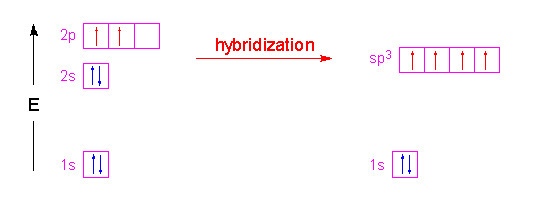
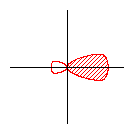
These hybrid orbitals have 75% p-character and 25% s-character which gives them a shape that is shorter and fatter than a p-orbital. The new shape looks a little like...
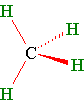
A stick and wedge drawing of methane shows the tetrahedral angles...(The wedge is coming out of the paper and the dashed line is going behind the paper. The solid lines are in the plane of the paper.)
A space-filling model of methane would look like...
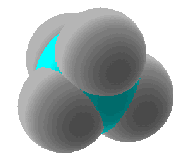
In the case of ammonia, the three 2p orbitals of the nitrogen atom are combined with the 2s orbital to form four sp3 hybrid orbitals. The non-bonded electron pair will occupy a hybrid orbital. Again we need a hybrid orbital for each atom and pair of non-bonding electrons. Ammonia has three hydrogen atoms and one non-bonded pair of electrons when we draw the electron-dot formula. In order to determine the hybridization of an atom, you must first draw the electron-dot formula.
A stick and wedge drawing of ammonia showing the non-bonding electrons in a probability area for the hybrid orbital...

A space-filling model of ammonia would look like...(Note the non-bonded electron pair is not shown in this model.)
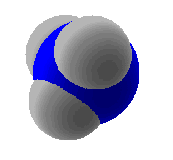
In the case of water, the three 2p orbitals of the oxygen atom are combined with the 2s orbital to form four sp3 hybrid orbitals. The two non-bonded electron pairs will occupy hybrid orbitals. Again we need a hybrid orbital for each atom and each pair of non-bonding electrons. Water has two hydrogen atoms and two non-bonded pairs of electrons when we draw the electron-dot formula.
A stick and wedge drawing of water showing the non-bonding electron pairs in probability areas for the hybrid orbital...

A space-filling model of water would look like...(Note the non-bonded electron pairs are not shown in this model.)
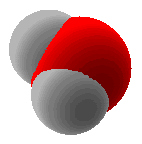
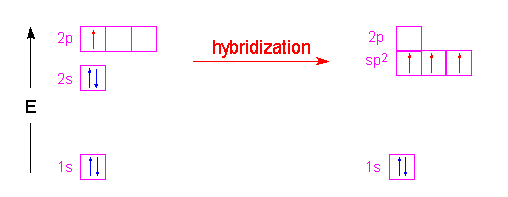
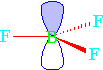
Now let's look at something a bit different. In the boron trifluoride molecule, only three groups are arranged around the central boron atom. In this case, the 2s orbital is combined with only two of the 2p orbitals (since we only need three hybrid orbitals for the three groups...thinking of groups as atoms and non-bonding pairs) forming three hybrid orbitals called sp2 hybrid orbitals. The other p-orbital remains unhybridized and is at right angles to the trigonal planar arrangement of the hybrid orbitals. The trigonal planar arrangement has bond angles of 120o.
In the following stick model, the empty p orbital is shown as the probability area...one end shaded blue and the other is white...there are no electrons in this orbital!
A space-filling model of boron trifluoride would look like...

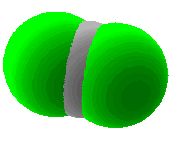
Finally let's look at beryllium dichloride. Since only two groups are attached to beryllium, we only will have two hybrid orbitals. In this case, the 2s orbital is combined with only one of the 2p orbitals to yield two sp hybrid orbitals. The two hybrid orbitals will be arranged as far apart as possible from each other with the result being a linear arrangement. The two unhybridized p-orbitals stay in their respective positions (at right angles to each other) and perpendicular to the linear molecule.
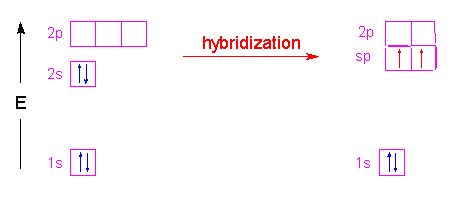
In the following stick model, the empty p orbitals are shown as the probability areas...one green and one blue.

A space-filling model of beryllium dichloride would look like...
Hybridization Involving d-Orbitals
As we discussed earlier, some 3rd row and larger elements can accommodate more than eight electrons around the central atom. These atoms will also be hybridized and have very specific arrangements of the attached groups in space. The two types of hybridization involved with d orbitals are sp3d and sp3d2.
The groups will be arranged in a trigonal bipyramidal arrangement with sp3d hybridization...bond angles will be 120o in the plane with two groups arranged vertically above and below this plane.

There will be an octahedral arrangement with sp3d2 hybridization...all bond angles are at 90o.

Non-bonded electron pairs are always placed where they will have the most space...in the trigonal plane for sp3d hybridization.
Try drawing the 3-dimensional electron-dot picture for each of the following molecules...First draw an electron-dot formula. Remember to put all the extra electrons on the central atom as pairs when drawing this initial electron-dot formula. Now count the groups around the central atom. If there are six groups (Remember to count non-bonding electron pairs as groups.) it will have sp3d2 hybridization. If it has five groups it will have sp3d hybridization.
ClF3 chlorine trifluoride
XeF2 xenon difluoride
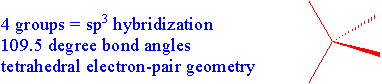
Summary of Hybridization...In the following summary, groups are considered to be atoms and/or pairs of electrons and hybrid orbitals are the red lines and wedges. When the octet of an element is exceeded, then hybridization will involve d-orbitals. Unhybridized p-orbitals are shown as probability areas in blue and green for sp hybridization and blue for sp2 hybridization. A single electron as found in a radical would occupy an unhybridized p-orbital.
| Number of Groups Attached to a Central Atom | Description and 3-Dimensional Shape |
| Two Groups...sp |

|
| Three Groups...sp2 |

|
| Four Groups...sp3 |
|
| Five Groups...sp3d |
.gif)
|
| Six Groups...sp3d2 |
.gif)
|
Hybridization Involving Multiple Bonds
Only a maximum of two electrons can occupy any orbital whether it is an atomic orbital or a molecular orbital due to electron-electron repulsion. When we draw a double or a triple-bond between two atoms, we imply that either four or six electrons are directly between these two atoms. Since this is impossible, we must have these extra electrons off to the side in what we refer to as pi bonds. Therefore, all multiple bonds are composed of two different kinds of molecular bonds called pi-bonds and sigma-bonds.
The sigma-bond is defined as the linear overlap of atomic orbitals (hybrids except for hydrogen) in which two electrons are directly between the two bonded nuclei.
Pi-bonds are defined as the parallel overlap of p-orbitals. A double bond has one sigma-bond and one pi-bond. A triple bond thus consists of a sigma-bond and two pi-bonds with the pi-bonds in different planes.
In the molecule C2H4, ethene, both carbon atoms will be sp2 hybridized and have one unpaired electron in a non-hybridized p orbital.
These p-orbitals will undergo parallel overlap and form one pi bond with bean-shaped probability areas above and below the plane of the six atoms. This pair of bean-shaped probability areas constitutes one pi-bond and the pair of electrons in this bond can be found in either bean-shaped area.
The 3-dimensional model of ethene is therefore planar with H-C-H and H-C-C bond angles of 120o...the pi-bond is not shown in this picture.
Now let's look at H2C2 (acetylene). Both carbon atoms will be sp hybridized and have one electron in each of two unhybridized p orbitals.
These p orbitals will undergo parallel overlap to form two pi-bonds at right angles to each other.
The 3-dimensional model of acetylene is therefore linear...the pi-bonds are not shown in this picture.
Electron-Pair Geometry and Molecular Geometry
Now for a discussion about the shape of molecules! Why should you learn two ways to describe the geometry.
When we experimentally look at molecules, we see how the atoms are arranged but don't see the non-bonded electron pairs. Therefore inorganic chemists tend to use molecular geometry since they deal a lot with solid ionic compounds.
When we think about the character of molecules and how they interact, those non-bonded electron pairs and their orientation in space become very important. Thus organic chemists tend to use electron-pair geometry. Since many of you will go on to take an Organic Chemistry class, you should understand both descriptions.
The various shapes for electron-pair geometry are linear, trigonal planar, tetrahedral, trigonal bipyramidal and octahedral as reviewed in the previous table. Remember a "group" is either an atom or a non-bonded pair of electrons.
Some of the common shapes for molecular geometry are linear, bent, trigonal pyramidal, tetrahedral, T-shaped, seesaw and octahedral.
Let's see how this works by doing some examples...
1. First draw the electron-dot formula.
2. Then determine the hybridization needed for the number of groups attached to the central atom.
3. Now draw the 3-dimensional shape corresponding to that hybridization as shown in the above table.
4. Place the non-bonded electron pairs in the most sterically open sites if the central atom has sp3d hybridization.
5. Finally describe both the electron-pair geometry and the molecular geometry.
CaCl2 calcium chloride
AlBr3 aluminum bromide
H3O+ hydronium ion
H2O water
·CH3 methyl radical...There is a single unpaired electron on the carbon atom.
CO2 carbon dioxide...What is the hybridization and geometry for each of the atoms?
O3 ozone...What is the hybridization and geometry for each of the atoms?
ClF3 chlorine trifluoride
XeF2 xenon difluoride
Concept 2
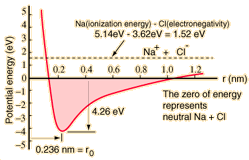
Chemical BondingChemical compounds are formed by the joining of two or more atoms. A stable compound occurs when the total energy of the combination has lower energy than the separated atoms. The bound state implies a net attractive force between the atoms ... a chemical bond. The two extreme cases of chemical bonds are: Covalent bond: bond in which one or more pairs of electrons are shared by two atoms. Ionic bond: bond in which one or more electrons from one atom are removed and attached to another atom, resulting in positive and negative ions which attract each other. Other types of bonds include metallic bonds and hydrogen bonding. The attractive forces between molecules in a liquid can be characterized as van der Waals bonds.
|
Index Bond concepts Bond data Chemical concepts |
||
|
Go Back |
Covalent BondsCovalent chemical bonds involve the sharing of a pair of valence electrons by two atoms, in contrast to the transfer of electrons in ionic bonds. Such bonds lead to stable molecules if they share electrons in such a way as to create a noble gas configuration for each atom. Hydrogen gas forms the simplest covalent bond in the diatomic hydrogen molecule. The halogens such as chlorine also exist as diatomic gases by forming covalent bonds. The nitrogen and oxygen which makes up the bulk of the atmosphere also exhibits covalent bonding in forming diatomic molecules.
|
Index Bond concepts Chemical concepts |
|||
|
Go Back |
Polar Covalent BondsCovalent bonds in which the sharing of the electron pair is unequal, with the electrons spending more time around the more nonmetallic atom, are called polar covalent bonds. In such a bond there is a charge separation with one atom being slightly more positive and the other more negative, i.e., the bond will produce a dipole moment. The ability of an atom to attract electrons in the presense of another atom is a measurable property called electronegativity. |
Index Bond concepts |
||
|
Go Back |
Ionic BondsIn chemical bonds, atoms can either transfer or share their valence electrons. In the extreme case where one or more atoms lose electrons and other atoms gain them in order to produce a noble gas electron configuration, the bond is called an ionic bond. Typical of ionic bonds are those in the alkali halides such as sodium chloride, NaCl.
|
Index Bond concepts |
|||||
|
Go Back |
Metallic BondsThe properties of metals suggest that their atoms possess strong bonds, yet the ease of conduction of heat and electricity suggest that electrons can move freely in all directions in a metal. The general observations give rise to a picture of "positive ions in a sea of electrons" to describe metallic bonding. |
Index Bond concepts |
||
|
Go Back |
Metal PropertiesThe general properties of metals include malleability and ductility and most are strong and durable. They are good conductors of heat and electricity. Their strength indicates that the atoms are difficult to separate, but malleability and ductility suggest that the atoms are relatively easy to move in various directions. The electrical conductivity suggests that it is easy to move electrons in any direction in these materials. The thermal conductivity also involves the motion of electrons. All of these properties suggest the nature of the metallic bonds between atoms. |
Index Bond concepts |
||
|
Go Back |
Hydrogen BondingHydrogen bonding differs from other uses of the word "bond" since it is a force of attraction between a hydrogen atom in one molecule and a small atom of high electronegativity in another molecule. That is, it is an intermolecular force, not an intramolecular force as in the common use of the word bond. When hydrogen atoms are joined in a polar covalent bondwith a small atom of high electronegativity such as O, F or N, the partial positive charge on the hydrogen is highly concentrated because of its small size. If the hydrogen is close to another oxygen, fluorine or nitrogen in another molecule, then there is a force of attraction termed a dipole-dipole interaction. This attraction or "hydrogen bond" can have about 5% to 10% of the strength of a covalent bond. Hydrogen bonding has a very important effect on the properties of water and ice. Hydrogen bonding is also very important in proteins and nucleic acids and therefore in life processes. The "unzipping" of DNA is a breaking of hydrogen bonds which help hold the two strands of the double helix together.
|
Index Bond concepts |
||
|
Go Back |
Chemical Bond Energy ConsiderationsA chemical bond forms when it is energetically favorable, i.e., when the energy of the bonded atoms is less than the energies of the separated atoms. Some of the types of tabulated data associated with chemical bonds are: Ionization energy: the energy required to remove an electron from a neutral atom. Electron affinity: the energy change when a neutral atom attracts an electron to become a negative ion. Electronegativity: the ability of an atom in a molecule to draw bonding electrons to itself. |
Index Bond concepts |
||
|
Go Back |
Ionization Energy and Electron AffinityThe ionization energy or ionization potential is the energy necessary to remove an electron from the neutral atom. It is a minimum for the alkali metals which have a single electron outside a closed shell. It generally increases across a row on the periodic maximum for the noble gases which have closed shells. For example, sodium requires only 496 kJ/mol or 5.14 eV/atom to ionize it while neon, the noble gas immediately preceding it in the periodic table, requires 2081 kJ/mol or 21.56 eV/atom. The electron affinity is a measure of the energy change when an electron is added to a neutral atom to form a negative ion. For example, when a neutral chlorine atom in the gaseous form picks up an electron to form a Cl- ion, it releases an energy of 349 kJ/mol or 3.6 eV/atom. It is said to have an electron affinity of -349 kJ/mol and this large number indicates that it forms a stable negative ion. Small numbers indicate that a less stable negative ion is formed. Groups VIA and VIIA in the periodic table have the largest electron affinities.
1 kJ/mol = .010364 eV/atom
|
Index Bond concepts |
||
|
Go Back |
ElectronegativityElectronegativity is a measure of the ability of an atom in a molecule to draw bonding electrons to itself. The most commonly used scale of electronegativity is that developed by Linus Pauling in which the value 4.0 is assigned to fluorine, the most electronegative element. Lithium, at the other end of the same period on the periodic table, is assigned a value of 1. Electronegativity generally increases from left to right on the periodic table and decreases from top to bottom. Metals are the least electronegative of the elements. The Pauling electronegativities for the elements are often included as a part of the chart of the elements. An important application of electronegativity is in the prediction of the polarity of a chemical bond. Because hydrogen has an electrognegativity of 2.1 and chlorine has an electronegativity of 3.0, they would be expected to form a polar molecule with the chlorine being the negative side of the dipole. The difference between the electronegativities of Na(0.9) and Cl(3.0) are so great that they form an ionic bond. The hydrogen molecule on the other hand, with zero electronegativty difference, becomes the classic example of a covalent bond.
|
Index Bond concepts |
||
|
Go Back |
Writing Ionic Formulas
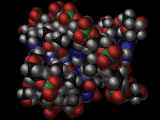
 When
learning about Ionic Formulas and how one goes about constructing them,
one must remember that ions are are atoms or molecules that has gained or
lost one or more electron (e-). This number is key to understanding the
concept of writing ionic formulas. When
learning about Ionic Formulas and how one goes about constructing them,
one must remember that ions are are atoms or molecules that has gained or
lost one or more electron (e-). This number is key to understanding the
concept of writing ionic formulas.
Example:
Na+1 Cl -1
Al +3 and SO4 -2
(Al)2
(SO4) 3
Hints and Tips: 2. When forming a compound the positive must ALWAYS be placed before the negative NO EXCEPTIONS!! 3. When a compound is unbalanced it becomes unbalanced and unstable. 4. the entire polyatomic ion must be placed in parenthesis to indicate that there are already a number of ions required |
|
Lewis Dot Diagrams * When first looking at a Lewis Dot Diagram, most students are somewhat perplexed. Before them is the periodic symbol of an element surrounded by a bunch of dots. This is what some Lewis Dot Diagrams for atoms look like:
* In Fordham Prep’s chemistry course, Lewis Dot Diagrams are drawn for atoms, molecules, and ionic compounds. The rules for molecules and atoms are identical, but rules for drawing Lewis Dot Diagrams for molecular compounds are slightly more complicated.
Atoms & Molecules
1) The symbol of an element is used to represent its nucleus and everything else, save its outer electrons.
2) The first step in drawing a Lewis Dot Diagram is determining the look of the element’s outer electrons. For this task, one must figure out the element’s electron configuration.
3) From an element’s electron configuration, it is possible to identify the electrons in the outer energy level.
4) Every symbol has four sides (top, bottom, left, right). Every side represents an orbital and every orbital can hold up to two electrons. Dots are drawn on appropriate sides representing the electrons in the orbitals.
5) The greatest number of electrons that can be depicted in a Lewis Dot Diagram is eight. Only two of these electrons, those in the "S" orbital, are paired together. This means that they will always be drawn on the same side, although which side that is does not matter.
6) All other electrons are to be distributed as equally as possible around the symbol. This means that there can never be two electrons, other than "S" electrons, on one side while another side is empty.
Molecular Compounds
* Lewis Dot Diagrams for molecular compounds depict bonds between two or more atoms of the same or different elements.
1) Once again, one must use an element’s electron configuration to determine its outer electrons. It is generally a good idea to draw the atom with the most outer electrons first.
2) When drawing this first atom of a molecular compound Lewis Dot Diagram, one must follow the same rules as one would when drawing a diagram for a single atom of the element.
3) The first atom should have one or more potential bonding sites (sides with less than two dots). 4) Draw the symbol of the any other atom next to the potential bonding sites. Use a small "x" in place of each dot when drawing this next atom. For this atom, draw the electrons in such a way that a bond is created at the potential bonding site. This means that on the side of the potential bonding site there is one dot and one "x". On a computer it is easier to use a "block" instead of an "x". Here are some examples of Lewis Dot Diagrams of molecular compounds: H2O NI3 O2
|
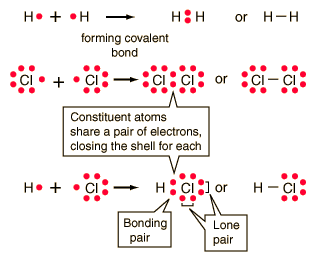
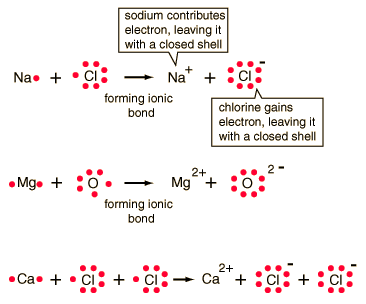
Lewis Diagrams for Compound FormationThe formation of many common compounds can be visualized with the use of Lewis symbols and Lewis diagrams. In a Lewis symbol, the inner closed shells of electrons can be considered as included in chemical symbol for the element, and the outer shell or valence electrons are represented by dots. The dots are placed in four groups of one or two electrons each, with 8 electrons representing a closed shell or noble gas configuration. Lewis diagrams are useful for visualizing both ionic and covalent bonds. In the idealized ionic bond, one atom gives up an electron to the other, forming positive and negative ions.
In the idealized covalent bond, two atoms share a pair of electrons, closing the shell for each of them.
|
Index Chemistry concepts Reference Shipman, Wilson, Todd Ch 12 |
||||||
|
Go Back |
Lewis Diagrams for Multiple BondsLewis symbols and Lewis diagrams can be used to describe multiple bonds, but further information must be supplied to account for the three dimensional geometry of the resulting molecules. For multiple single bonds, the procedure is similar that for a single bond.
The Lewis diagrams can also help visualize double and triple bonds.
|
Index Chemistry concepts Reference Shipman, Wilson, Todd Ch 12 |
|||
|
Go Back |
Energy and Chemical Reactions
Energy is usually defined as "the ability to do work." In this definition, the term work is not being used like we use it in English. So, in order to understand energy, you must understand work. Work is defined as "the result of a force acting on a body and producing motion." If you push a desk across the floor you are doing work on the desk because you are exerting a force that causes motion. You use energy to do the work. The amount of work done is equal to the force used multiplied by the displacement of the object (W=Fxd). Greater amounts of work require greater amounts of energy. The SI unit of work or energy is the joule (J). You will learn much more about work in your study of Physics.
The two basic categories of energy are potential energy and kinetic energy.
Potential Energy
It is probably easiest to think of
potential energy as "stored" energy. It is also defined as "energy of
position."
Gravitational potential energy is "stored" energy that an
object has due to its weight and its position with reference to some other
point. A bowling ball has more gravitational potential energy sitting on a
shelf, than does a ping-pong ball sitting on the same shelf. The same bowling
ball would have even more gravitational potential energy, with reference to the
floor, if it were on a higher shelf.
Chemical energy is stored in foods and fuels, and can be
released when these compounds undergo chemical reactions. You probably
remember, from Biology, how energy is released from glucose during the process
of respiration, as shown below:
C6H12O6 + 6O2 ---> 6H20 + 6CO2 + ENERGY
Kinetic Energy
Kinetic Energy is defined as "the
energy of motion." A fast moving car has a great deal of kinetic energy, based
on both its mass and velocity (speed). When a car crashes into the back of
another car, it transfers some of its kinetic energy into the car in front of
it. When a car going 60 mph hits a parked car, the parked car does not move
away at 60 mph. In a future lesson, we will discuss where the rest of the
kinetic energy goes.
Billiard balls are good models for kinetic energy as well. Before the break
shot, the balls have no kinetic energy with reference to the table.
Energy comes from the moving cue stick to set the balls in motion.
Thermal Energy is defined as the energy that a substance has due to the chaotic motion of its molecules. Molecules are in constant motion, and always possess some amount of kinetic energy. In fact, when you measure the temperature of an object, you are measuring the average kinetic energy of the molecules of that object. Does that mean when something has a temperature below 0oC it has negative kinetic energy? Look for the answer to that question in lesson 2-9.
Conservation of Energy
Similar to the law of conservation of mass, the law of conservation of energy states that "energy is conserved", or "energy can neither be created nor destroyed." Like the aforementioned law, this law does not hold true in the case of nuclear reactions, but it does hold true for the reactions that we encounter in our everyday life.
You know of course that the engine does not create the energy that powers your car. The engine is a machine that allows the stored chemical energy of gasoline to be transformed into mechanical energy that drives the wheels of the car. Energy is not always found in a convenient form, so many of man's inventions are designed to transform one type of energy to another. Below are a few examples of what I mean.
1. Different types of stoves are used to transform the chemical energy of the fuel (gas, coal, wood, etc.) into heat energy.
2. Solar collectors can be used to transform solar energy into electrical energy.
3. Wind mills make use of the kinetic energy of the air molecules, transforming it to mechanical or electrical energy.
4. Hydroelectric plants transform the kinetic energy of falling water into electrical energy.
Now, if energy is always conserved, why does it seem that energy is sometimes lost? For example, a "break shot" in a game of billiards causes the balls to bounce around on the table for a period of time. We transfer kinetic energy from the cue stick - to the cue ball - to the other balls. Eventually the balls on the table stop moving. If energy were conserved, wouldn't the balls continue to move? Well, energy is lost, but it is not destroyed. Some of the kinetic energy is transformed into various types of energy which the billiard balls can't make use of. A large amount of the kinetic energy is turned into heat energy because of the friction between each ball and the surface of the table. That is why more expensive pool tables are made with certain materials, which will cause less friction
Chemical Reactions
A chemical reaction is a series of changes that results in the production of one or more new substances. These chemical changes, which were introduced to you in lesson 1-5, are always accompanied by a change in energy. That means that either energy is given off during the reaction, or energy is taken in.
Reactions that release energy are called exothermic. In this type of reaction, the products have less potential chemical energy than the reactants, because energy was given off in the form of heat. When you stand next to a barbecue grill, you feel the heat being released by the combustion reaction that is taking place around the burners. The reaction of the propane gas found in grills is shown below:
C3H8
+ 5O2 ---> 4H2O + 3CO2 + energy
propane + oxygen yields water +
carbon dioxide + energy
Reactions, which take in energy, are called
endothermic. In this type of reaction, the products have more
potential chemical energy than the reactants. Think of the chemical reaction
that takes place in "cold-packs." A seal is broken that separates two
containers with the plastic bag. As the contents from the separate containers
begin to react, energy is absorbed from the surroundings. If you place the
cold-pack on your body, your body begins to supply some of the energy that is
required to get the reaction going. What you experience as "cold" has to do
with the temperature of that area of your body changing as heat flows to the
cold-pack.
Some exothermic reactions require some energy to get them started, but then they release more energy than they originally took in. Think of the fact that a match requires initial energy, provided by the friction between it and the sandpaper on the matchbook, to start burning. Once the match starts burning, it releases more energy than it took in, so the reaction is still exothermic. The products still have less potential chemical energy than the reactants. The initial energy that is required to get the reaction to begin is called activation energy.
Now, be sure to check out the worksheets and the online quizzes!


.gif)
.gif)
.gif)
.gif)