WAVE AND VIBRATIONS
Period: time for one cycle (s)
Frequency: Number of cycles in a unit of time (Hz)
Amplitude: Maximum distance of the vibrating object from its rest position (equilibrium position)
T: Period (s)
Dt: Time interval (s)
N: Number of cycles
f: frequency (Hz)
1 hertz (Hz) = 1


f . T = 1
`````````````````````````````
Mechanical resonance: Transfer of energy of vibration from one object to a second object having the same natural frequency.
````````````````````````````````````````````````````
Wave: Disturbance that transfers energy through a medium by means of a series of vibrations. Energy transferred by means of waves, but the medium through which the wave is traveling does not move.
Transverse Waves: medium vibrates at right angles to the direction of travel of the wave.
Longitudinal Waves: Particles of the medium vibrate back and forth parallel to the direction in which the wave is traveling.
Wave in phase: If Objects have the same period and pass through the rest position at the same time, these objects will be called in phase.
``````````````````
Speed of Waves:
Universal Wave Equation:

Dd = λ
Dt = T

λ: Wave length (m)
v = f. λ
Water wave from deep water to shallow water
Universal wave equation: v = f. λ
f: Frequency (1/s)
λ: Wavelength (m)
|
Deep Water |
Shallow Water |
|
|
f1 |
f2 |
f1 = f2 |
|
λ1 |
λ2 |
λ1 > λ2 |
|
V1 = f1. λ1 |
V2 = f2. λ2 |
|
|
V1 |
V2 |
V1 > V2 |
|
n: Absolute index of refraction θ1: Angle in vacuum θ2: Angle in substance
|
|
Snell’s Law: n1.sin θ1 = n2.sin θ2

CRITICAL ANGLE
Snell’s Law: n1.sin θ1 = n2.sin θ2
n1 > n2
θ1 > θ2
θ2 = 90
θ1: Critical angle
n1.sin θ1 = n2.sin 90

DIFFRACTION
λ: Wavelength (m)
w: Width of the opening (m)
Higher the
 ,
higher the diffraction, or smaller the
,
smaller the diffraction
,
higher the diffraction, or smaller the
,
smaller the diffraction
INTERFERENCE OF WAVES IN TWO DIMENSIONS
The two vibrating sources have same frequencies, amplitudes and in phase.
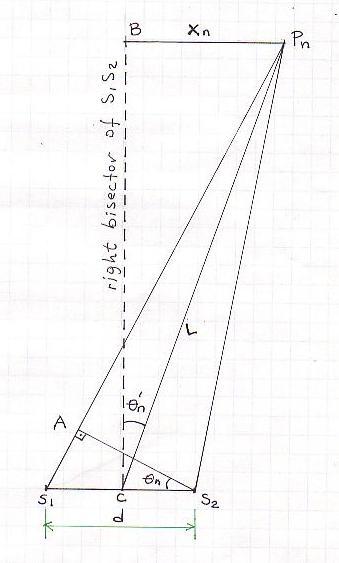
| Pn.S1 - Pn.S2 | = (n – 0.5). λ = Xn / L = sin θn
This formula is valid if Pn is far enough from S1 and S2 and the two vibrating sources have same frequencies, amplitudes and in phase.
Pn: nth nodal point
n: Nodal line number
θn: Angle for the nth nodal line
S1: First point of source of vibrating
S2: Second point of source of vibrating
d: Distance between the sources (m)
λ: Wavelength (m)
L: Distance from the midpoint of S1S2 to the point Pn
Xn: Perpendicular distance from the right bisector of S1S2 to the point Pn