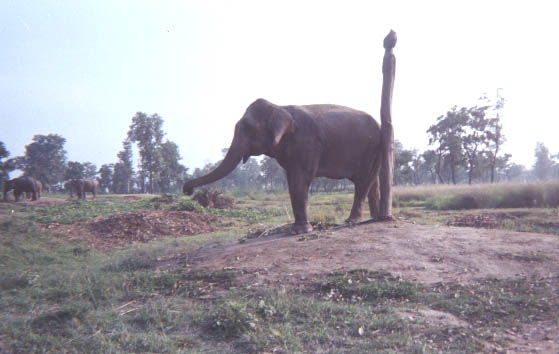
One of the domestic elephants that work in the park.
I arrived from India in Nepalganj, a small border town. The first job was to go to the bank to get some Nepali Rupees. Unfortunately, the bank was closed for the festival of Dassin, which I'd completely forgotten about. I decided that my only hope was to press on with the few Indian Rupees I had left and reach the Royal Bardia National Park where I was planning to spend a few days looking at the wildlife. I'd also read that I could exchange travellers cheques at the lodge there so this seemed like the best plan. The book said it was only a couple of hours to the park from Nepalganj, but it turned out to be more like 4. I arrived at the outskirts of the park and was met by numerous touts from all the lodges. I'd settled on the lodge I wanted to stay in from the guide book so was able to fend off the offers without too much hassle, however, the Nepalis seemed less insistant that the Indians and this made things a lot easier. I had to wait for an hour for the jeep to return from within the park to pick me up. I killed the time by teaching some of the locals how to juggle, which isn't easy by moonlight, and by watching the fireflys in the trees.
The following day I took an afternoon trek in the jungle. I was luck enough to see wild elephant as well as deer, monkeys and lots of tracks of rhino, tigers, elephants, etc. The following day was Tika day, part of Dassin. We were all marked with a crimson tikka mark on our foreheads and the day was a holiday with no activites. At the end of the afternoon, we were taken into the village to see the domestic elephants. They were to have some kind of competition with them as part of the celebrations, but this didn't happen. Instead we watched the elephant keepers preparing rice bundled in grass for the elephants. It looked like hard work. Especially when you consider each elephant eats 15kg of rice a day, and with more than 10 elephants it was no trivial task.
One of the domestic elephants that work in the park.
Unfortunately, at this point, the Delhi Belly got the better of me. I'd sort of planned for this eventualilty and was hoping that if I was going to be sick it would be before heading to Pokhara and embarking on a long trek. To avoid too strenuous a day, I took a gentle rafting trip down the Karnali river into the park. This turned out to be a good decision as we saw mongooses, lots of monkeys, a crocodile, kingfishers, turtles, a boar, deer, river otters, bee eaters, storks, ibis, and a rhino! The rhino was a good sighting as many people spend a couple of days in the park and see nothing. Unfortunately I didn't see any tigers of leopards, but I count myself lucky with what I did see. The only other sighting was a rather cute 3 month old baby elephant that was being kept in a domestic compound near the lodge. Not exactly a true wild sighting, but still fun.
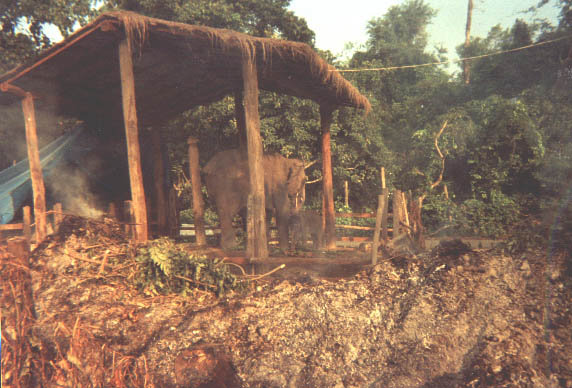
Life goes on in Bardia.
My journey on from Bardia was another memorable one. I was sat at the back of the bus on a very bumpy road that the driver insisted on driving along at top speed. For about 8 hours I was bouncing 1ft in the air. I resolved to sit nearer the front on all future bus journeys where the intertia of the heavy engine would reduce such discomfort. I stopped for one night in Butwal and then moved onto the quite hillside town of Tansen in the foothills of the Himalaya. The real things to see in Tansen are the views, but unluckily I was there on a hazy day. Even worse than that, I was unable to get any money from the bank. Even though Dassin was officially over, the banks seem to have an extended holiday that really stuffed me.
I decided to press on to Pokhara and after I had paid my hotel bill and bought my bus ticket, I had only 13 Rupees (about 13p) to my name. The bus journey to Pokhara was beautiful but long again. Leaving at 9pm I didn't arrive until 5:30pm. I caught my first glimpses of the Annapurnas from the coach and couldn't wait to see more. I took a taxi to a hotel and told them to stop when I spotted a cash machine. Finally, money at last! I checked in and felt better to know that I had some money.
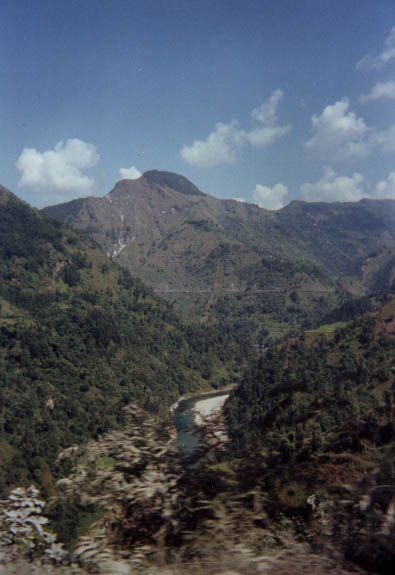
A piccy snapped from the bus on the way to Pokhara.
My plan in Pokhara was to rest and get over the delhi belly and then go trekking. Feeling somewhat better I tried to climb a small hill outside town called Sarangkot. It actually turns out to be higher than Ben Nevis but not such a big climb as Pokhara is quite elevated to start with. It was very hard work, though the views were rewarding from the top. The Annapurnas and Machhapuchhare (that some naive american teenagers thought was Mauchu Pichu) were splendid. Though I knew I wasn't ready for the full trek, I knew I definitely wanted to go.
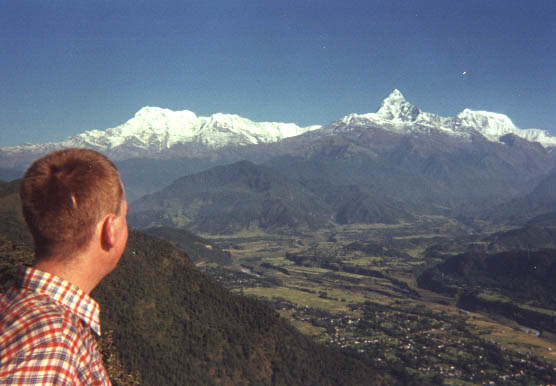
The view from the top of Sarangkot.
Eventually the delhi belly eased off and I got my strength back, so I caught the bus early one Saturday morning to Besisahar, the starting point of the Annapurna Circuit. I met an Austrian guy called Peter on the bus and we ended up doing the trek together.
We started off going through quite fertile country where the hillsides were covered with picturesque rice paddies. The rural life was all around us and it was interesting to see things like the mini corn mills which were tiny buildings, just big enough to contain a millstone, which were built directly over a stream and the vertical shaft from the stone would be driven by a horizontal wheel, in the flow of the water. The ingeneous buddhists had also used this technology to power their prayer wheels so that the mantra inscribed on the wheel would be automatically involked, time and time again, until the water runs out!
After a few days, we got out first views of snow capped mountains between the peaks of the valleys we had been walking through. After several long days trekking these started to open out into spectacular panoramas. We decided to take the higher route from Pisang to Manang and were rewarded well for our effort. The cloud lifted to give us the most breath-taking views yet, we saw a wonderful old Gompa (buddhist monastry) and although we didn't find the 'fields of marijuana' and 'acres of marijuana' that the map had indicated (I believe the harvest had just been made) we did find a nice restaurant with several healthy plants growing in the garden right between the tables!
We spend the night at Ngawal where there happened to be a Lama disco! Apparently, it was a celebration of the end of the harvest and, just as promised, the Lamas danced! It wasn't quite disco dancing but it was interesting to watch. As well as the Lamas, the locals were celebrating too. Many were drinking and in high sprits as they were 'allowed to do anything on that day in the name of fun'. Part of this involved some of the men taking phallic shaped pieces of wood and chasing the women of the village with them, much to the amusement of all around. Unfortunatley, Peter, the other westeners present and myself were not exempt from this part of the activities!
We spend the pre-requisit 2 nights in the 'wild west' town of Manang to help acclimatise to the altitude. The wide dusty main street and wooden buildings made it the ideal location for the horse races that took place while we were in town.
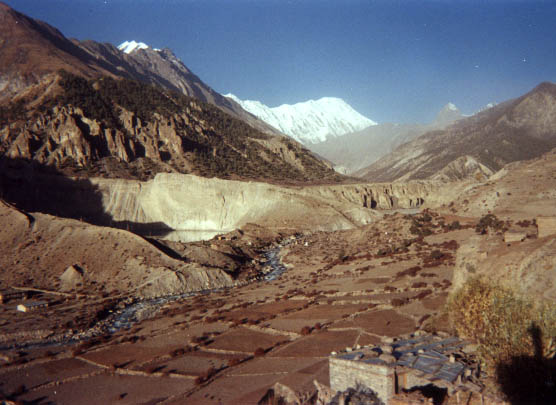
The view from Manang.
We pressed on slowly to avoid altitude sickness and stopped in several villages along the way. Gunsang had a lovely hotel with great food and the best panorama in the Manang valley. Yak Kharka (or Yak Pastures) really did have lots of Yak though, unfortunately, there were no blue sheep to be seen.
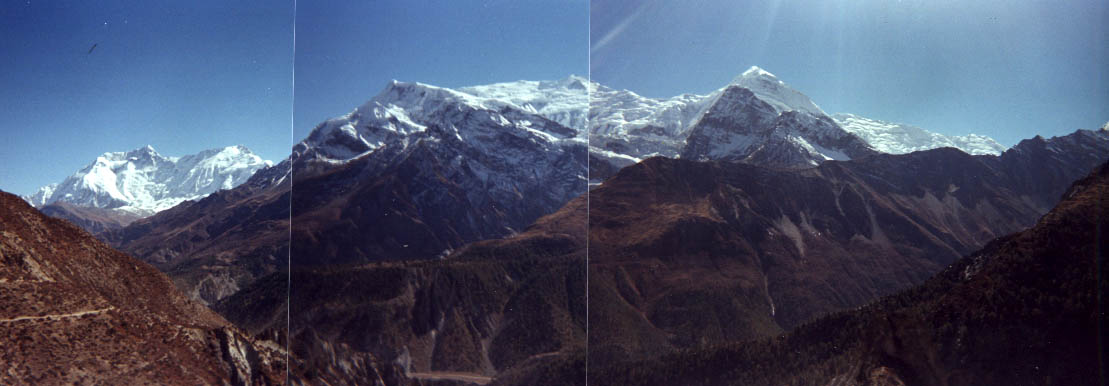
The spectacular vista from Gunsang.
The last stretch up to the Thorong La pass was hard work. The thin air and cold nights weren't exactly what I had expected when I set off to the tropics. Our acclimatisation saw us over the pass without any altitude sickness which we were glad of. The pass, at 5416m, is over 4 times higher than Ben Nevis and is even higher than Mont Blanc, the highest Alp! This is probably the closest I'll ever get to mountaineering.
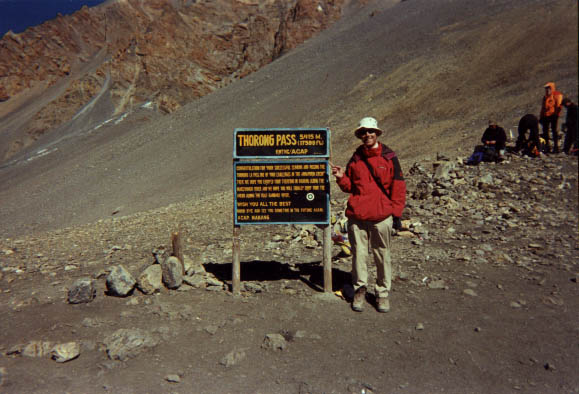
Me, looking (and probably smelling) like the Yeti on the
Thorong La pass.
We took it easy on the last leg after the pass. We spend a couple of days in Munktinath and saw the famous shrine where both water and fire (a natural gas jet) emerge from a rock at the same point, saw the picturesque village of Jarkot on a spur over the valley and watched the local men ploughing their fields with bulls, singing to them to direct them. We saw the famous monastry at Kagbeni where the admission tickets are about the size of an A5 piece of paper, and I also had my first shave in 2 weeks when I found hot water, a sink and a mirror all together. A first in 2 weeks of trekking! We sampled the apple brandy from Tukuche (very nice!) and the hot springs at Tatopani. A few luxuries didn't go amiss after the hardship endured on the pass.
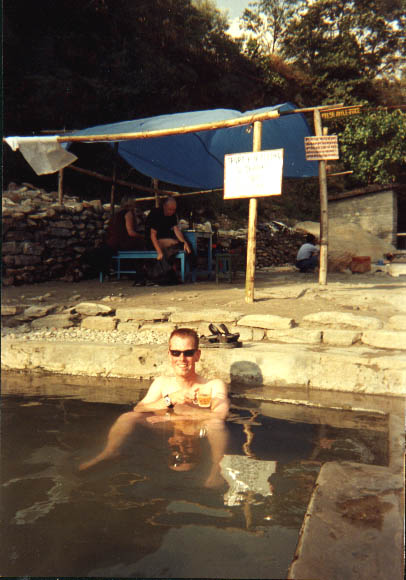
Relaxing at the hot springs in Tatopani.
We made our final stop in Ghorepani to see the spectacular morning view from Pune Hill. Unfortunately, my of which didn't come out at all well.
Back in Pokhara I enjoyed a couple of days of luxury. Good, cheap food, hot showers and a comfortable room. I made a day trip with Peter to Bandipur which was a nice, quiet hilltop village before we parted company. Peter went south to Tansen and I went on to Gorkha, the city whose rulers originally united Nepal into the country that withstood all subsequent attempts at colonisation, and, of course, the place after which the famous and fearless Gurka soilders are named. It's a pretty, peaceful town these days. The old palace, Gorkah Durbar, on the hilltop is very beautiful with it's carved wooden windows and red brick structure. It didn't seem the sort of place that could produce such feared combateers.
I moved on to the hustle and bustle that is the Kathmandu valley. It's very strange to be in a big city again after the tranquility of the mountatins. I see all the usual sights including the 3 major cities Kathamndu, Patan and Bhaktapur and their 'copy-cat' Durbar Squares. The architecture is all very impressive though quite similar and it's hard not to get temple-weary after a while.
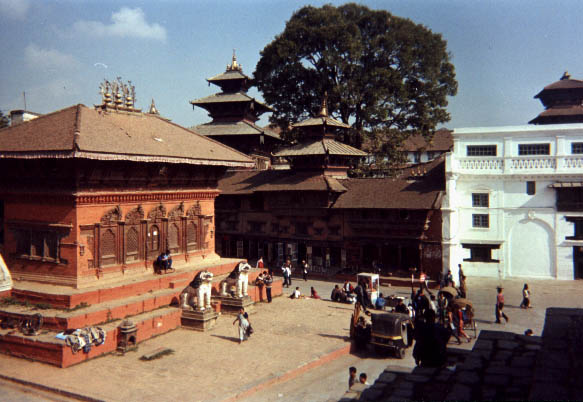
Kathmandu's lively Durbar Square.
I go to the famous Swayambuath Stupa or Monkey Temple as it's better known and play and win 2 games of Bagh Chal, the Nepali 'tiger moving' game with one of the street traders. I guess it's more than just beginner's luck when he insists that such a master of the game should own a board, and he's just the man to sell it to me. I visit the famous riverside site of Pashupatinath where one of the valley's most sacred temples is located and the river bank is the site of cremations facilatate the disposal of the ashes afterwards into the holy river. I spot a couple of young girls washing their pots and pans immediately downstream of the cremation area. I suppose that hygene means different things in different parts of the world.
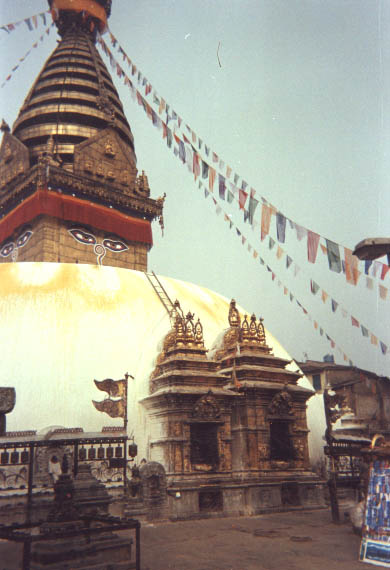
Monkey temple, and yes, the monkies there are cheeky.
I make for the quite village of Bungamati for a day trip. The hectic life in Kathmandu with all the hawkers, street vendors, traffic and pollution are just driving me away. The village is very quite, almost untouched. I only see a couple of other tourists there and life is as it must have been for hundreds of years. The image of the local deity, Rato Machhendranath, is in the town square getting a new coat of red paint from the chosen painters before he heads off to Patan on his annual pilgrimage in a few day's time. I meet a local who is very friendly and shows me one or two of the other sights in the village and then invites me back to his house for a cup of tea. Altogether a rather refreshing change from city life.
I leave Kathmandu on a terrifying bus ride down to the border. The driver is so crazy that some of us on the bus go up to him when he makes a stop and ask him to slow down a bit. It works to a certain extent and we make it to Sonauli in one piece. I didn't bother going to Lumbini, the birth place of the Buddha, in the end. I reckoned that I'd had plenty of temples and would be getting a lot more in Varanasi. Anyway, Sonauli was a pretty awful border town and I didn't really want to spend any longer there than I had to.
So now it's back to India...