
Commission
for Water Sustainability of the International Geographical Union (IGU) is
hosting an international conference on:
“Environmental change and rational water use”
Buenos Aires, Argentina, 29th August – 1st September 2005
Announcement
We
are pleased to extend an invitation to the next Meeting of the Commision for
Water Sustainability of the International Geographical Union (IGU), hosted by
the Argentine geographical community, to be held at Buenos Aires, Argentina. The
conference is open to all scientists across the spectrum of the Earth,
Environmental, Engineering, Developmental and Social Sciences.
The challenges facing water resources, both globally and regionally, are
many and varied and are arguably of greater significance than ever before.
Innovation, new technology and efficient networking are required to face the
challenges posed inter alia, by globalization, the sustainable and equitable
utilization of water resources, degradation and global warming. The Meeting aims
to present a forum at which these challenges can be addressed. Participants can
choose from a range of pre- and post-conference scientific excursions to some of
the exotic destinations in Argentina.
Aims
and objectives of the Commission
The
Commission interprets “sustainability” in the widest possible sense,
including the sustainability of the environment in the face of water development
work as well as the sustainability of water resources. It aims to foster closer
links between the human and physical aspects of water management, with specific
concern for the sustainability of water resources and for the impacts of water
management on the environment.
The
Commission focuses specifically on developing research is the following areas:
1)
Study of adaptation and measures to enable sustainability
2)
Water sustainability for the environment
3)
Hydrologic modelling for planning and impact studies of water sustainability in
a changing environment
4)
Quantifying water sustainability
5)
A world inventory of water resources for sustainability
Full details are available on the website: http://water-sustainability.ph.unito.it
The
Conference is calling for papers focusing on the following major themes
·
Section 1.
Management of surface and groundwater resources
·
Section 2. Methods
for evaluating and monitoring the pollution of water resources
·
Section
3. Water
ecosystems, their conservation and modeling
· Section 4. New approaches to the evaluation and forecasting of changes in water resources under global warming
·
Section
5. The problems of
sustaining freshwater supplies
·
Section 6. South America water resoiurces:
Poblems, possibilities and management.
The
Conference is particularly concerned with changes in water quality and quantity,
and hydrological regime in relation to environmental and human-induced changes,
such as climate change, land-use changes, and increasing population and water
demand. Water is a strategic resource and the future health, livelihood and
development of many people and countries in the world will depend on the way we
manage both water and the environment. Water quality and quantity are very
sensitive to changes in plant cover, farming systems and patterns of
industrialisation. Thus the main question is: How can we manage both the
environment and water resources in order to ensure human development and
sustainability?
The
programme will include 3 days of scientific sessions, followed by a fieldtrip:
August
29 Registration, Opening Ceremony, Oral Presentations
August
30 Oral and Poster
presentations
August
31 Oral and Poster
presentations. Closing Ceremony.
September
1 Fieldtrip
Language
of the Conference:
English
Tony
Jones (Commission Chair, UK)
Academician
Changming Liu (Vice-President IGU, China)
Ming-ko
Woo (Commission Vice-chair, Canada)
Olga
Scarpati (Secretary, Argentina)
Claudio
Cassardo (Italy)
Tom
McMahon (Australia)
Heinz-Theo
Mengelkamp (Germany)
Kazuki
Mori (Japan)
Peter
J Robinson (USA)
A K Sinha (India)
K U Sirinanda (Brunei)
I
J van der Walt (South Africa)
Jun
Xia (Vice-chair IAHS and IWRA, China)
Local
Scientific Organizing Committee
Olga
Eugenia Scarpati, Presidente del Congreso. Consejo
Nacional de Investigaciones Científicas y Técnicas y Universidad Nacional de
La Plata (Argentina).
Carlos
Eduardo Ereño, Sub - Responsable. Inter-American
Institute for Global Change Research (IAI), Universidad de Buenos Aires
(Argentina) y Academia de Geografía.
José María
Coccaro, Universidad Nacional de La Plata y
Universidad de Río Cuarto (Argentina)
Susana
Isabel Curto, Consejo Nacional de Investigaciones
Científicas y Técnicas y Academia de Geografía
Héctor Oscar José Pena. Instituto Geográfico Militar.
María
Josefa Fioriti, Secretaría de Recursos Hídricos
de la Nación (Argentina).
Blanca A.
Fritschy, Consejo Nacional de Investigaciones
Científicas y Técnicas y Universidad Católica de Santa Fe (Argentina)
Jesús María
Gardiol, Director Departamento de Ciencias
de la Atmósfera y los Océanos Universidad de Buenos Aires (Argentina)
Guillermo
Murphy, Universidad de Buenos Aires (Argentina)
Inés
Velasco, Universidad de Buenos Aires (Argentina)
Alberto Capriolo,
Consejo Nacional de Investigaciones Científicas y Técnicas
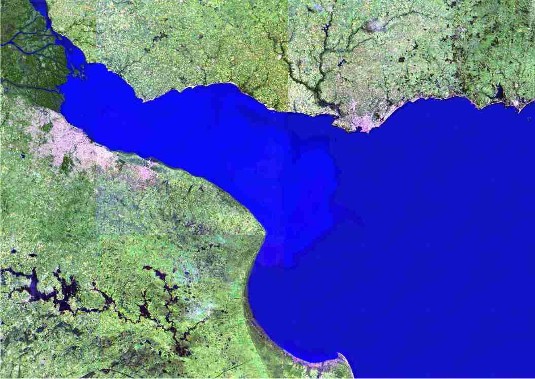
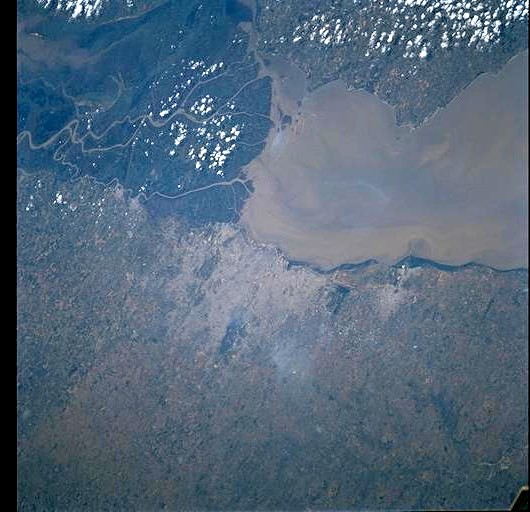
Professor Scarpati (Argentina) has organised an optional fieldtrip for participants. This will include a tour of Paraná River Delta, studying the environmental impacts of water management works.

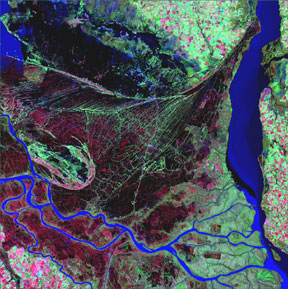 |
Parana River Delta The Parana River delta is a huge forested marshland about 20 miles northeast of Buenos Aires, Argentina. The area is a very popular tour destination. Guided boat tours can be taken into this vast labyrinth of marsh and trees. The Parana River delta is one of the world's greatest bird-watching destinations. This image highlights the striking contrast between dense forest and wetland marshes, and the deep blue ribbon of the Parana River. The Parana River Delta can be found on Landsat 7 WRS Path 225 Row 83, center: -33.18, -58.36. Gorgeous image with river in blue spidering through black and green and red delta. Red is Vegetation. |
Abstracts and Publication
Abstracts
must be received by the Organising Committee by April 30th 2005. They
must include the title of the paper and author(s) name(s) and address(es) at the
top. The text should cover no more than one page. Up to three papers per author
can be accepted.
They would be submitted before 1st November, 2005.( ENGLISH VERSION )
Selected
full papers will be evaluated and published in a book.
GUIDELINES
There is not fixed format for your chapter. Neither is there a fixed length, although an upper limit of about 12 pages seems appropriate.
Manuscript preparation
All manuscripts are subject to peer review and copy editing
Manuscripts must be written in English and should be typed in double-line spacing throughout with at least 2.5 cm margins
Use a normal, plain font (e.g., Times New Roman) for text.
Use the automatic page numbering function to number the pages
For indents use tab stops or other
commands, not the space bar
Use the equation editor of your word processing program or MathType for equations
Abbreviations should be defined at
first mention in the abstract and again in the main body of the text and used
consistently thereafter.
Essential footnotes to the text
should be numbered consecutively and placed at the bottom of the page to which
they refer
Please arrange your manuscript as follows:
Title page
Abstract
Keywords
Introduction
Materials and methods
Results
Discussion
Acknowledgements
References
Title page: Including name(s) of author(s), a
concise and informative title, affiliation(s) of the author(s), e-mail address,
telephone and fax numbers of the corresponding author.
Abstract
Each paper must be preceded by an abstract presenting the most important
results and conclusions in no more than 250 words
Keywords
Five keywords should be supplied after the abstract for indexing purposes
Introduction
The introduction should state the purpose of the investigation and give a
short review of the pertinent literature.
Materials and methods
This section should follow the Introduction and should provide enough
information to permit repetition of the experimental work
Results
This section should describe the outcome of the study. Data should be
presented as concisely as possible, if appropriate in the form of tables or
figures, although very large tables should be avoided.
Discussion
The discussion should be an interpretation of the results and their significance with reference to work by other authors.
Acknowledgements
These should be as brief as possible. Any grant that requires acknowledgement
should be mentioned. The names of funding organizations should be written in
full.
References
Literature citations in the text should indicate the author's surname with
the year of publication in parentheses, e.g. Carlin (1992); Brooks and Carlin
(1992). If there are more than two authors, only the first should be named,
followed by "et al."
References at the end of the paper should be listed in alphabetical order by the
first author's name. If there is more than one work by the same author or team
of authors in the same year, a, b, etc. is added to the year both in the text
and in the list of references.
*Journal papers: name(s) and initial(s) of all authors; year; full title;
journal title abbreviated in accordance with international practice; volume
number; first and last page numbers
Example:
Thorsson S, Lindqvist M, Lindqvist S (2004) Thermal bioclimatic conditions
and patterns of behaviour in an urban park in Göteborg, Sweden. Int J
Biometeorol 48: 149-156
If available, the Digital Object Identifier (DOI) of the cited literature
should be added at the end of the reference in question.
Example:
Scian BV (2004) Environmental variables for modeling wheat yields in the
southwest pampa region of Argentina. Int J Biometeorol DOI
10.1007/s00484-004-0198-2
*Single contributions in a book:
name(s) and initial(s) of all authors; year; title of article; editor(s); title of book; edition; volume number; publisher; place of publication; page numbers
Example:
Jones PD (2001) Instrumental Temperature Change in the Context of the Last 1000 Years. In: Brunet India M, Lopez Bonillo D (eds) Detecting and Modelling Regional Climate Change.
Springer, Berlin Heidelberg New York, pp 6-55
*Book:
name and initial(s) of all authors; year; title; publisher; place of
publication
Example:
Pinardi N, Woods J (eds) (2002) Ocean Forecasting. Springer, Berlin
Heidelberg New York
Springer, Berlin Heidelberg New York, pp 6-55
*Book:
name and initial(s) of all authors; year; title; publisher; place of
publication
Example:
Pinardi N, Woods J (eds) (2002) Ocean Forecasting. Springer, Berlin
Heidelberg New York
Tables and figures
Tables must be numbered consecutively with arabic numerals. They should have
a heading explaining any abbreviation used in that table. Footnotes to tables
should be indicated by superscript lower-case letters.
Illustrations must be restricted to the minimum needed to clarify the text.
All figures (photographs, graphs or diagrams) should be cited in the text, and
numbered consecutively throughout. Figure parts should be identified by lower-case
roman letters (a, b, etc.). If illustrations are supplied with uppercase
labeling, lower-case letters will still be used in the figure legends and
citations.
Figure legends must be brief, self-sufficient explanations of the
illustrations. The legends should be placed at the end of the text.
Line drawings
Inscriptions should be legible, with initial capital letters and
appropriately scaled to the size of the drawing. Letters 2 mm high are
recommended. Scanned line drawings should be digitized with a resolution of 800
dpi relative to the final figure size
Computer drawings
Computer drawings are acceptable provided they are of comparable quality to
line drawings (minimum resolution of 300 dpi). Computer-drawn curves and lines
must be smooth. Lettering must be of high quality; Helvetica is the preferred
font. Lettering fonts must be consistent within and among all figures.
Halftone illustrations (black and white and color)
Sharp, well-contrasted photographic prints trimmed at right angles and in the
desired final size should be submitted. Please indicate the top on the back.
Magnification should be indicated by scale bars. For scanned halftone
illustrations, a resolution of 300 dpi is usually sufficient.
Color illustrations
The authors will be expected to make a contribution towards
the extra costs of color reproduction and printing.
General information on data delivery
Please send your data, preferably by e-mail to the Editor-in-Chief:
Full
papers should be submitted to the Chair of the Local Organising Committee, from
whom further details are available:
Prof. Ing. Agr. Olga E. Scarpati,
Consejo
Nacional de Investigaciones Científicas y Técnicas. Universidad Nacional de La
Plata. (La National
Research Center and La Plata Nacional University) (Argentina)
E-mail:
[email protected]
E-mail:
[email protected]
Proofreading
The file name should be memorable (e.g., author name) and Paper Code, and
include no accents or special symbols. Use only the extensions that the program
assigns automatically (.doc).
Example: Scarpati_RA100.doc

