 IEEE
Maharaja Sayajirao University
IEEE
Maharaja Sayajirao University
IEEE
Maharaja Sayajirao University
Networking the World™ Student Branch - (95601)
Visitors: Members of IEEE
Every
year IEEE arranges two trips. This year one of which was the outdoor trip
to The General Motors, Halol.
Here the basic idea was to study the assembling of cars, the varieties being
Opel Corsa, Astra and Swing. We will try to brief out the steps as follows.
As
we enter, the first thing we are informed about is the safety measures being
taken by them including the various modes of failure they have experienced.
For
instance, there are different charts, which point out the areas most vulnerable
to the occurrence of injuries.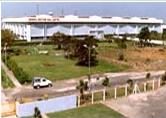
The process begins at well sub-assembly area wherein different small parts are
assembled with the help of arc wielding. While spot wielding assembles basement,front
side and bottom part of the cars. Seven people working as a team do this task.
There are separate lines for all the three models. Capacity is to produce
six cars/hour. As per requirement they are producing 40-45 cars/day though they
can stretch up to a limit of 55 cars/day.
After wielding, outer body of the car is made. In the framing area, fitting
the small parts assembles complete body. For this they are brought into the
main
line.
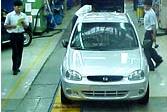
Now we enter into the inspection area. Here it is checked for weak parts which
may exist or if the wielding is left out. The complete body is taken to the
painting section where they buffer at least 6-8 cars. First of all black-dull
painting is done to prevent the car from rusting. Though we were not allowed
to
enter the paint shop, we were informed that initially the cars are washed by
some chemical and cleaned. Anode-cathode or electrolyte process is used and
the
car is painted automatically.
Next
is the trim area. Here we have a trim line on which cushions are provided
at the bottom. Different experts for different kinds of fittings are placed
at
regular interval. Each of them has to complete the task of fitting at least
3-4
fittings within 10 minutes as the conveyer belt moves slowly.
Thus almost the whole structure including front glasses, window glasses and
other inner parts is assembled. Doors were already removed before the car
enters the trim line for easy operation. But now at the assembly line, they
are
refitted as per the assigned number of cars.
External assembly is fitted at the chassis point. This includes fitting of the
wheels and engine for which the car has to be lifted up.
Finally for inspection, cars are taken at the VNI station. Speed is checked.
If any vibrations are observed it is taken as a defect.
Then comes the water test booth. Here, water is sprinkled from all the four
sides and if any drop of water comes in, it is taken as a defect.
No
wonder the sight of hundreds of cars lined up together outside the factory
definitely seems beautiful. Especially, after having an insight to the
assembling process.
Compiled
by,
Bijal Jambusaria. (IEEE Member)
&
Dipal Parmar. (IEEE Member)
(B.E.II Electronics.)