I. Fantasy Hockey Origins
Fantasy hockey has been around for thousands of years. It is thought that the first pool was begun during the ice age by Unga Bunga. Players would slide around on the ice with clubs and hit each other, and the pool members would get a point whenever their players did not die. Unga Bunga kept score and handed out the prizes of mammoth tusks and cave wenches. Eventually pieces of bone from losers would be knocked around on the ice with sticks, and the first prehistoric hockey pool began.
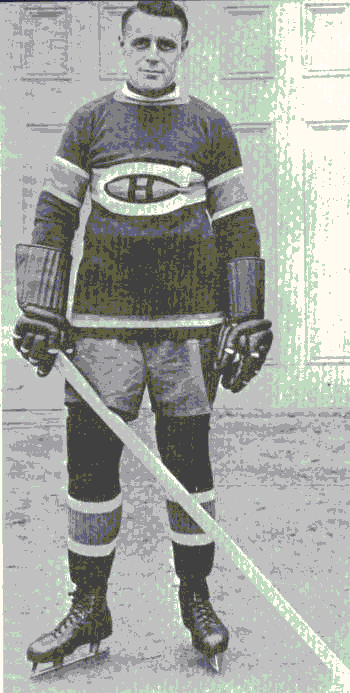
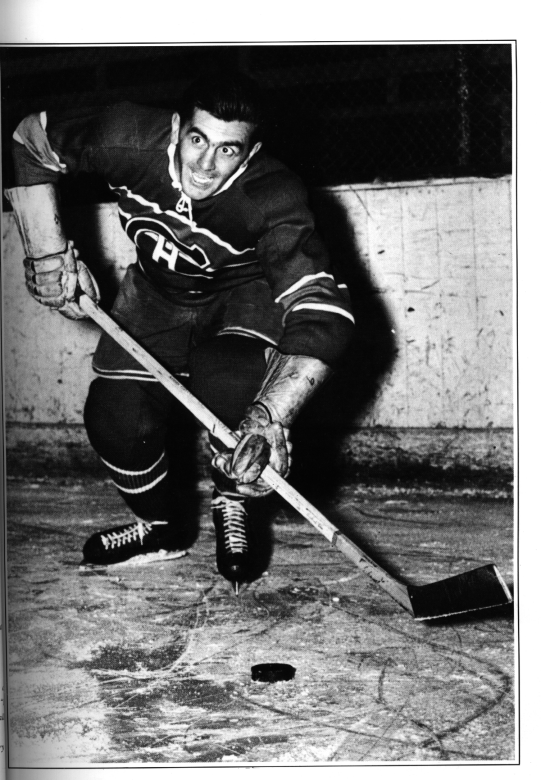
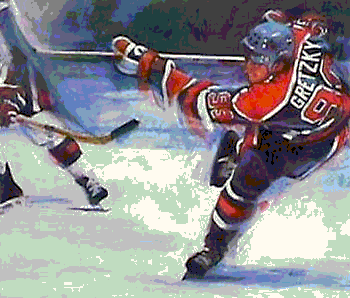
Of course, over the years fantasy hockey would evolve as ice hockey evolved too. By the 20th century professional hockey teams existed, and the NHL was born in 1917. Fist fights broke out in early fantasy hockey gatherings, as team owners gathered together to draft, fighting over Joe Malone year in and year out until the 1930's. Malone, the first hockey pool great, eventually retired and handed the reigns over to Howie Morenz, who handed the reigns over to Maurice Richard and Gordie Howe. The Golden Age of defensemen began in the late 1960's as the NHL expanded, and Bobby Orr scored goals like goalies were obsolete. This was followed by the Wayne Gretzky era. It is a dreadful shame that the internet did not become popular until the mid-90's, as many deaths occurred as pool members fought each other in mortal combat over who got the first two picks of the draft. Many lives were saved in the 1990's as scoring parity came to the NHL, and the Internet made face-to-face drafts obsolete. It was in this environment that the IDHL Cup began its magnificent rise to glory.
II. The MSNBC and CMU Days
In 1993, Shane Hockin joined the MSNBC Surpreme Hockey Pool. His team, The Little Black Bag, won him $25 on the backs of star centres Goofy Mulbutt and "Dirty" Henry Olglethropleschmitz. These were the days of gambling, booze, and dirty money. Teams paid out $60 million to players, and turned out major profits of $25, $50, or even $100! In 1994 Hockin joined forces with pool-shark, Gary Greene to form Microcosmic Gods, which netted them both $25 each. The names Hockin and Greene would be familiar to fantasy hockey fans for years to come. They split up after the first year, and Greene iced two teams in 1995. The first one, Bifrost Bridge, battled for the division league with league greats Jim Gristletoe up front, "Fatty" Gordie Thinman on defense and "Skinny" Louie Lardo in goal. The other Greene team, Adam Bomb, sat on the bottom of its division with a bunch of no-name punks from Yellowknife. Greene decided to abandon Adam Bomb and put all he had into getting Bifrost Bridge into the finals. In one of the greatest comebacks in hockey history, Adam Bomb's defective no-name leftovers fought their way to win their division and $200! Bifrost Bridge only placed sixth.
In 1996, wanting to create a clean-cut, free-style league, Shane Hockin and Gary Greene dropped out of MSNBC and created a new league with newcomer organizational genius, Mike Phillips. With Shane's charisma, Mike's brain, and Gary's "go along with whatever you say" attitude, the Central Michigan Hockey League was formed. Early on it only had three teams, but this created a lot of competition on the teams. Mike's Kenora Thistles were able to snatch up scoring greats Culfap Grobsplaq and Reet Weem. Shane's Montreal Maroons iced sniper I Like Cheese and goalie great The Lord. Gary's Yellowknife Slavers boasted tough guys Igor Alotov and "Goober" Flatsfeldamooliegravy. Competition was so tough that many games ended with no goals, just a lot of teeth rolling around on the ice, chattering, and speaking Spanish.
Columbian Spanish, with a bit of an accent, as if they lived close to Venezuela in a more rural setting.
1997 introduced significant expansion to the CMHL. The New York Americans, Quebec Nordiques, Oakland Seals, and the Colorado Rockies joined the league, making it a 7 team league. Controversy ruled the headlines throughout the season as accusations arose over corruption and favoritism, as the Montreal Maroons zoomed to the championship. The alcoholic owners of Oakland and Quebec accused the kind and intelligent owner of Montreal of fixing the results, and making illegal trades. The Oakland/Quebec drunk coalition even attempted to bypass Montreal's success by trading all their best players to one team, and all the worst players to the other. The new and combined juggernaut of Quebec still only finished third. An independent arbitrator ruled that all corruption accusations were unfounded, and the true nature of the Coalition's failure was an inability to understand the simple and easy-to-follow scientific, algebraic equation that calculated scores based on goals, assists, points, PIM, +/-, shots, save percentage, shutouts, goals against, hair color, direction of wind, Einstein's Theory of Relativity, Pythagorean Theorem, and Shane Hockin's birth date and favorite number. The Montreal Maroons were officially awarded the championship.
The Coalition vs Montreal fiasco, along with a slumping economy and parting of ways for members, resulted in the CMHL closing down. Minor hockey pools between Hockin, Phillips, and Greene occurred on occasion for the next few years, sometimes joined by newcomer Steven Sundbeck and his dancing giraffes. These were the dark ages where hockey was an afterthought for people as they struggled to stay alive in the wilderness for the next 3-4 years. Hockin even rejoined MSNBC for a year, and won $250 with a team called Evil Spoon, but never received the money after moving and the ending of MSNBC's Surpreme Pool. Out of this darkness would arise a bright glow that would light the world with happiness and joy.
III: The Interdenominational Hockey League
In the year 2000, Mike Phillips and Shane Hockin joined up again to form a new hockey league dedicated to spreading joy and excitement amongst all who would be willing to dedicate a little time each week or two or ten or so. The Interdenominational Hockey League was designed to be simple and fun, based on goals alone, and actually matching teams up against each other on a week-to-week basis. Unfortunately, many of the records kept for this first season of hockey pool bliss were lost in the Great Chicago Fire of 1871. It is known from the studies of old pottery and porn magazines that there were ten teams owned by the likes of Hockin, Phillips, Greene, Sundbeck, as well as Kristin Sunbeck, Paul Oatman, Thea and Bonnie Hockin. Two teams, the Montreal Maroons and Toronto Maple Leafs were owned by the "League." It was one of these teams, the Montreal Maroons, that would dominate the league with its play. Chosen from a list of players in The Hockey News, and never making a line change except for serious injury, the Maroons won the regular season title, narrowly beating out Gary Greene's Thor's Hammer. Then the Maroons marched to the finals and defeated Mike Phillips' Kenora Thistles for the first IDHL Championship.
2001-2002 opened up with the introduction of the IDHL website, this year maintained by Steve Sundbeck. Angela Hockin joined the League with Paraguas Malvado, and the modern-day IDHL took its shape. The League owned two teams, Pachelbel's TacoHell and Ohio Raccoons, who both drafted late to make up for the league Montreal Maroons surprise run at the championship the year before. The Maroons were permanently disbanded, as it was ascertained that all their players were on steroids or something. The battle for first place consisted of Grodzisk Goblins and Chicago Chevaliers, with Grodzisk riding surprise superstar and IDHL MVP Jarome Iginla to first place. Third place was taken by the Tallahassee Terrible Tree Frogs. The Kuroneko Knives and Ohio Raccoons would fail to make the playoffs. Few would notice that BIGTIM, which had been a big bottomfeeder almost all season, managed to sneak into the eigth and final playoff spot after a flash winning streak and some crafty free agent pickups and trades. BIGTIM would then go on to upset Grodzisk in the playoffs, and then Chicago too, who had just barely beaten Pachelbel's TacoHell in the first round. Thor's Hammer, who had slumped terribly at the end of the season, squeaked past Tallahassee in another upset. Even this game was not nearly as exciting as the Hartford/Paraguas matchup in the first round. Hartford had surprised everyone all season with their ability to win tight, low-scoring games. It went up to the final seconds, with Hartford scoring the win 8-7. The surprising Whalers could not outwit Thor's Hammer, however, and the final was set. It would not disappoint, with the lead changing several times. Like the early round Hartford game, this one would come down to the very last hour of the last day. Down by a goal and needing the win, BIGTIM was able to score a shut out from goalie Jocelyn Thibault, and won the IDHL Championship by the score of 7-6!
2002-2003 began with the loss of league-owned teams, and the introduction of Shawn Boyle's Alabama Punch Monkeys and Brooke Wright/Thea Hockin's Brother Ben. Alabama would open up the season on a hot streak, taking first place on the wings of Pavel Bure. Alabama failed to turn in a team logo, however, and this cursed the team, who lost Bure for most of the season. The Tallahassee Armadillos would soon take over first place, which they would not relinquish all season. BIGTIM, Kuroneko, and Chicago Chevaliers would fight for second place most of the season, with Chicago finally winning the spot. Kuroneko came in third. Paraguas Malvado and Hartford Whalers, two entertaining playoff teams the year before, missed the playoffs. Tallahassee would become the first team to ever win a playoff series based on home-ice advantage as they tied Brother Ben in the first round. BIGTIM, Chicago, and Thor's Hammer also advanced in less exciting games. Second place Chicago was upset in the semi-finals by defending champion BIGTIM, who was riding a hot streak by Tony Amonte and Markus Naslund. The Tallahassee versus Thor game was one of the highest scoring games ever, with 26 goals scored. Unfortunately for the Dictator Award winning Tally team, 16 of those goals were for Thor's Hammer, despite centre Vincent LeCavalier's 5 goal output. A rematch of the previous year's final was the result! The game would once again be classic and close as Thor's Hammer tried to avenge its loss of the year before. However, BIGTIM would gain an early lead and hold onto it, repeating as champion by the score of 11-9. Roman Cechmanek was the playoff hero for BIGTIM, scoring 6 playoff goals, all in the Final. Cechmanek had sat on the bench for almost the entire IDHL regular season. Thor's Todd Bertuzzi edged out BIGTIM's Markus Naslund for IDHL MVP with 40 goals, but BIGTIM was once again IDHL Champion.